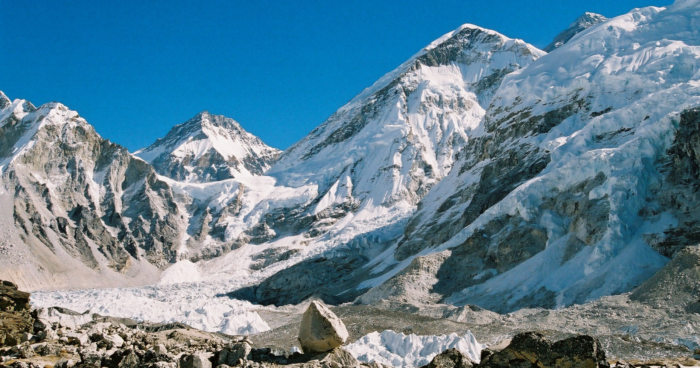
Everyone is aware that Mount Everest holds the title of the highest mountain on Earth. It’s one of the few geographic truths that nearly every literate adult retains throughout their lives, alongside the population of China and the fact that the Amazon is a river.
Everest stands at 8,848 meters above sea level. It ascends through the Himalayas at the boundary of Nepal and Tibet, and its peak is the highest position on the planet’s surface when measured from sea level.
This is a precise measurement, and it is completely accurate. However, it does not equate to being the spot on Earth that extends the farthest into space.
The location that extends the farthest into space is not situated in Nepal. It is not found in Tibet. It is not even within the Himalayas. It is located in Ecuador, atop a long-dormant volcano named Chimborazo — a mountain that most individuals outside of South America are unfamiliar with, positioned one degree south of the equator, and over two and a half kilometers shorter than Everest.
Nevertheless, if you were to measure the distance from the precise geometric center of the Earth to the surface, the summit of Chimborazo would be approximately 2.1 kilometers further from that center than the summit of Everest.
The explanation lies within one of geography’s more elegant facts.
The Earth is not a sphere.
This is something that everyone understands in theory. Almost nobody comprehends the specific scale.
The Earth is not a flawless sphere. Its rotation causes its mass to bulge outward, particularly around the equator. Over 4.5 billion years of constant rotation, this centrifugal force has generated a permanent, quantifiable bulge at the equator — a bulge that slightly flattens the planet at the poles and thickens it in the middle.
The scale of this effect is considerably larger than most individuals imagine. Mean sea level at the equator is around 6,378 kilometers from the center of the Earth. Mean sea level at the poles measures approximately 6,357 kilometers from the center.
This results in a difference of about 21 kilometers — meaning a boat floating at the equator is, in explicit geographic terms, twenty-one kilometers higher than a boat float in the Arctic Ocean, purely based on their respective locations relative to Earth’s rotation.
A mountain rising from equatorial sea level, therefore, essentially begins from a much higher launching point than a mountain arising from polar or sub-polar sea levels. And Chimborazo, located nearly directly on the bulge, enjoys almost all of that advantage. Everest, at nearly 28 degrees north, has far less.
A head start of twenty-one kilometers significantly outweighs the approximate 2.6 kilometers by which Everest surpasses Chimborazo in height. Thus, Chimborazo triumphs in distance from the Earth’s center by a slim yet real margin of 2.1 kilometers.
The nuance that the title requires.
Whether you classify Chimborazo as “the closest piece of land on Earth to outer space” depends on the definition of space.
If you characterize space based on the distance from the geometric center of the Earth — a definition rooted in radius, concerning the pure geometry of where the planet’s surface extends into the surrounding void — then indeed, Chimborazo’s summit is the closest. It represents the solid ground positioned farthest from the core, and thereby farthest into the cosmos.
However, if you consider space by the altitude above sea level, which is the more common everyday understanding (and how the Kármán line at 100 kilometers is determined), then Everest is the nearer one. Everest is approximately 2,580 meters higher than the ocean.
Both assertions are accurate. They address different inquiries. Chimborazo is the point on Earth farthest from the planet’s center. Everest is the point on Earth that is highest above sea level. Neither statement negates the other. They are two distinct calculations of different phenomena.
One claim that is evidently false, despite being repeated in various popular interpretations of this narrative, is the assertion that Chimborazo is “closer to the Sun.” The Sun is approximately 150 million kilometers away, and Earth’s orbit around it varies by around 5 million kilometers each year. A difference of 2.1 kilometers between two mountain peaks is insignificant in comparison. The Sun also traverses the sky as the Earth rotates; no static mountain can truthfully be described as consistently nearer to it.
The honest, concise, and accurate rendition of the narrative is: Chimborazo’s summit is the point on the solid surface of the Earth that extends the farthest distance from the planet’s geometric center. That is a declaration concerning geographic radius, and it holds true.
The reason we know this at all.
The most captivating aspect of the Chimborazo tale is not the fact itself. It is the manner in which humanity came to understand it.
In 1735, the French Academy of Sciences sent an expedition to Ecuador known as the French Geodesic Mission, led by Charles