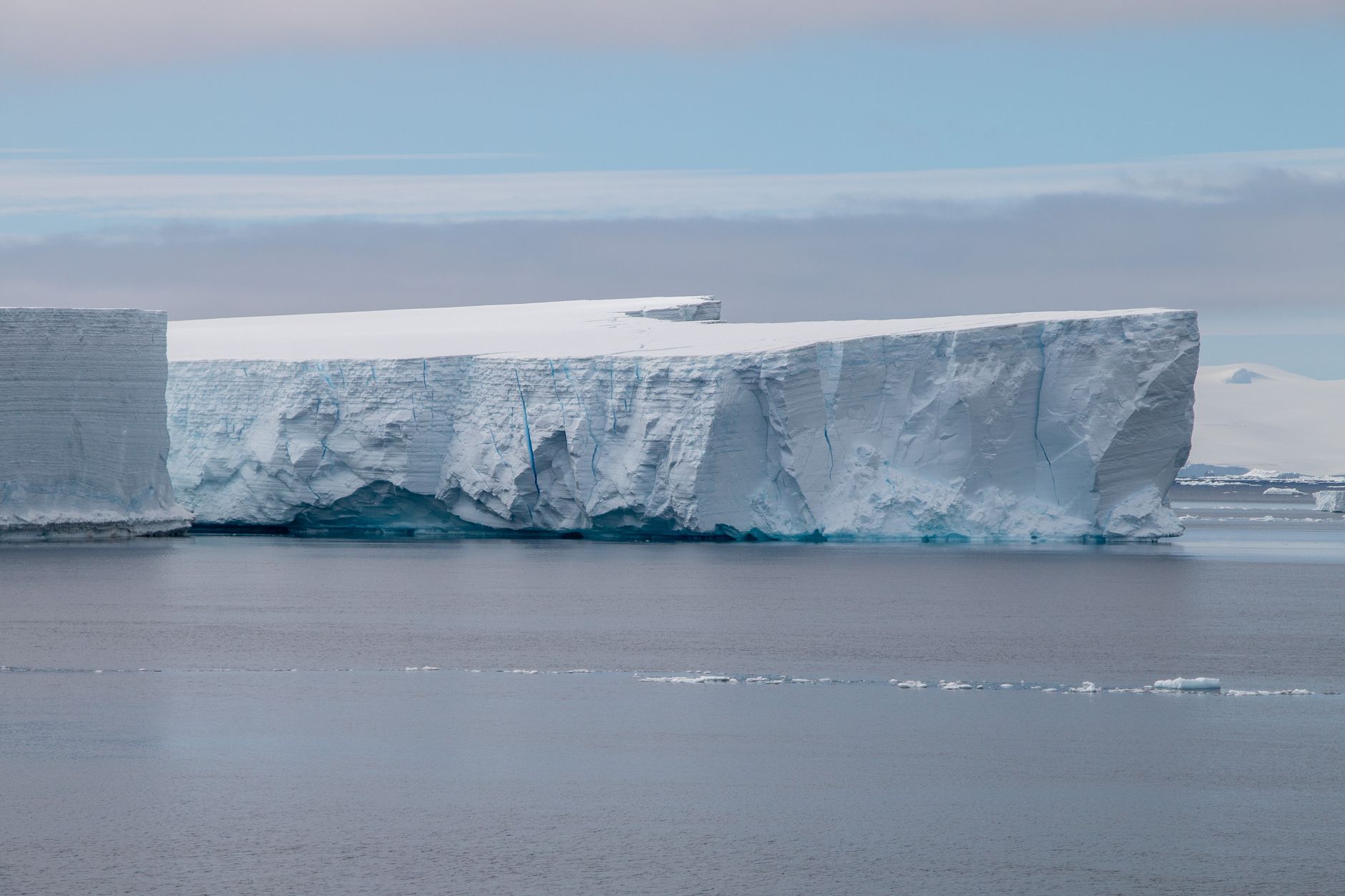
The essential aspect of the Antarctic iceberg narrative isn’t the iceberg itself; rather, it is what emerged once the ice retreated.
On January 13, 2025, an iceberg subsequently dubbed A-84 detached from the George VI Ice Shelf situated on the Antarctic Peninsula. NASA Earth Observatory characterized it as approximately 30 kilometers long and 17 kilometers wide, encompassing an area close to that of Chicago. For satellite observers, it constituted a substantial ice mass quickly moving along the coastline.
For a research vessel already operating in the vicinity, it represented something far more unique: an entrance to a seafloor that had never been directly investigated by human researchers.
On March 20, 2025, Schmidt Ocean Institute declared that scientists onboard their research vessel Falkor (too) altered their expedition plans following the calving. By January 25, the team had arrived at the newly uncovered seafloor in the Bellingshausen Sea, deploying the remotely operated vehicle SuBastian into an environment previously sealed under floating ice.
This report from the expedition is not a comprehensive peer-reviewed species inventory. While the finding should be taken seriously, it should not be interpreted as conclusive. A significant portion of the biological analysis occurs after the ship returns, when specimens, imagery, and environmental data can undergo thorough examination.
A concealed seafloor, now within reach
Iceberg calving is a standard occurrence in ice-shelf dynamics. However, the timing and site of this particular event granted researchers a rare opportunity.
NASA’s Earth Observatory notice from February 2025 indicated that A-84 had drifted approximately 250 kilometers from its origin point between mid-January and mid-February. This iceberg originated near the southern end of the George VI Ice Shelf, a floating glacier connected to the Antarctic Peninsula ice sheet. NASA observed that the George VI shelf has been gradually losing ice over time, although its retreat has been less dramatic compared to some collapses witnessed elsewhere on the peninsula.
The newly revealed region was significant because it had remained physically inaccessible while ice covered it. Schmidt Ocean Institute stated that the calving unveiled about 510 square kilometers of seafloor, making this expedition the first extensive interdisciplinary study of such a large area newly uncovered from beneath a floating ice shelf.
However, it does not imply that life beneath Antarctic ice shelves was completely unknown. In 2021, researchers from the British Antarctic Survey documented stationary animals under the Filchner-Ronne Ice Shelf after penetrating ice several hundred meters thick. Still, direct, extensive exploration using an ROV across a newly exposed terrain offers different insights compared to observing a few organisms through a borehole. It provides scientists an opportunity to assess characteristics such as shape, abundance, habitat, and community structure across a broader landscape.
What SuBastian discovered
For eight days, ROV SuBastian surveyed the deep seafloor, reaching depths as profound as 1,300 meters. The visuals depicted were not of an empty muddy expanse.
Schmidt Ocean Institute reported thriving ecosystems of large corals and sponges, along with animal life such as icefish, giant sea spiders, and octopuses. One image caption described a sizable sponge and anemones at nearly 230 meters depth in a zone that had only recently been unveiled from beneath the ice shelf. Another image highlighted an octopus resting on the seafloor at 1,150 meters.
The term “forest” does not denote a formal scientific classification here. It serves as a convenient visual analogy for how large, upright, filter-feeding animals can organize the seafloor, creating habitats for other organisms. Just as a coral garden is not a garden in the human conception, a sponge forest represents a living three-dimensional community constructed by animals rather than plants.
The enormity of certain organisms is part of why the finding garnered attention. Sponges have a slow growth rate. Schmidt Ocean Institute noted that one specimen’s size suggested the community had been active for decades, possibly even hundreds of years. Expedition co-chief scientist Patricia Esquete from the University of Aveiro conveyed that the communities observed likely existed for decades, perhaps even longer.
This is the cautious interpretation of the “centuries without sunlight” assertion. The ice-covered environment had been isolated from typical surface food sources, and it appears some animals may have existed long enough to remain there over extended periods. The precise ages and histories of the organisms require further investigation.
The food dilemma
The pressing question is how such a community sustains itself.
Most deep-sea ecosystems rely, either directly or indirectly, on photosynthesis in the upper layers of water. Tiny organisms flourish in sunlit waters, die, disintegrate, or are consumed, with some of that organic material descending. Over time, this sinking matter nourishes the seabed fauna.
Under a thick floating ice shelf, this straightforward model becomes complex. Schmidt Ocean Institute stated that the newly explored ecosystems had been obscured by around 150 meters of ice for centuries, isolating them from surface nutrients. If sunlight does not penetrate to the water above the community, the usual influx of local photosynthetic material cannot account for their sustenance.