The lion captivates human imagination like few other predators can. It serves as the emblem on shields and flags, the roar symbolizing the essence of untamed Africa, the creature we instinctively view as the ultimate ruler of the continent. However, success in the hunt does not equate to a strong reputation. Examined hunt by hunt, the narrative becomes more intricate.
A lion is an effective predator when conditions align: close proximity, cover, darkness, surprise, or assistance from other lions. Yet, in broad daylight, a solitary lion often pushes its body to perform tasks it isn’t ideally suited for over long durations. Pioneering research on lions in East Africa, notably George Schaller’s *The Serengeti Lion*, revealed that many hunts fail before reaching the climactic kill that humans envision.
Subsequent field studies underscored this message more clearly. In [a 1984 study published in the African Journal of Ecology](https://doi.org/10.1111/j.1365-2028.1984.tb00682.x), Karl van Orsdol indicated that hunting success was heavily influenced by cover, size of prey groups, hunting group size, and, at nighttime, the presence of moonlight. Lions thrived when the environment aided them in reducing the distance to their prey before it could respond.
## An ambusher on the run, not a long-distance runner
Consequently, the statistic of “one chase in five” should be understood as a specific comparison rather than a universal principle regarding lions. It highlights the challenging odds for a lone lion hunting during the day, when achieving surprise is difficult and prey can detect the approach. Under other circumstances, particularly at night or with increased cover, lions can achieve greater success.
The lion’s physicality clarifies much of this. Lions are built for explosive power rather than endless endurance. They can launch into fierce bursts and overpower substantial prey at close quarters, yet they are not designed to pursue antelope over extended distances. If the initial surge fails, the chase typically ends there, allowing the prey to escape as the lion’s chance has lapsed.
Hunting in groups alters the dynamic, yet not in a straightforward manner where “more lions equal greater success.” In [a 1992 study published in Behavioral Ecology and Sociobiology](https://doi.org/10.1007/BF00168530), P. E. Stander illustrated role differentiation among lionesses, with individuals frequently taking on distinct positions during cooperative hunts. Some act akin to wings, while others function more as centers during an ambush. This system is effective because lions can transform cover, angles, and timing into an advantageous trap.
Even then, lions are not assured a meal. Their prey have also evolved for this competition. Zebras kick. Buffalo turn and stand ground. Wildebeest and antelope flee quickly upon sensing danger. A hunt does not depict a scenario where a predator merely chooses to kill. It is a complex interplay of physics, fear, terrain, and timing, where prey often has a say.
## The predator with prominent ears
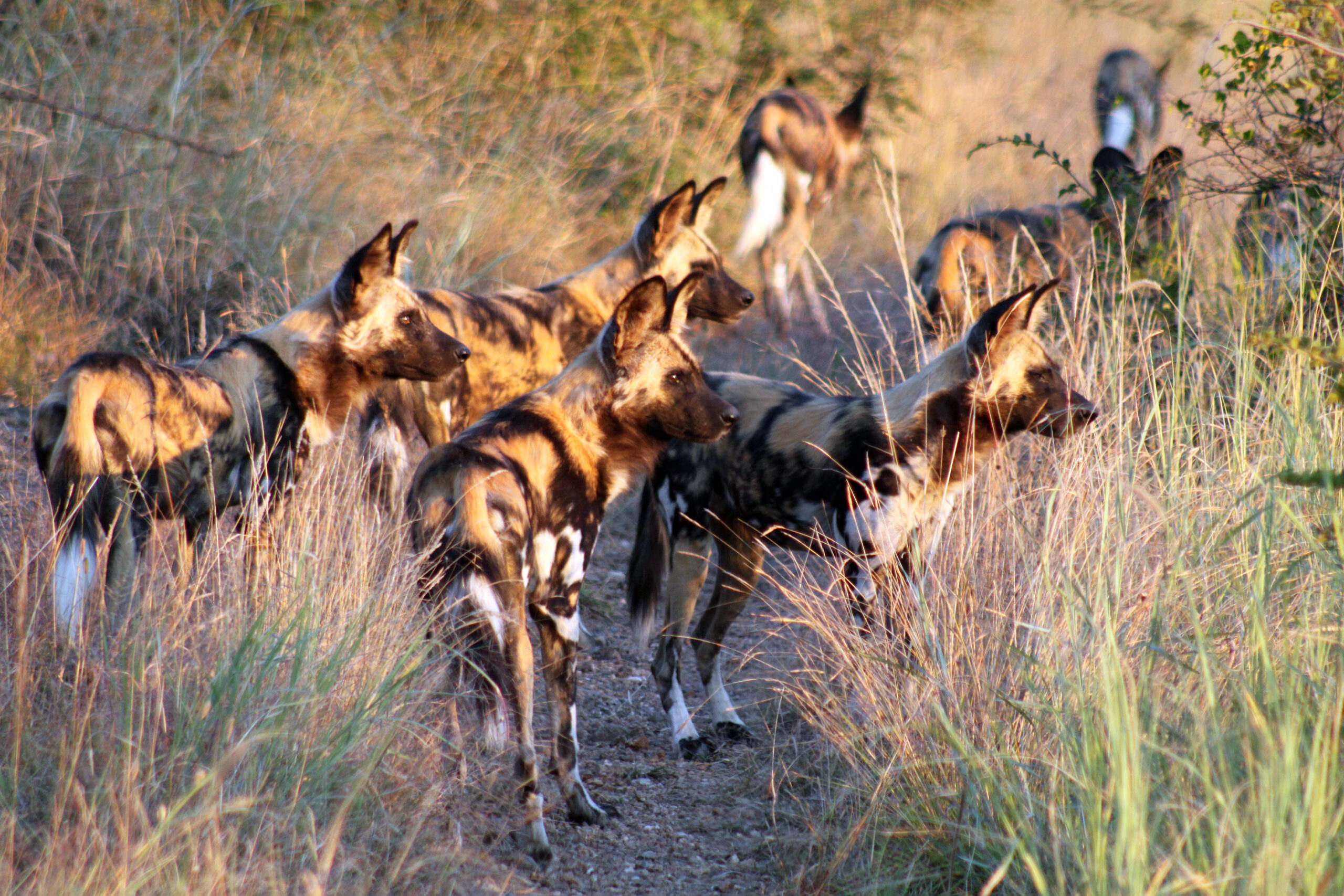
The African wild dog resides in the lion’s shadow, both literally and in a cultural sense. It is smaller, thinner, and seldom afforded the same symbolic weight. Its large ears lend it an almost too expressive appearance for a top predator. Nonetheless, those prominent ears, mottled coat, and social complexities belong to one of the most exceptional hunting systems among mammals.
The species, *Lycaon pictus*, is also facing challenges. The [IUCN Red List categorizes the African wild dog as Endangered](https://www.iucnredlist.org/species/12436/16711116), with remaining populations fragmented due to habitat loss, human hostility, disease, and conflicts with larger carnivores. This animal can demonstrate remarkable hunting efficiency yet remains vulnerable in a world that disrupts the necessary space for a pack.
In contrast to lions, the wild dog functions as a coursing pack hunter. A chase can unfold as a series of quick, opportunistic pursuits by multiple individuals rather than a single dramatic ambush. Historical accounts frequently portrayed wild dogs as endurance hunters that wore down prey over long distances. Recent data from collars has complicated that view.
In [a 2016 study in Nature Communications](https://www.nature.com/articles/ncomms11034), researchers equipped African wild dogs in northern Botswana with high-resolution GPS and inertial collars, tracking 1,119 high-speed chases by a six-member pack. The dogs did not merely exhaust prey through prolonged pursuits. Many chases were brief, swift, and individually unsuccessful, but the pack’s collective feeding strategy allowed the overall system to function effectively.
## Why nine out of ten isn’t the complete narrative
The notable high success rates for African wild dogs stem from specific field studies and particular interpretations of success. In [a 1993 paper in the Journal of Mammalogy](https://doi.org/10.2307/1382403), Todd Fuller and Pieter Kat examined wild dogs in southwestern Kenya, a line of research frequently cited in discussions surrounding the species’ exceptionally high hunting success.