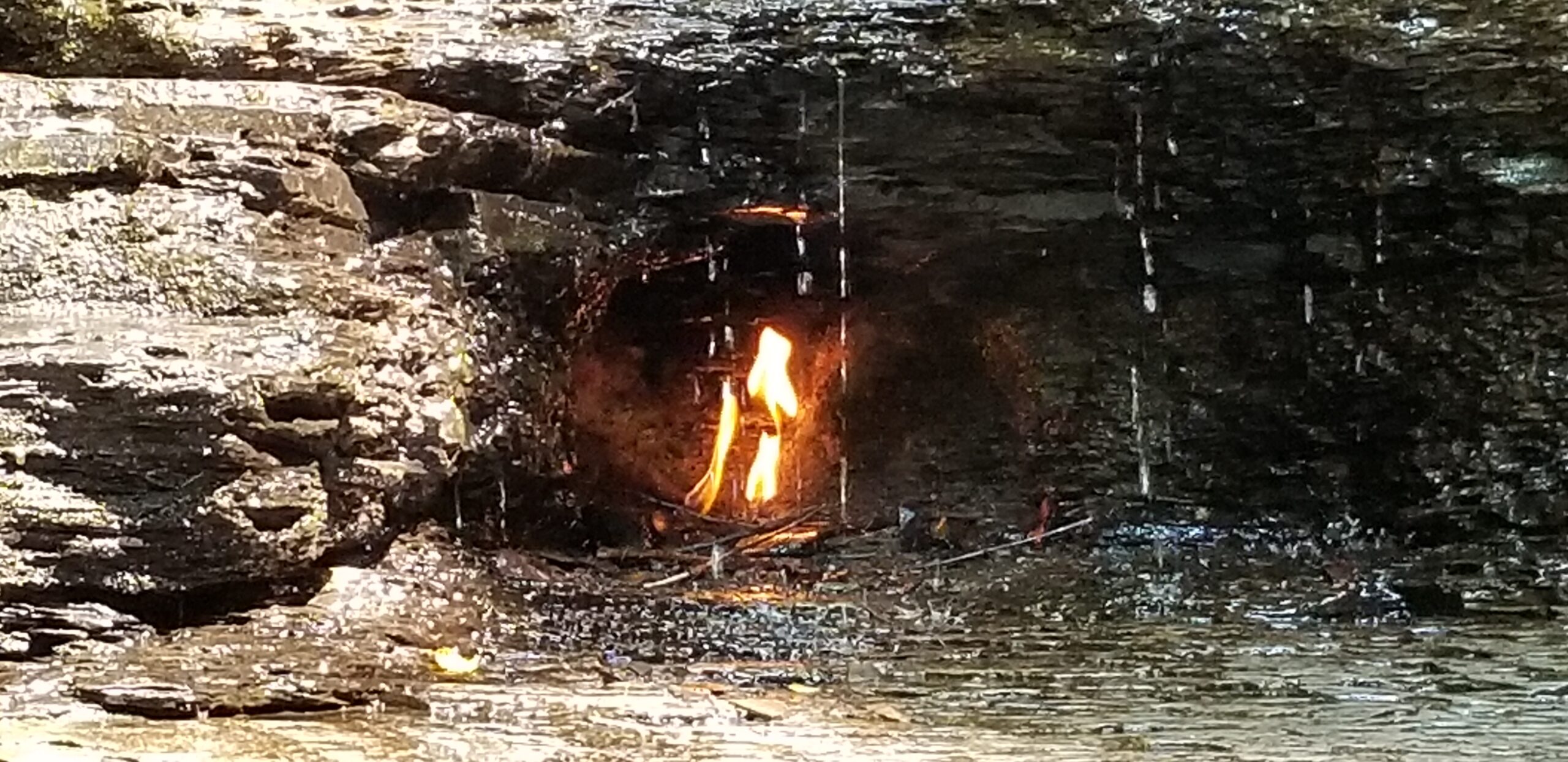
**Behind a Delicate Curtain of Water: The Enigma of Eternal Flame Falls**
Located in western New York, within an enchanting corner of Chestnut Ridge Park, exists a geological marvel that captivates both visitors and researchers alike. Eternal Flame Falls is famous not for the stream of water that cascades over its shale ledge but for the mysterious flame that dances in its hollow, resisting the elements to burn consistently from a natural gas leak.
### A Natural Wonder
The flame rises from a fissure in the dark shale and, depending on the season, may be encircled by snow or splashed with water. This flame, while appearing everlasting, is susceptible to being snuffed out by natural forces—but spectators frequently manage to rekindle it. The enduring aspect of this location is the persistent seepage of natural gas, which has endured over extensive geological periods.
### An Intriguing Composition
In 2013, a global team explored the origins of this gas. They uncovered hydrocarbons typical of those produced deep below ground, despite the relatively low thermal maturity of the shale source. This shale layer, situated approximately 400 meters beneath the surface, is thought to be the Rhinestreet Shale of the Upper Devonian West Falls Group. Its lack of maturity is puzzling, as such conditions typically do not yield substantial thermogenic gas.
### The Chemistry of a Riddle
The gas is notably “wet,” abundant in ethane and propane—hydrocarbons that distinguish it from the majority of natural gas seeps. Studies indicated a vitrinite reflectance showing only slight thermal maturity, challenging conventional theories of natural gas generation. Potential explanations for this anomaly include more intricate local geological histories or catalytic processes occurring at lower temperatures.
### A Natural Parallel to Fracking
The phenomenon of Eternal Flame Falls has been likened to hydraulic fracturing. However, the fractures permitting gas escape are naturally formed, rooted in the area’s tectonic past. This naturally “fractured” shale system demonstrates how geological processes can establish conditions similar to contemporary drilling methods, albeit through ancient processes.
### Implications and Fascinating Questions
Research into Eternal Flame Falls underscores not only the subtlety of geological processes but also the wider significance for comprehending natural methane emissions. Unlike industrial leaks, this seepage is innate to the Earth’s geological relaxation. The study unveils the intricacy of differentiating various methane sources—a critical element in climate science.
### A Convergence of Nature and Mystery
Eternal Flame Falls presents a captivating contradiction, where the tranquility of a waterfall intersects with the erratic dance of fire. While contemporary science may trace the flame’s origin and assess its emissions, the underlying geological processes challenge established models. The charm of the flame lies not only in its enduring glow but in the echoes of ancient Earth narratives that it continues to convey.
Thus, while the visible flame may flicker and extinguish, the invisible seepage persists, perpetuating the cycle of curiosity and exploration for all who wish to uncover the mysteries nestled behind a veil of water.