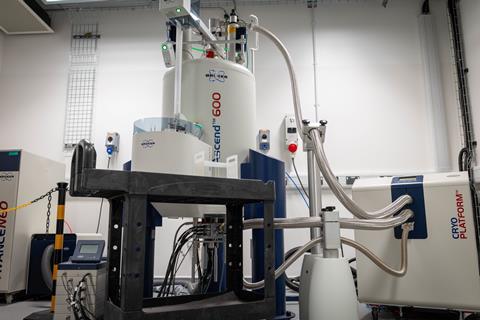
The Defence and Science Technology Laboratory (DSTL) of the UK has launched an advanced Nuclear Magnetic Resonance (NMR) suite at Porton Down in Salisbury. This development signifies a notable enhancement in chemical analysis abilities. As stated by Soumya, the chief scientist of the new NMR center, analyzing the composition of a sample can be intricate, but the latest instruments and innovative techniques improve their analytical prowess.
DSTL’s engagement with NMR technology commenced in 1980 with their initial machine, followed by two additional units in 1996 after the Chemical Weapons Convention (CWC) was ratified in 1993. This convention, which includes over 190 member nations including the UK, forbids the development and deployment of chemical weapons. DSTL serves as a prominent laboratory for the Organisation for the Prohibition of Chemical Weapons (OPCW) and stands among the top-performing OPCW labs worldwide.
The newly established NMR suite contains multiple high-resolution devices, featuring innovative technology that enables the examination of samples at lower concentrations than previously achievable. NMR forms part of DSTL’s comprehensive toolkit for chemical analysis, which also includes gas and liquid chromatography and mass spectrometry, allowing intricate analysis across various chemical and biomedical samples.
NMR has been vital in probing incidents related to chemical warfare, such as the poisonings in Salisbury and Amesbury and the use of chemical arms in Syria, as highlighted by DSTL’s Chief Science and Technology Officer, Andy Bell. With the evolving landscape of chemical warfare, cutting-edge technology like the new NMR suite is crucial for implementing effective countermeasures.
To promote collaboration, DSTL collaborates with UK academic institutions and international organizations. Imogen Daniel, a PhD candidate from the University of Southampton, is conducting research on microcoils that may improve NMR sensitivity for trace samples. Likewise, Simon Duckett from the University of York is investigating parahydrogen as a hyperpolarisation approach to enhance NMR sensitivity. By disrupting the symmetry of parahydrogen, the signal can be significantly amplified, facilitating improved analysis of low-concentration samples.
The inauguration of the NMR facility aligns with DSTL’s celebrations of 25 years in operation, positioning it as a ‘gem in the crown’. The newly outfitted NMR laboratory is set to continue being a fundamental component of DSTL’s research capabilities in the years ahead.