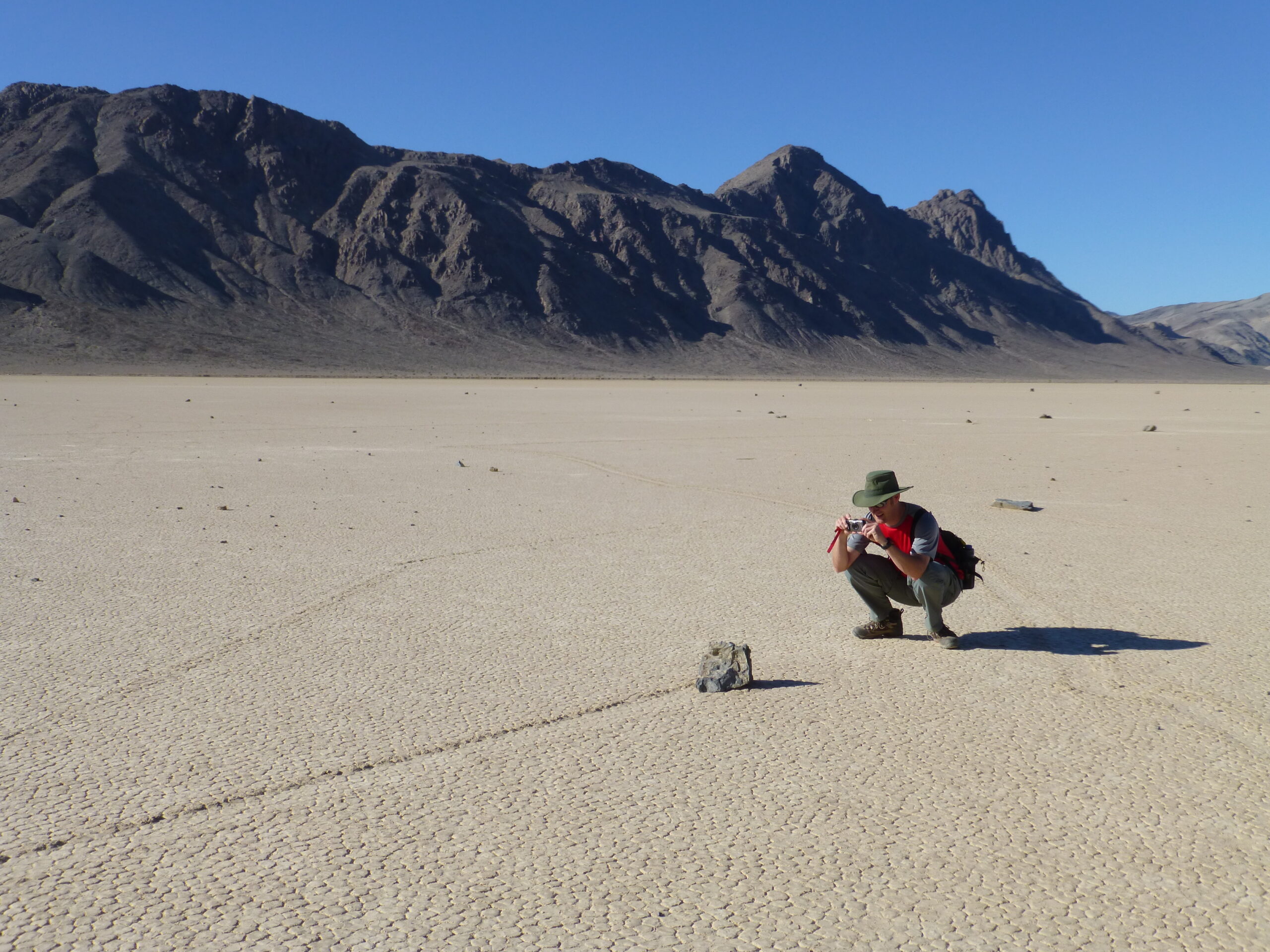
Across an arid lakebed in one of the hottest zones on the planet, hefty stones leave elongated trails in the mud as if they have journeyed under their own motion. Some pathways stretch straight for hundreds of metres, while others curve, intersect, or halt suddenly. For numerous decades, scientists could examine the traces left behind at Racetrack Playa in Death Valley, yet no one had scientifically observed the rocks while they were actually in motion.
The solution eventually came during a rare winter scenario involving rain, freezing nights, morning sunshine, and gentle winds. Cameras and GPS devices captured rocks gliding over the damp lakebed at a walking speed or slower, propelled by massive sheets of ice only a few millimetres thick.
The rocks were not raised and transported on ice rafts. Rather, broad floating layers of melting ice pressed against rocks that remained in contact with the soft mud. A breeze that would hardly be noticed could shift a sheet tens of metres across, providing ample surface area to push several stones simultaneously.
A riddle inscribed in the mud
Racetrack Playa is an extraordinarily flat basin situated in a secluded valley between the Cottonwood and Last Chance mountain ranges. Rain occasionally inundates the fine sediment, creating a shallow temporary lake. Once the water evaporates, the mud hardens into a tough mosaic of patterns. Rocks that fall from the encircling slopes end up scattered across this landscape.
Many of those rocks possess trails trailing behind them. The National Park Service notes that the Racetrack is a dry lakebed renowned for rocks that have traversed distances up to 1,500 feet, or approximately 457 metres. Some weigh several hundred kilograms.
The trails confirmed that movement took place, but the desert seldom provided observers. Conditions required sufficient rain to cover part of the playa, chilly nights to freeze the water, along with the appropriate wind and temperature as the ice began to melt. Rocks could remain still for years. By the time visitors showed up, the water and ice had vanished, leaving only a stone and its enigmatic groove.
Proposed theories included hurricane-strength winds, dust devils, slick algae, seismic tremors, and various iterations of an ice mechanism. Ice was a strong possibility long before the conclusive observation, yet researchers disagreed on whether thick ice floated the rocks, whether frozen collars acted like sails, or whether sheets of ice pushed them along the earth.
An experiment meant to wait
In 2011, a research group led by Richard Norris and James Norris set up a weather station near the playa, positioned time-lapse cameras, and placed 15 specially prepared rocks equipped with motion-activated GPS devices. They anticipated that the experiment might take years before suitable weather conditions emerged.
In late November 2013, rain and snow formed a shallow pond a few centimetres deep over part of the playa. An overnight freeze created a transparent layer of ice. On 20 December, the researchers arrived to find the pond still frozen and watched as the late-morning sun began to weaken it.
The ice fractured into panels stretching tens of metres across. Winds of around 4 to 5 metres per second, or approximately 14 to 18 kilometres per hour, moved the floating sheets over the water. The panels pressed against visible rocks and gradually propelled them through the soft mud beneath.
The team’s 2014 study published in PLOS ONE reported the first direct scientific observation of the rocks in action. The ice was merely about 3 to 6 millimetres thick. The stones moved at approximately 2 to 5 metres per minute, slow enough to appear nearly motionless without a fixed point of reference, yet quick enough to carve discernible tracks.
Over 60 rocks moved in unison
The most significant observed occurrence on 20 December involved more than 60 rocks. Some monitored stones traveled up to 224 metres through several movements between December 2013 and January 2014. In one instance, rocks separated by hundreds of metres began moving around the same time, indicating that a widespread environmental force was acting across the playa.
The GPS data, weather recordings, photographs, and direct observations all relayed the same narrative. According to the Scripps Institution of Oceanography’s report on the discovery, the researchers documented five movement episodes while the temporary pond was present, some involving hundreds of rocks.
Not all stones moved in sync, even