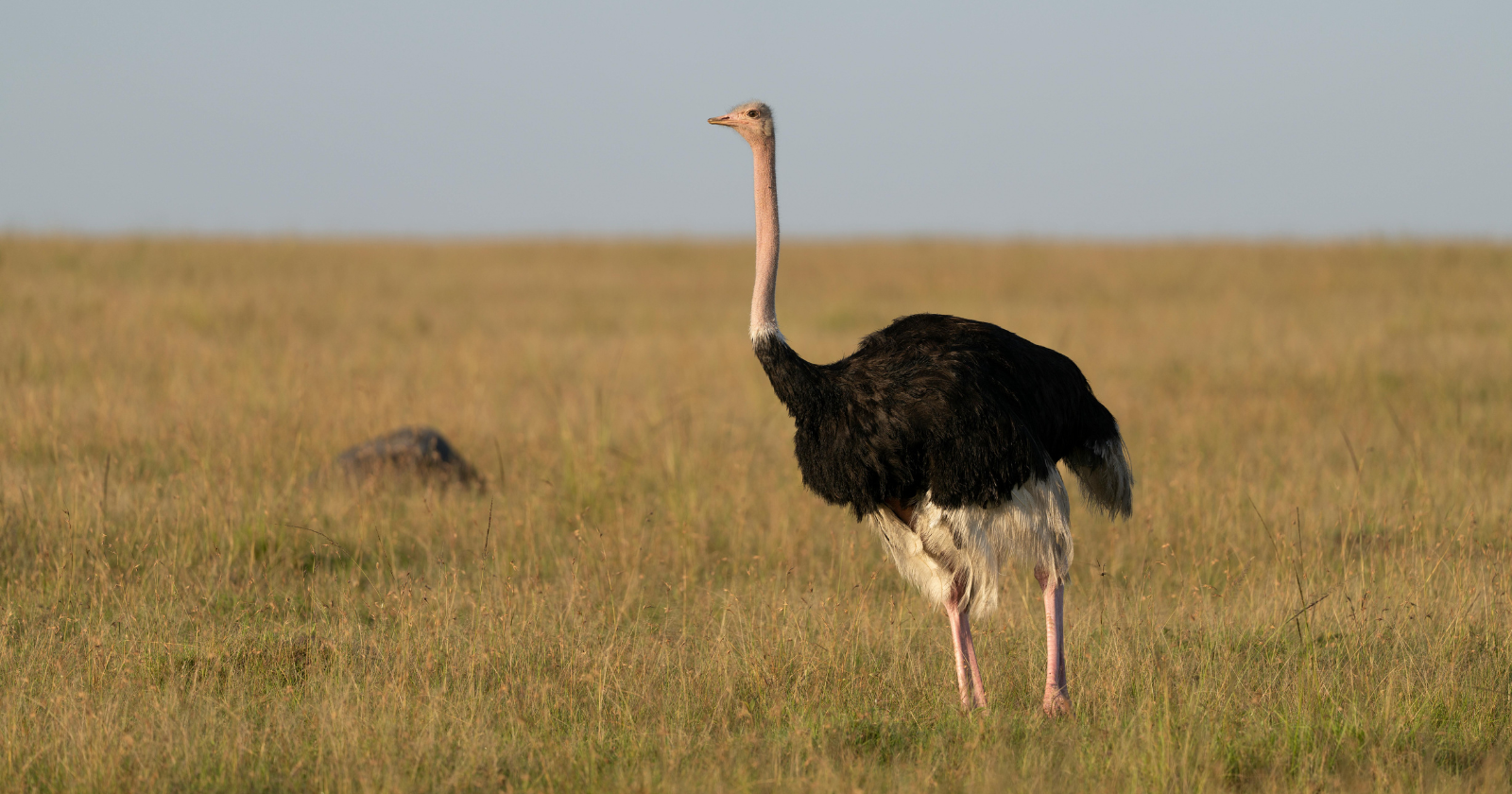
The bird renowned for its infamous survival tactic has never actually performed it. An ostrich with its head buried in the sand isn’t concealing itself — it’s suffocating.
The two actions that ostriches genuinely exhibit are stranger and more beneficial than the myth.
## A claim that collapses under biological scrutiny
The imagery is straightforward and memorable: a startled ostrich, head immersed in the sand, body humorously exposed. This depiction appears in cartoons, sayings, and workplace analogies about denial. However, it is utterly unfeasible. A head buried in sand cannot inhale, and a large bird cannot maintain that position without asphyxiation. National Geographic Kids states clearly: “Ostriches don’t bury their heads in the sand—they wouldn’t be able to breathe!”
There’s an additional issue. An ostrich facing danger has a far superior strategy than hiding. It is the [swiftest-running bird](https://nationalzoo.si.edu/animals/ostrich) known, reaching speeds of approximately 70 km/h (43 mph). A bird capable of such rapid movement has little need to dig itself into the earth.
## What observers have actually seen: turning eggs
So, where did this imagery originate? The most plausible explanation is the nest. Ostriches create a shallow dent in the ground, and the [bird lowers](https://kids.nationalgeographic.com/nature/article/animal-myths-busted#:~:text=But%20they%20do%20dig%20holes%20in%20the%20dirt) its head into that dip multiple times daily to access the eggs.
The head’s activity down there involves meticulous work. The bird utilizes its beak to rotate and adjust the eggs several times each day. Glinda Cunningham of the American Ostrich Association informed [National Geographic](https://kids.nationalgeographic.com/nature/article/animal-myths-busted#:~:text=If%20you%20see%20them%20picking%20at%20the%20ground%20from%20a%20distance) that “if you see them picking at the ground from a distance, it may appear as though their heads are buried in the ground.” The nest accentuates this effect. These scrapes are shallow, wide depressions cleared into open ground, and a head lowered into one truly does disappear from the view of an observer at a distance.
## The second action: lying flat to disappear
The other basis for the myth is a defensive strategy that relies on disappearing instead of running. When a quick getaway isn’t viable, the bird drops down. The [Cleveland Zoological Society](https://www.clevelandzoosociety.org/z/2020/03/11/truth-or-tail-do-ostriches-really-bury-their-head-in-the-sand-when-scared-or-frightened#:~:text=when%20an%20ostrich%20senses%20danger%20and%20cannot%20run%20away) describes it as follows: “when an ostrich senses danger and is unable to flee, it will collapse to the ground and stay still, trying to blend in with the surroundings.” It stretches its neck flat against the earth and remains motionless, allowing its coloration to blend into the arid terrain.
From a significant distance, a stationary ostrich pressed to the ground with its neck extended could resemble a bird that has lost its head. The neck lays in a low line that the eye finds challenging to distinguish against sand and vegetation. The illusion is almost an immediate interpretation.
## Why a small head on a large body completes the illusion
Both actions deceive us for the same reason: the ostrich’s physique. It is the largest extant bird, standing over 2.8 m (9 ft) tall and weighing up to 150 kg (330 lb) in the largest males, according to [Birdfact](https://www.birdfact.com/articles/do-ostriches-bury-their-heads-in-the-sand#:~:text=over%202.8m%20(9ft)). That massive body supports a small head on a slender neck. When the head is lowered, whether into a nest or flat against the ground, the part that disappears is minimal while the part remaining is unmistakable. The eye perceives the large pale body, cannot locate the head, and fills in the narrative it is already familiar with.
## What the myth actually reflects
The head-in-the-sand ostrich is a misinterpretation that solidified into reality. Two genuine behaviors, turning eggs in a scraped ground nest and flattening to conceal, both drop the head from view while the body remains entirely visible. Combine a small head with the largest bird on the planet, and a distant observer doesn’t require a cartoon to arrive at the incorrect conclusion. The myth endures because it was an effortless misconception to form.