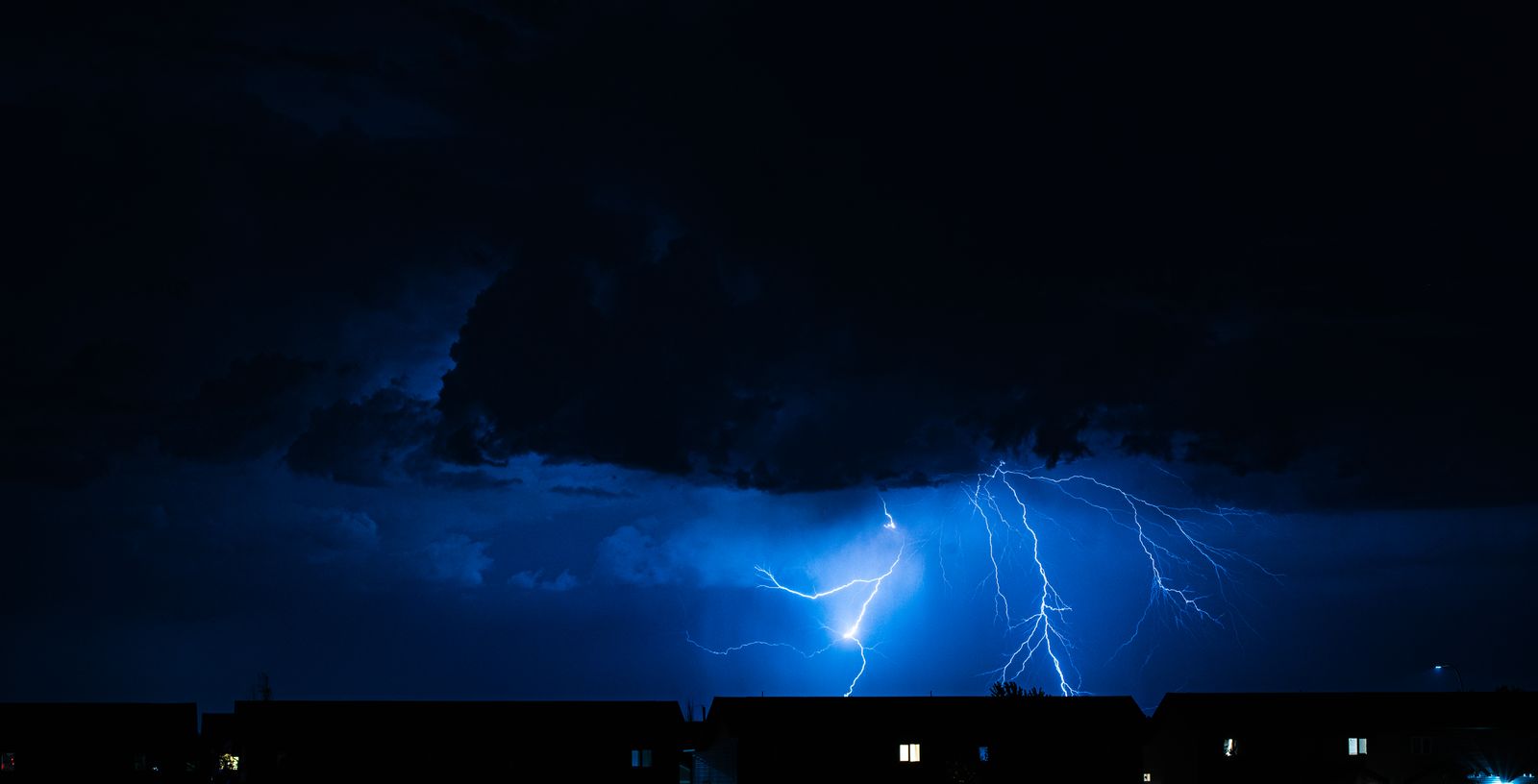
On the evening of October 22, 2017, a solitary lightning bolt sliced through the sky above the American Midwest and continued onward. It originated in eastern Texas and extended all the way to near Kansas City, Missouri — an astonishing 829 kilometers from beginning to end, all in one uninterrupted flash. The World Meteorological Organization (WMO) has officially recognized it as the longest lightning flash ever documented on Earth.
This distance is approximately the straight-line length from Washington, D.C. to Detroit, or from Paris to Venice. One bolt. One flash. One sky.
What a typical lightning bolt appears like alongside this one
A standard lightning strike is a localized occurrence. Randall Cerveny from Arizona State University, who acts as the chief of records confirmation for the WMO, stated the baseline clearly: most bolts extend less than 16 kilometers and last for less than a second.
The record-setting megaflash was about 51 times longer than that.
Envision a bolt that starts as your aircraft pushes back from the gate at London Heathrow and continues to branch through the clouds when the plane reaches cruising altitude over Germany. The underlying physics are identical to those of a backyard thunderstorm. The magnitude is not.
The storm that generated it
Megaflashes require a very specific type of weather pattern: a Mesoscale Convective System, or MCS. These are expansive thunderstorm complexes, frequently covering hundreds of kilometers, where many individual storm cells combine into a single organized mass of electrified cloud. The anvil tops disperse at high altitudes and remain connected long enough for a single discharge to span one end of the complex to the other.
The storm systems responsible for these phenomena are colossal. Satellite images from the U.S. National Oceanic and Atmospheric Administration (NOAA) consistently depict thunderstorm complexes sprawling across the U.S. South and Plains, their cloud shields extending across multiple states.
Cerveny has mentioned that there are only a few locations on Earth that consistently generate MCS systems large and stable enough to facilitate megaflashes. The U.S. Great Plains and Gulf Coast is one. The La Plata Basin in South America — encompassing parts of Argentina, Uruguay, and Paraguay — is the other.
How to measure a bolt from space
It is impossible to gauge an 829-kilometer flash from the ground. No solitary weather station has a broad enough view of the sky. The record exists thanks to instruments observing from above.
The primary equipment used is the Geostationary Lightning Mapper, or GLM, aboard NOAA’s GOES-16 satellite. The GLM constantly monitors the Western Hemisphere from geostationary orbit, capturing the optical signature of every flash below in near real-time.
This capability is what allowed researchers to reconstruct extreme flashes frame by frame. Prior to the introduction of geostationary lightning mappers in the late 2010s, ground-based networks would have logged these massive strikes as a series of separate detections. Only from orbit can they be discerned as single, continuous bolts.
Why this surpassed the old records
The 2017 super-bolt was acknowledged through a recent thorough reanalysis of satellite data, officially surpassing the previous record-holder: a 768-kilometer megaflash that illuminated Texas, Louisiana, and Mississippi on April 29, 2020. That 2020 bolt had broken an earlier 709-kilometer record from Brazil. The newly verified 2017 flash exceeded the 2020 benchmark by 61 kilometers — reaching 515 miles compared to the 2020 flash’s 477.2 miles.
Meanwhile, the duration record remains in South America. A flash over Uruguay and northern Argentina in June 2020 lasted an incredible 17.1 seconds. These extreme records are assessed by the WMO and published in the Bulletin of the American Meteorological Society.
Cerveny has made it clear that this is a narrative about detection catching up with reality. In statements regarding these significant atmospheric announcements, he remarked that it is highly probable that even greater extremes exist, and that lightning detection technology will eventually capture them. In other words: larger bolts are almost certainly out there. Cameras just need to be directed at the appropriate storm.
Was anyone at risk?
No. These record-setting distance megaflashes are almost entirely cloud-to-cloud occurrences. They traverse horizontally through the anvil tops of enormous storm systems, several thousand feet above ground level, discharging between regions of separated charge within the cloud shield rather than striking the ground directly.
However, the WMO utilizes these findings to emphasize an important public safety message. If a single flash can span the length of a small country within a cloud, the old adage — that you are safe from a storm once it is over the horizon — needs to be reassessed. Charge can bridge from an active cell to a cloud that appears innocuous from beneath. Even the data from the previous 2020 flash prompted meteorologists to recognize the vast distances over which modern lightning can travel.