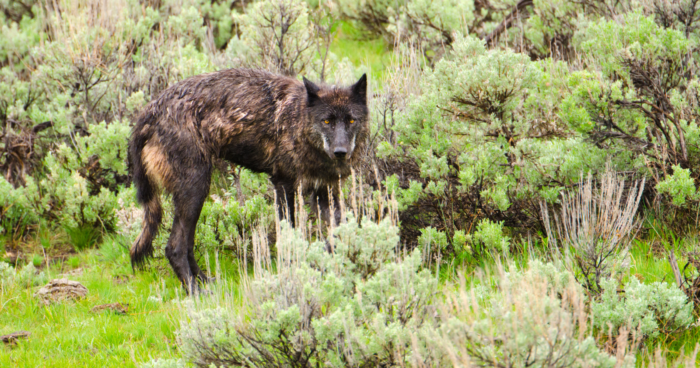
A four-minute film titled “How Wolves Change Rivers” has garnered more than 46 million views. It presents a neat narrative: reintroduce the wolves, and the rivers will transform. This is a significant number of people embracing a claim that scientists studying Yellowstone still debate among themselves.
A brief note before proceeding. I am not an ecologist, wildlife biologist, or hydrologist, and nothing presented here is a judgment on the science. This is a piece for reading and reflection on an ongoing scientific disagreement. The studies at its core are observational, derived from field sites within one particular park, and even the researchers involved express their findings in cautious, qualified language.
The popular narrative, articulated clearly
Gray wolves were largely missing from Yellowstone, primarily eradicated by a predator-control initiative, from 1914 to 1926. However, they made their return in early 1995.
The initial wolves arrived by truck via the Roosevelt Arch on January 12, 1995. In total, fourteen wolves were placed into three acclimation pens in Lamar Valley that year, released by late March. A subsequent group followed, culminating in 31 wolves by the close of 1996.
The storyline that emerged from this is what ecologists refer to as a trophic cascade. Wolves diminish and alarm the elk, leading elk to stop overbrowsing the young willow and aspen adjacent to the streams, the revitalizing plants stabilize the banks, beavers return, and the water flows differently. As stated in the video, “We all know that wolves eliminate various animal species, but we might be less aware that they also foster life for many others.” It’s a compelling statement, and yet scientists often highlight it as overly simplistic.
Where the science currently stands
The argument for a pronounced cascade has been largely supported by William Ripple and Robert Beschta from Oregon State University, who have advocated for this notion for two decades. Their prior research indicated that young aspen and willow along the streams prospered as elk foraging decreased post-wolf reintroduction.
More recently, a 2025 paper from Ripple and colleagues reported a striking statistic: approximately a 1,500 percent increase in willow crown volume.
That figure is where things become intriguing, as it is based on a method: the team utilized willow height, which was converted into an estimate of crown volume, to represent how much plant material actually exists. This conversion is precisely what critics targeted.
The reanalysis that complicated matters
In October 2025, a team led by Daniel MacNulty from Utah State University released a formal comment contending that the 1,500 percent figure doesn’t hold up. Their primary objection is mathematical.
As MacNulty elucidates, “Since height was used both to calculate and to anticipate volume, the relationship is circular—mathematically assured to appear strong even if no biological change took place.”
Co-author David Cooper from Colorado State University articulated the conclusion of the reanalysis directly, stating that once the errors are rectified, “there is no evidence that predator recovery led to a significant or system-wide increase in willow growth.” This is a firm stance, reflecting the critics’ interpretation of the same dataset, rather than a conclusive position in the field.
Ripple’s group did not concede the argument. In a 2026 response addressing the closely linked issue regarding aspen, they rectified an error in their effect-size estimation and reported a reduced figure, yet still described the outcome as a strong, ecologically significant cascade, while acknowledging it was never a complete restoration of every aspen stand. Although the corrected figure was lesser, the disagreement itself remained unresolved.
What ecologists do and don’t concur on
The scientists engaged in this debate are not divided into wolf advocates and detractors.
MacNulty emphasizes that the critique is not an indictment of predators: “Our aim is to clarify the evidence, not minimize the role of predators,” he stated. His articulated principle is the type most researchers would endorse: “Predator effects in Yellowstone are genuine but context-dependent—and robust claims necessitate robust evidence.”
Examining both perspectives reveals a rough consensus. Almost everyone agrees that some cascade occurred. What is disputed is its magnitude and origin, whether the willow recovery is substantial and widespread or modest and sporadic, and how much is attributable to wolves versus hydrology, climate, beaver, bison, and the particular fortunes of individual streambanks.
Why the simpler narrative prevails
One could argue that the reason the river-altering narrative resonates so widely is that it is simply a superior story. Wolves portrayed as landscape architects, one decision in 1995 cascading outward into the contour of the water. It possesses a structure our minds find appealing. “Willow crown volume responds modestly and variably to a mix of browsing pressure, water tables, and local conditions” does not achieve 43 million views.