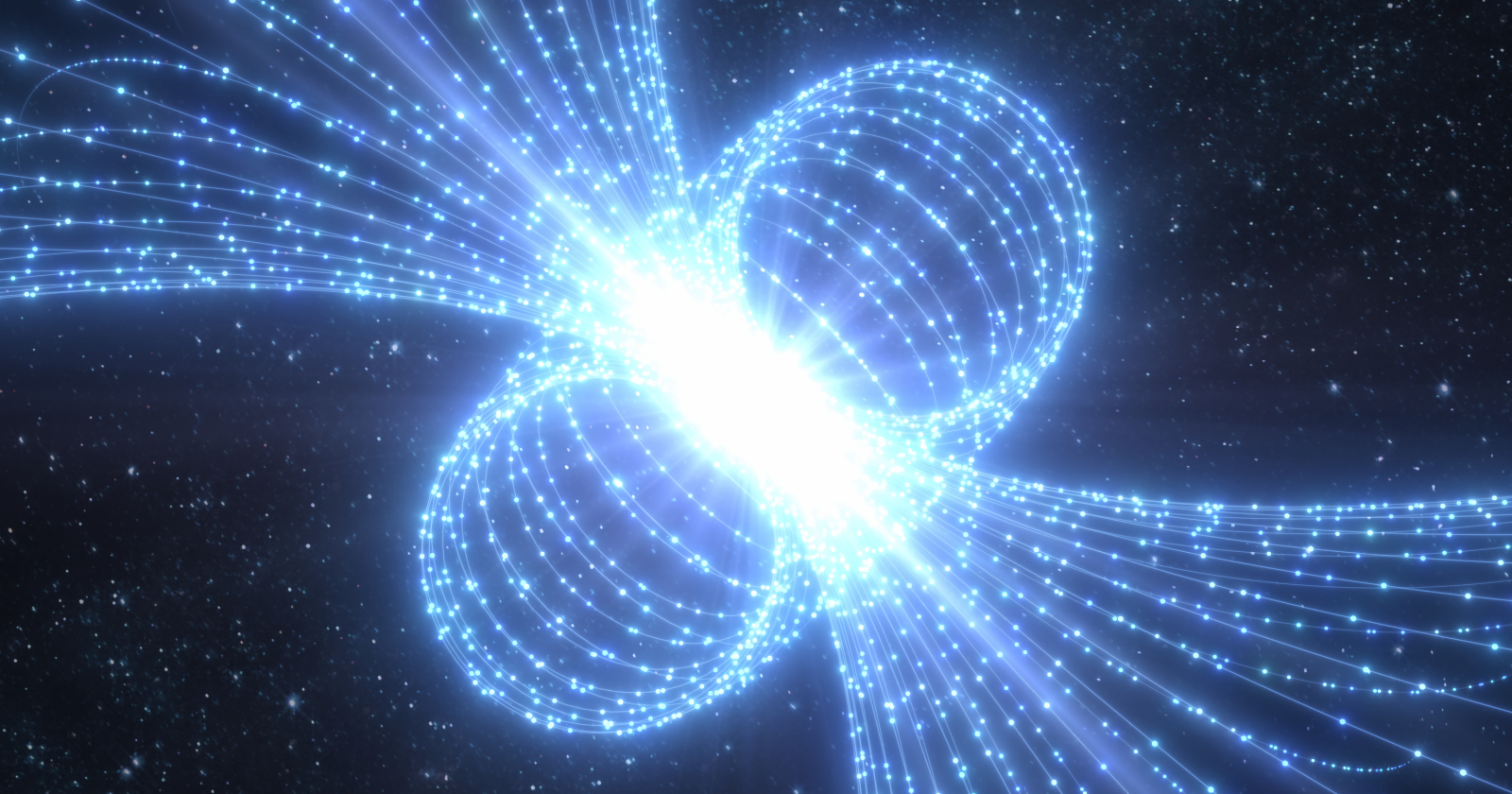
A magnetar is an extinct star comparable in size to a city, rotating in the cosmos and enveloped in an almost unimaginable magnetic field. Approach too closely and atoms would stop behaving as they do on Earth. Their electron clouds would become elongated, their binding energies would shift, and the familiar chemistry that sustains human life would collapse.
These distances serve more as conceptual exercises than precise limits. No one has investigated what would occur to a human beside a magnetar, and any real encounter would also involve deadly gravity, X-rays, and gamma rays.
Nonetheless, the computations show just how extreme these cosmic entities are.
### A unique type of neutron star
When a colossal star depletes the fuel in its core, the core can collapse during a supernova, resulting in the formation of a neutron star. NASA characterizes neutron stars as being around 20 kilometers in diameter, roughly equivalent to the width of a city, yet usually containing more mass than the Sun.
Their density is nearly unfathomable. A spoonful of neutron-star material would weigh approximately a billion tons in Earth’s gravitational field.
A magnetar is a rare kind of neutron star whose behavior is influenced by an extraordinarily powerful and frequently intricate magnetic field. Only about 30 such entities are known to exist within the Milky Way, although this number can fluctuate based on the inclusion of uncertain candidates.
### Fields at the extreme of nature
Earth’s surface magnetic field registers approximately 0.25 to 0.65 gauss. Magnetar fields generally span between 1014 and 1015 gauss. At the higher end, this equates to between one and several quadrillion times stronger than Earth’s field, contingent on the measurement location of Earth’s field.
Astrophysicist Kenzie Nimmo portrayed neutron-star fields as being “at the limits of what the universe can produce.” Therefore, magnetars are not just powerful magnets by earthly standards. They inhabit a realm of physics that cannot be replicated in any human laboratory.
### The impact of an extreme field on atoms
It is often claimed that a magnetar would simply disintegrate atoms, but the truth is more complex. Calculations indicate that atoms can remain bonded in immense magnetic fields, although they no longer take the form of the roughly spherical atoms we know from Earth.
The field compresses electrons tightly along its direction, leading to narrow, elongated electron clouds and altering the energy needed to bind electrons to nuclei. In certain conditions, atoms may even link up into molecular chains or condensed structures of highly magnetized matter.
Christopher Bochenek, an astrophysicist at Caltech, explained the effect by stating that magnetar fields can “squish atoms into pencil-like shapes.” This is a more accurate description than envisioning every atom being instantly stripped down to its bare nucleus. The atoms may retain their bonds, but their structure and chemistry become drastically altered.
### The potential effects on a person
NASA has illustrated that a person within roughly 600 miles, or about 1,000 kilometers, of a magnetar would have the atoms in their body torn apart. This phrasing is best understood as dramatic outreach rather than a precise physical limit.
NASA has also indicated that a magnetar situated halfway to the Moon could erase credit cards on Earth!
This variation shows that this serves as a scale illustration rather than a universal erasure distance. Magnetars vary in strength, while magnetic stripes differ in their susceptibility to demagnetization. Orientation and shielding would also be significant factors.
### The significance of magnetars
The very conditions that render magnetars fearsome also render them scientifically significant. ESA observations of SGR 0418+5729 have revealed local areas where the magnetic field could attain 1015 gauss across regions only a few hundred meters wide.
Magnetars may also be responsible for at least some fast radio bursts. In 2020, an FRB-like flash was detected from a known magnetar in the Milky Way, demonstrating that these stars can produce brief yet incredibly intense radio explosions.
In close proximity, surviving near a magnetar would be impossible due to a combination of radiation, gravity, and magnetic distortion. However, from a safe distance, it becomes a natural laboratory for investigating matter and energy under conditions that are unattainable anywhere on Earth.