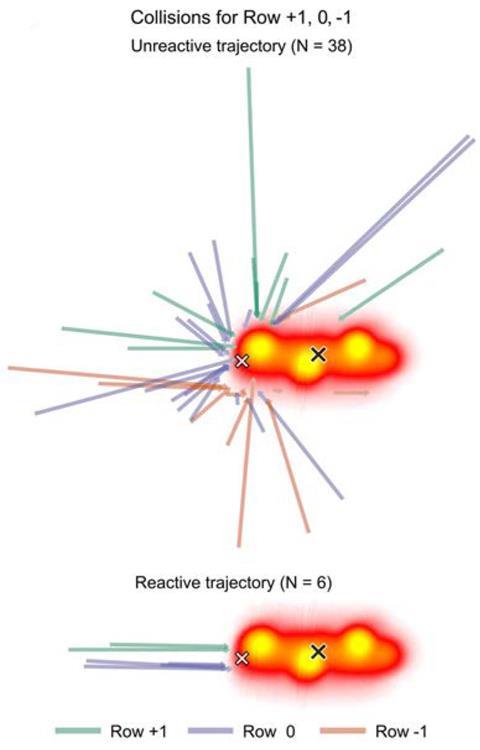
The probability that two molecules in collision will react is significantly influenced by the angle, as demonstrated by researchers in Europe.1 This research may be broadened to investigate the impacts of additional factors on collision results and, in the end, to develop more effective pathways for chemical reactions.
During collisions between atoms or molecules, the particles might merely bounce off one another. However, such collisions can also result in the formation or breaking of bonds. The elements that determine whether a collision is reactive remain largely unclear. In 2018, a team of chemical physicists led by John Polanyi at the University of Toronto in Canada – who received the Nobel prize in chemistry in 1986 for contributions to reaction dynamics – directed difluorocarbene molecules adsorbed on copper towards one another and utilized scanning tunneling microscopy (STM) to demonstrate that a head-on collision was more likely to result in a reaction compared to a glancing impact.2
In recent studies, chemical physicist Matthew Timm, a PhD candidate in Polanyi’s 2018 partnership, along with colleagues from the group of Leonhard Grill at the University of Graz in Austria and theorists from the Czech Academy of Sciences in Prague, expanded this research to explore molecular orientation in reactions. They achieved this by employing rod-like dibromoterfluorene molecules chemisorbed at various angles on the textured surface of face-centered cubic copper. Initially, they applied STM to remove one of the terminal bromine atoms, resulting in the formation of the highly reactive BTFyl radical. Subsequently, they electrically propelled difluoromethylene radicals towards this radical and utilized STM to observe whether a bond was created. The energy barrier for projectiles traveling along these rows on the copper surface was considerably lower than for them to jump across the ridges, indicating that the texture of the surface enabled the projectiles to strike the chemisorbed targets in their intended spots.
The researchers observed that when the projectiles approached the target carbon on the BTFyl radical at an angle less than 1° from the molecular axis, a bond was consistently formed. Conversely, when the angle exceeded 15° or the projectile was even a single row lower than the radical, bonding ceased to occur. Interestingly, bonding occasionally happened when the molecule was directed one row too high, implying it should have entirely missed the radical. Theoretical calculations proposed that the displacement of the underlying surface due to the chemisorbed radical might facilitate the movement of the projectile between rows. Calculations conducted by the team indicate that this limited region of reactivity is governed by steric interactions.
The researchers now aim to investigate how the spatial sensitivity of reactivity changes if the target atom or the degree of steric hindrance in the molecule alters. ‘These are inquiries that intrigue me and I believe should also captivate the broader community – how to bond effortlessly and effectively and how to design molecules to achieve these bonds,’ remarks Timm.
Theoretical chemist Jonas Björk at Linköping University in Sweden characterizes the dual control over the position and angle of impact on the target as ‘extremely clever’ and ‘a significant contribution’. He proposes that these techniques could now be employed to examine the impacts of different chirality or to explore molecules on alternative, less reactive surfaces like silver and gold, to determine if a trend can be established and potentially extrapolated to predict behaviors in free space. ‘The broader the spectrum of chemistries we can investigate, the more we can understand how these parameters influence chemical reactions among colliding molecules,’ he concludes.