In England throughout the Early Modern Period, a remarkable change was witnessed in the domain of practical mathematics, primarily owing to the significant influence of mathematical and scientific tools. These tools, which have existed since ancient times, experienced a considerable increase in both their diversity and production from the mid-sixteenth to the seventeenth century, establishing them as a crucial facet of the scientific milieu of that time.
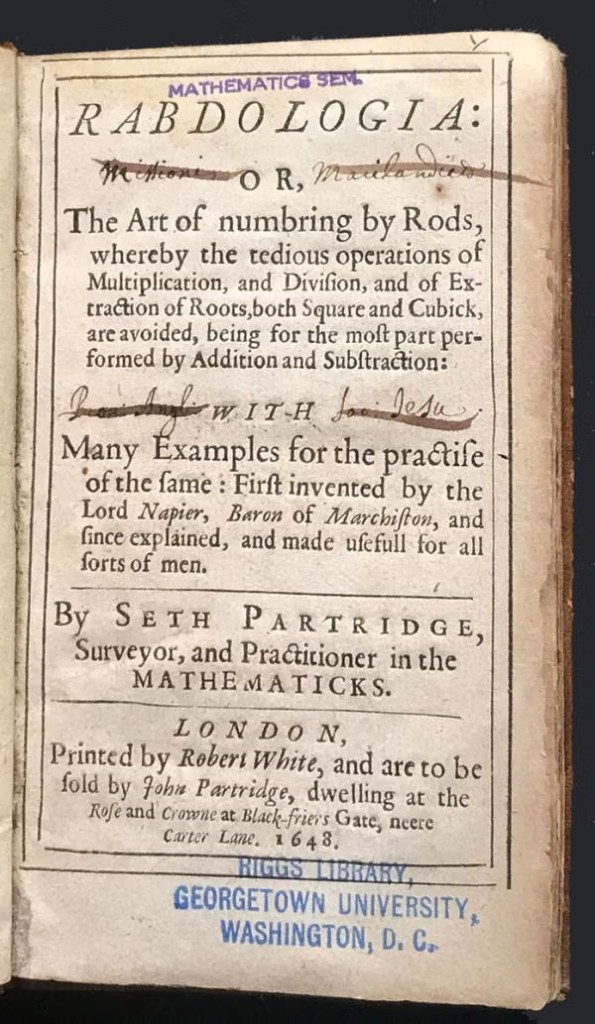
More than just characterizing the era, these tools also played a vital role in defining the functions of “mathematical practitioners,” a term that encompassed various professions dependent on practical mathematics. From surveyors and navigators to gunners, architects, shipwrights, sundial makers, military engineers, and bookkeepers, these practitioners frequently identified themselves as “practitioner in the Mathematicks” in their writings. Notable examples include Henry Bond, Seth Partridge, and William Purser, who emphasized their mathematical knowledge in their publications.
Gauging, which entailed assessing the volume of barrels or ships for taxation purposes with the aid of mathematical tools, stood out as one of the most prevalent subjects in mathematical literature of this duration. Similarly, dialling, or the crafting of sundials, was also a common topic of discussion. Kepler’s contributions to gauging utilizing early integration techniques and Partridge’s “Rabdologia,” centered around Napier’s Bones, were significant milestones. Napier’s Bones was a straightforward calculating implement that aided in various mathematical computations.
The accuracy in surveying experienced notable enhancement during this era. Aspects such as the revival of Ptolemaic mathematical mapping and modifications in land ownership regulations demanded more precise surveys. This was met by innovations like Frisius’ triangulation method in 1533, which shaped the practices of cartographers across Europe, along with tools such as the plane table, theodolite, and circumferentor that enabled superior measurements.
Advancements like Gunter’s Chain and sector significantly enhanced measurement precision and calculation effectiveness, which were essential for surveyors and navigators. The incorporation of logarithms, initially published by John Napier, additionally streamlined trigonometric computations, rendering complex geometrical surveys more attainable.
The application of instruments was not confined to professional use but was also woven into the education of gentlemen, amidst an increasing acknowledgment of the relevance of mathematics for estate management, navigation, and governance. The aim was to ensure that gentlemen were well-versed in the practical applications of mathematics, as instruments bridged the gap between theoretical concepts and practical uses.
In conclusion, during the Early Modern Period, mathematical instruments became essential to the functions of mathematical practitioners and were fundamental to the educational and professional realms of England.