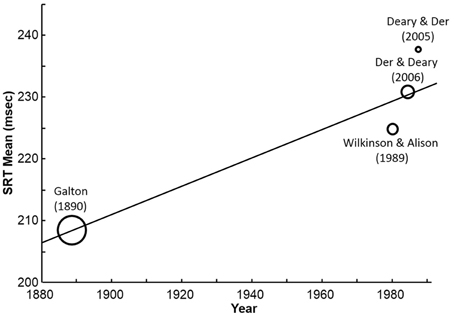
Psychologists have historically employed reaction times (RTs) as an essential means of exploring cognitive processes, a practice that predates the formal establishment of psychology as a discipline. By examining variations in response times under different conditions, researchers can deduce how cognitive processing might change in various situations. The historical foundations of this approach can be traced back to individuals like Francis Galton, whose extensive data collection on RTs in the late 19th century established fundamental concepts linking processing speed to intelligence.
Galton’s explorations were influenced by the belief that faster RTs could indicate greater intelligence, a notion that sparked his fascination with individual differences. While the contemporary understanding and use of RT data have evolved, the historical backdrop poses compelling questions regarding shifts in cognitive capabilities over generations. Notably, determining whether modern humans exhibit quicker or slower RTs than their Victorian predecessors could shed light on broader patterns of cognitive development.
This generational discussion is intensified by the Flynn Effect—the documented increase in IQ scores over the decades. This phenomenon contradicts the idea that there is an intellectual decrease with successive cohorts, challenging the instinctual beliefs of those associating modernity with a decline in attributes such as intelligence and discipline. Nevertheless, RT data might offer an alternative perspective.
Recent analyses contrasting Galton’s results with modern investigations indicate that contemporary individuals could be slower in RTs, an observation noted in various studies. For example, research by Silverman (2010) reveals that RTs in studies conducted post-1941 are longer compared to those measured by Galton. Although this reflects a mere 20-millisecond difference over a century, it is significant within RT metrics, suggesting a 10% deceleration.
Several explanations could account for this slowdown: actual cognitive deterioration, greater cognitive demands due to a more intricate modern environment, changes in motivation, or variations in experimental techniques. Given the scarcity of historical data, these interpretations remain hypothetical but encourage consideration of what RTs genuinely reveal about cognitive performance over time.
In conclusion, while the notion of cognitive decline might be partially supported by RT data, it is crucial to take into account larger contexts and possible methodological factors before reaching conclusive judgments about the cognitive abilities of both past and current generations.