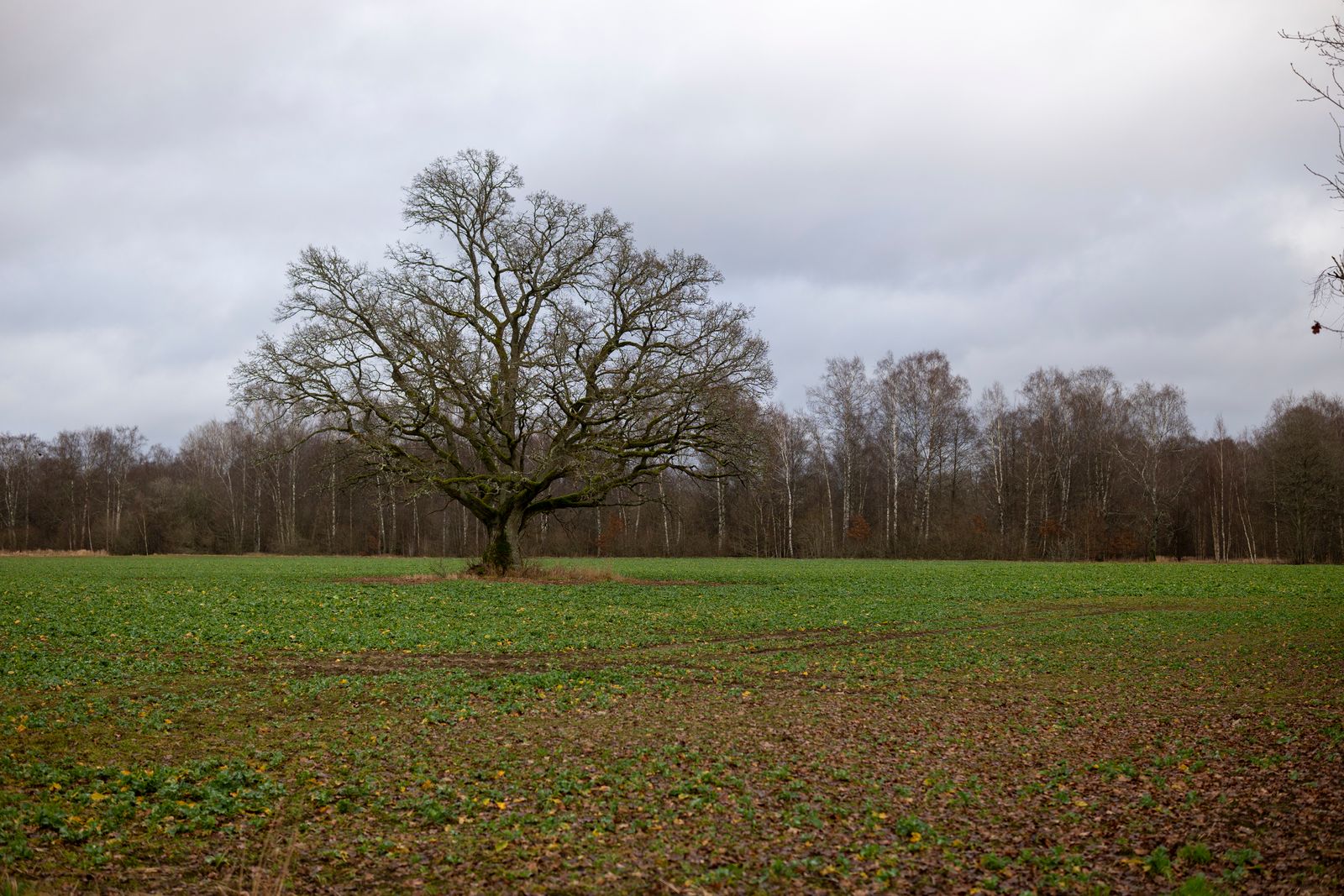
Here is a truth that took me some time to accept: in the precise terminology of biology, there is no actual entity known as a tree. Not in the implication that trees are fictitious, of course, but rather in the understanding that “tree” does not represent a cluster of interconnected organisms. It is a form.
I am a writer, not a botanist, so I have relied on experts who dedicate their careers to this subject. However, this claim is not obscure, and once it resonates, it alters your perception of a forest.
## A tree is a method, not a lineage
Living organisms are generally classified by their ancestry. Cats constitute a family because they originate from a shared cat-like ancestor. Trees do not adhere to this model. A pine, an oak, a palm, and a tree fern are all categorized as trees, yet they are only distantly related to one another.
What they have in common is an approach to a challenge. If you are a plant striving for sunlight, growing tall and developing a rigid woody trunk to support yourself is an effective strategy for success. That approach has been independently discovered multiple times, by lineages that were not initially trees. Biologists refer to this as [convergent evolution](https://en.wikipedia.org/wiki/Convergent_evolution), indicating that different starting points lead to the same outcome, similar to how eyes or wings have evolved more than once.
The evolutionary distances are vast. Tree ferns, which contribute to the prehistoric appearance of a rainforest, are not even seed plants. Their lineage was growing tall with trunks, albeit in a fibrous manner rather than creating true wood, hundreds of millions of years prior to the emergence of the first oak or pine. A tree fern and an oak are both trees in everyday terms, and they are as distantly related as any two plants can be.
Thus, “tree” fits into the same category as “swimmer” or “digger.” It defines what something does, not from which it descends.
## Why an oak is more akin to a strawberry than to a pine
This example underscores the point for me. An oak and a pine may seem like evident relatives. Both are large, woody, long-lasting trees.
Yet an oak is a flowering plant, an angiosperm, just like a strawberry. A pine, however, is a gymnosperm, originating from a lineage that diverged before the existence of flowering plants, over 300 million years ago. On the plant family tree, the oak and the strawberry occupy the same major branch, while the pine resides on a much older branch.
In other words, the oak is more closely related to the small herb in your garden than to the conifer it resembles. Their shared tree-like characteristics are merely a coincidence of approach, not indicative of familial ties.
## The most compelling proof: trees are continually reinvented
If the tree form is merely a replicable trick, one would expect to observe plants evolving it. Indeed, you can.
A striking instance is what botanists term insular woodiness, where ordinary herbaceous plants evolve into woody shrubs and small trees upon colonizing islands. A 2022 study published in the journal PNAS, spearheaded by Frederic Lens and colleagues, identified over a thousand island plant species that underwent this transformation, arising from at least 175 separate evolutionary shifts across 31 archipelagos.
The instances are vivid once you learn to observe them. The giant Hawaiian silverswords, the tree-sized lettuces of the Canary Islands, and the woody viper’s-buglosses from the same region all stem from soft, herbaceous ancestors that transitioned to woody forms in situ. Each represents a small, recent, independent creation of something tree-like.
Part of what enables this phenomenon is that woodiness seems to be an age-old ability in flowering plants. Many herbaceous lineages, which we typically associate with the opposite of trees, descend from woody progenitors and have simply deactivated that trait. Evolving back into a tree often means less a leap into something novel and more a reactivation of mechanisms their ancestors already possessed.
Woodiness proves to be relatively straightforward for a plant to reinitiate, which is precisely why the tree form is so widespread and irregularly distributed within the plant kingdom.
## Why this extends beyond a simple nuance
It is reasonable to inquire whether any of this is significant, since “tree” serves as an entirely functional everyday term and no one is suggesting we cease its use.
What shifts is the image in your mind. A forest is not a unified family of organisms engaged in the same ancient activity. It is a congregation of diverse lineages that independently discovered identical ways to sustain themselves, representing a convergence rather than a lineage. The oaks and pines in a mixed woodland resemble less relatives at a gathering and more like independent firms that happen to have constructed similar towers.
The magnitude of that convergence is difficult to visualize. A 2015