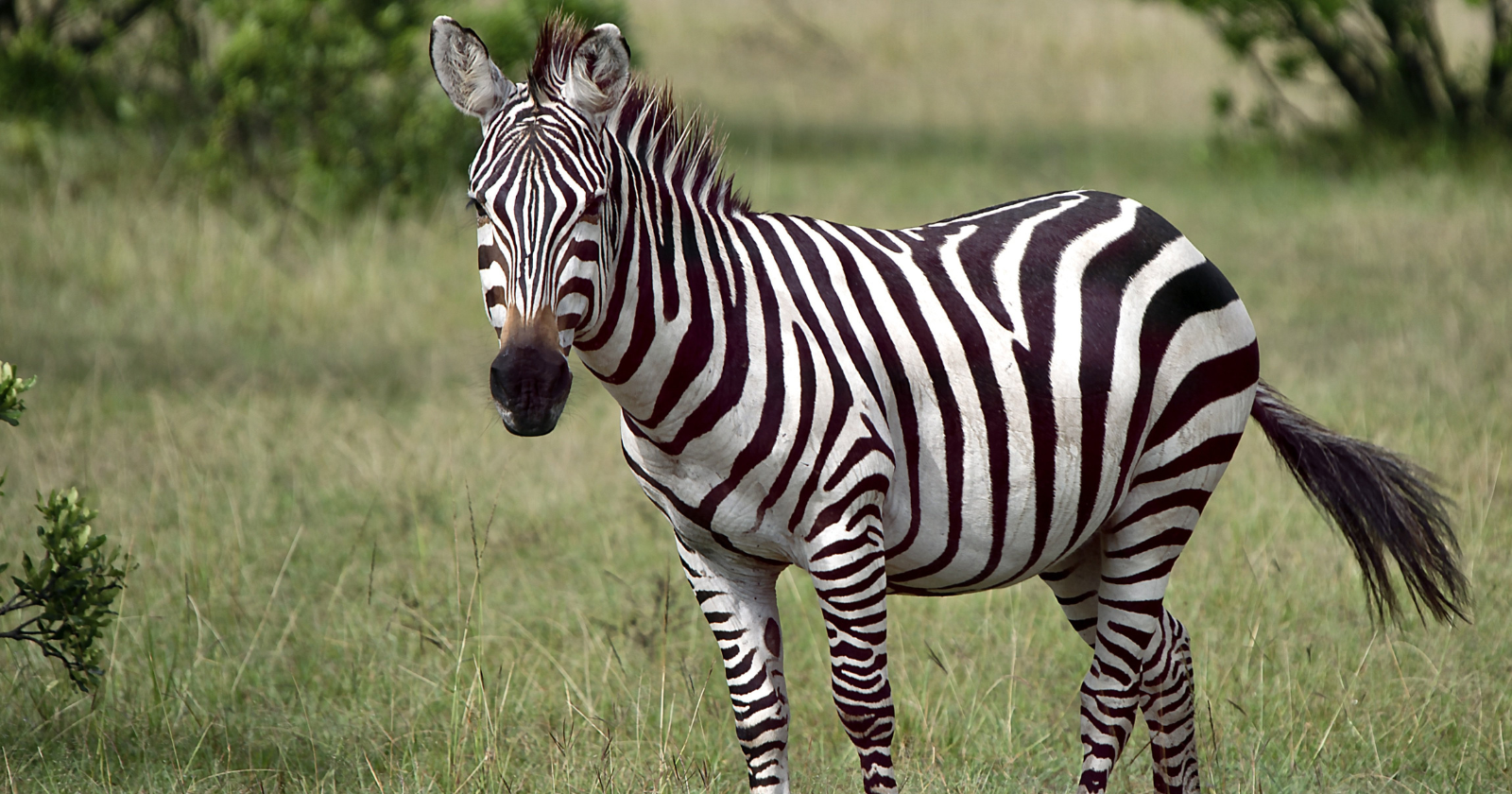
For a significant portion of the timeline of evolutionary biology, the reason behind zebras’ stripes has remained a mystery.
This lack of understanding does not stem from a lack of effort. The unique pattern stands out as one of the most evidently perplexing characteristics of any mammal on the planet — bright, symmetrical, seemingly expensive to uphold, and entirely ineffective for the purposes that stripes typically serve in nature. The camouflage theory against savanna plants, the most straightforward explanation, fails: zebras are, in fact, quite conspicuous at the distances from which lions and hyenas pursue them. Consequently, biologists have suggested numerous alternatives. Thermoregulation. Social signaling. Disorienting predators during pursuits.
Most of these hypotheses have gradually fallen out of favor. In 2019, however, a team of Japanese agricultural researchers painted six black cows with white stripes, bringing the last strong candidate for a solid explanation closer to acceptance.
## The cow experiment
The research was spearheaded by Tomoki Kojima at the Aichi Agricultural Research Center in central Japan, with findings published in *PLOS ONE* in October 2019.
The setup was straightforward. Six Japanese Black cows — a breed that is inherently uniformly dark — were categorized into three treatment groups through a Latin-square rotation: painted with black-and-white zebra stripes, painted with only black stripes (to control for the paint’s effect), or left unpainted. The cows engaged with each treatment on natural pasture where biting flies were plentiful. Researchers captured images of the animals at regular intervals and counted the number of flies visible on their bodies in each photograph.
The outcomes were clear. Cows displayed with zebra stripes attracted around half as many biting flies as the same cows when they were left unpainted or painted with black-only stripes. Additionally, the cows exhibited significantly fewer fly-repelling behaviors — the head tosses, ear movements, leg stamps, skin jitters, and tail flicks that cattle employ to rid themselves of pesky insects. They were, by measurable standards, experiencing less annoyance.
The specific paint design was effective. The stripes had a purpose.
## What the stripes are actually doing to the flies
The leading explanation for this phenomenon centers around the specific visual mechanics involved in how biting flies land.
Flies do not simply head straight towards a target. During their final approach, they depend on optical flow — how visual patterns shift across their compound eyes as they near their landing spot — to assess distance, speed, and the precise moment to decelerate for landing. Uniform surfaces create smooth optical flow. In contrast, striped surfaces generate a visual pattern that the fly’s visual system struggles to interpret accurately. The alternating light and dark stripes produce misleading movement signals, hindering the fly’s ability to judge how close it truly is to the surface.
The result is that flies approach striped surfaces at an incorrect speed, often overshooting or bouncing off without landing properly. Over the course of an afternoon in a pasture abundant with flies, this minute optical discrepancy accumulates to a notable decrease in successful landings.
None of this necessitates that flies be actively repelled by the stripes. It merely requires the stripes to complicate the landing process.
## What used to be believed
The insect-deterrent theory has taken years to reach its current level of acceptance, as it has contended against three other plausible explanations that biologists once favored.
Camouflage was the most apparent initial hypothesis — the thought that vertical stripes might obscure the zebra’s outline against tall grass or blend with the patterns of trees at dawn and dusk. This theory was repeatedly tested throughout the twentieth century but did not hold up. Zebra stripes do not diminish visibility to lions or hyenas at typical hunting ranges. At close distances, zebras are even more distinctive against savanna foliage compared to uniformly-colored antelopes.
Thermoregulation was another prominent theory. Some scientists suggested that the alternating light and dark stripes might create minor convection currents over the zebra’s skin, cooling the animal in sunlight. A 2018 investigation by Gabor Horvath and colleagues, published in *Scientific Reports*, directly tested this using metal barrels covered in various patterns. Zebra stripes failed to cool the barrels. Consequently, the thermoregulation theory is now largely viewed as unsupported.
The predator confusion hypothesis — the notion that a moving herd of zebras generates a visually chaotic pattern, complicating a predator’s ability to identify a single target — has held up somewhat better but has been demonstrated in controlled experiments to have only limited effects.
Simultaneously, evidence was mounting for the insect-deterrent hypothesis. Tim Caro at the University of California Davis evidenced in 2014 that stripe patterns among equid species significantly correlate with the geographical distribution of biting flies. Variants and subspecies of horses and zebras from areas rich in flies are more heavily striped than those from regions with fewer flies. In 2019, Caro and associates dressed live horses in striped and plain coats and directly observed a decrease in fly attacks on the striped coats.
The Japanese cow experiment was the next step.