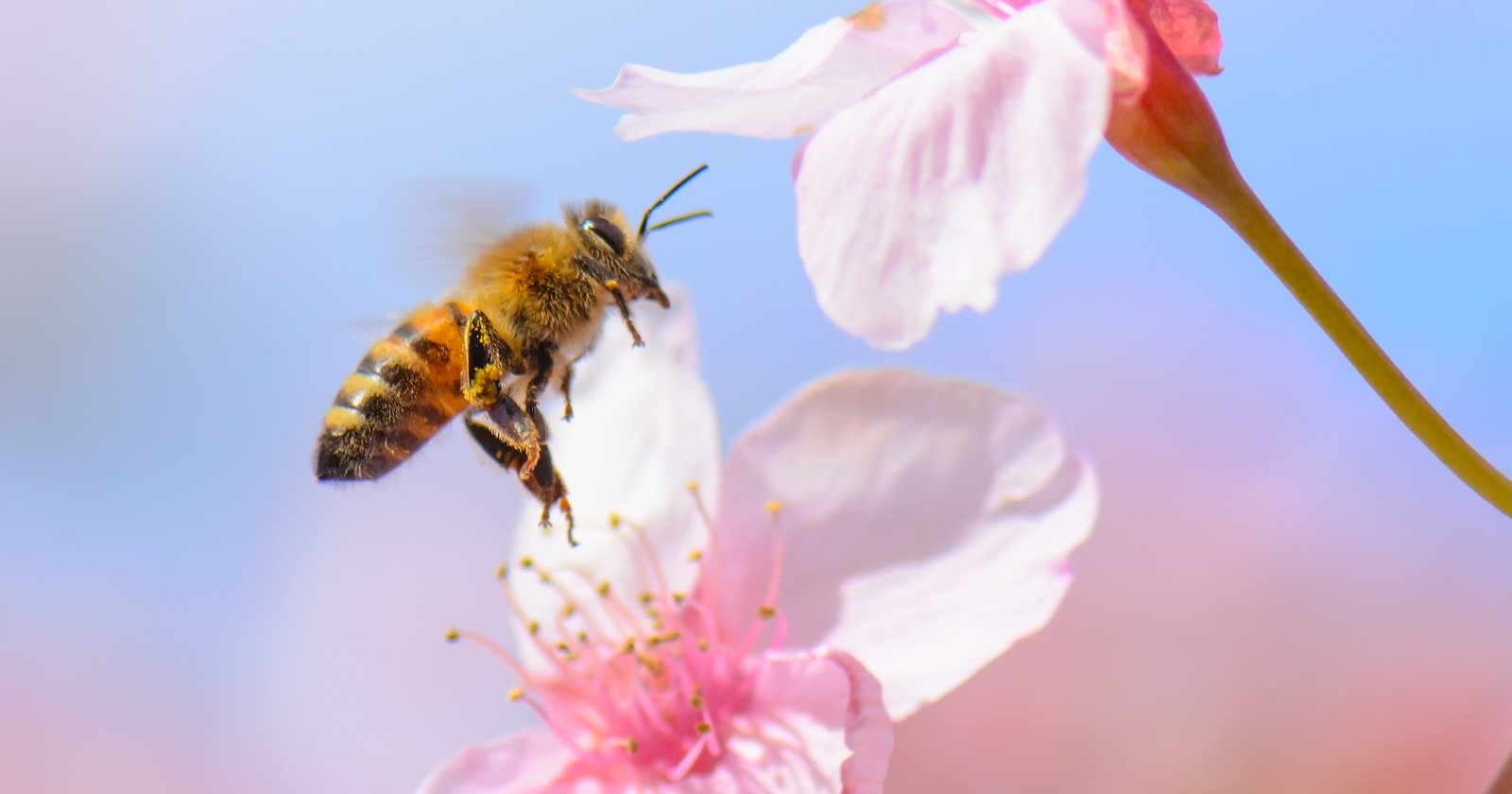
For the majority of bee research history, a single honey bee has been regarded as a minor component of a much larger system. Colonies consisting of tens of thousands of bees operate as superorganisms, with the colony rather than the individual being the significant unit of behavior. Individual bees are born, briefly engage in work, and ultimately die. Throughout a single foraging season, thousands come and go. Historically, the specific choices of any single bee were presumed to hold little significance, either due to their replaceability with any other worker or because substantial navigation was believed to be represented at the colony level via the waggle dance.
Researchers at the University of Freiburg have recently demonstrated that this perception is incorrect in a fascinating manner. Individual bees are not interchangeable. Once a bee learns a route, it flies its own distinct path—executing it with a precision that individual humans would find challenging to match.
## What the researchers actually did
The study, published in *Current Biology* in February 2026 and directed by neurobiologist Andrew Straw with lead author Rachael Stentiford, employed a method that had not been feasible in bee research before.
Traditionally, observing individual insects across a landscape has been difficult. Bees are small, fly rapidly, and do not remain stationary. Earlier research utilized harmonic radar—ground-based apparatus capable of tracking transponder-tagged bees at a limited range and with moderate resolution. The Straw group at Freiburg developed a novel technique named Fast Lock-On (FLO) Tracking, where a small multicopter drone equipped with an onboard computer monitors individual bees in real time. Each bee is attached with a tiny reflective marker—three millimeters wide and weighing 20 milligrams—affixed to its upper thorax. The drone’s camera detects the reflected light, and the onboard software aligns with the marker within milliseconds, following the bee wherever it moves.
The team conducted a controlled experiment in an agricultural environment. A beehive was positioned near a large tree at the edge of a hedgerow. A food source—an artificial flower feeder containing sugar water—was located 120 meters to the south, just beyond a cornfield. A large tree situated between the two points obstructed the direct route. Bees were required to navigate around it.
Twenty-five individual bees were monitored across 255 separate flights—92 outbound trips from the hive to the feeder and 163 inbound returns—over three weeks of field observations in July and August 2025.
## What they found
The bees had three primary routes at their disposal. They could fly around the western side of the tree through a gap in the hedgerow. They could fly east and cross over the hedgerow before circling back. Alternatively, they could take a broader loop east around the end of the hedgerow entirely.
They did not randomly distribute themselves among these options. Each bee, after establishing a route, consistently took that same route on subsequent flights, and did so with remarkable precision. Individual bees frequently flew within centimeters of the identical path taken on previous trips—the specific curves, altitude, and angle of approach to the feeder remained consistent.
Different bees favored distinct routes. Some consistently navigated around the tree to the west. Some crossed the hedgerow. Only one bee took the expansive loop east around the hedgerow. These preferences seemed to be individual rather than genetic; bees that emerged and learned the area together adopted different paths that they then repeated reliably.
The particular factor influencing precision was landmarks. When bees flew near distinctive features—the tree, the hedgerow, specific gaps in the vegetation—they adhered to their personal routes with almost geometric accuracy. In contrast, where the landscape became more uniform—the stretch of cornfield just before the feeder—the flight paths diversified, and different individuals converged on similar routes due to the absence of distinguishing features to guide their personal preferences.
## What this changes about the waggle dance
This discovery carries a specific and significant implication for the understanding of bee cognition.
The waggle dance—the distinctive figure-eight movement performed by honey bees inside the hive to convey the direction and distance of food sources—was deciphered by Karl von Frisch in the 1940s and remains one of the most esteemed breakthroughs in animal communication research. Von Frisch and subsequent researchers documented that the directional information present in the waggle dance is imprecise. For a food source approximately 100 meters away, the direction indicated in the dance can deviate by up to 30 degrees from the actual bearing.
For decades, the prevailing interpretation of this imprecision was that bees must possess similarly imprecise navigation. If the dance was ambiguous, the assumption was that the bees utilizing it must also be fuzzy navigators. Follower bees interpreting the dance would fly in the approximate direction indicated and then search when they reached near the destination.
Straw’s team has now demonstrated that this assumption was incorrect. Individual