**The Timeless Importance of Reaction Times in Cognitive Psychology**
For centuries, psychologists have delved into the intricacies of human cognition through the measurement of reaction times (RTs). With origins predating the formal establishment of psychology, RT evaluations have been crucial in comprehending how humans interpret information. Psychologists frequently examine the discrepancies in response times to various stimuli as a reflection of cognitive processing differences across different conditions.
One notable figure in this domain was Francis Galton, a contentious personality recognized for his contributions to eugenics and statistics. In the late 19th century, Galton gathered an extensive dataset of ‘simple reaction times’ involving 3,410 subjects. Unlike many modern psychologists, Galton’s main focus was on employing RTs to investigate individual differences, hypothesizing that variations in processing speed might correlate with intelligence levels.
Galton’s dataset now offers a distinctive chance to investigate generational alterations in cognitive abilities. Are individuals today faster or slower compared to Galton’s contemporaries from over a century ago? Galton’s theory posits that differences in reaction time could not only influence the results of a hypothetical quick-draw contest with a Victorian opponent but also provide insights into wider cognitive transformations through the ages.
RT data presents an intriguing contrast to the Flynn Effect, the well-recognized phenomenon of increasing IQ scores across generations. The Flynn Effect often astonishes those who instinctively view the younger generation as less capable—a perspective acknowledged since Ancient Greece. Additionally, it poses challenges for scholars speculating that intelligence should decrease as more intelligent individuals typically have fewer offspring.
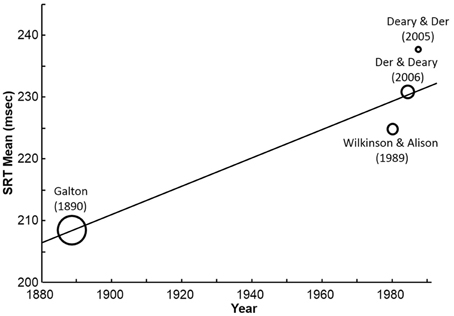
Despite the Flynn Effect indicating rising intelligence, RT data suggests that Victorian individuals may have exhibited faster reaction times. Research, such as that conducted by Silverman (2010) and Woodley et al. (2015), has contrasted Galton’s results with contemporary studies. Many of these inquiries endeavored to replicate Galton’s techniques, utilizing similar apparatus.
Silverman’s review of 14 studies from 1941 onwards indicated that modern participants exhibited longer RTs than those recorded by Galton—with one exceptional case. Moreover, Woodley et al. (2015) provided data suggesting a gradual deceleration of RTs over the decades, with one study even showing modern participants as roughly 10% slower.
These outcomes, though seemingly trivial—averaging only ~20 milliseconds over a century—are still significant within the context of RT. However, these findings need to be interpreted with care due to the scarcity of comparable historical data. The challenge persists in accurately identifying the reasons behind the slower modern RTs. Possible explanations include actual cognitive decline, heightened cognitive demands, motivational aspects, or shifts in experimental methodologies.
The discourse remains alive, prompting many to reflect on what these temporal variations in RTs genuinely indicate about our cognitive abilities across generations. While it raises pertinent questions regarding our cognitive path, confidence in present and future generations should not be hastily undermined.
**References:**
– Irwin, W. S. (2010). Simple reaction time: it is not what it used to be. *American Journal of Psychology*, 123(1), 39-50.
– Woodley, M. A., Te Nijenhuis, J., & Murphy, R. (2013). Were the Victorians cleverer than us? The decline in general intelligence estimated from a meta-analysis of the slowing of simple reaction time. *Intelligence*, 41(6), 843-850.
– Woodley, M. A, te Nijenhuis, J., & Murphy, R. (2015). The Victorians were still faster than us. Commentary: Factors influencing the latency of simple reaction time. *Frontiers in Human Neuroscience*, 9, 452.