In the typical discussions across Europe, only a select few scientists have names that resonate with the broader population—Copernicus, Galileo, Descartes, Newton, Darwin, Einstein, and Curie. Yet, the awareness often pertains only to vague notions surrounding their notoriety, clouded by clichés, myths, and tales. One individual from Ancient Greece who merits similar acknowledgment is Archimedes of Syracuse (c.287–c.212 BCE), famed as a mathematician, physicist, engineer, and astronomer. Authentic details of his life are scarce, with phrases such as ‘Eureka’, ‘Give me a place to stand…’, and ‘Do not disturb my circles’ prevailing. There are also myths regarding the weaponry he engineered for Syracuse’s defense against the Romans, heavily steeped in legend.
Archimedes is primarily recognized as a mathematician, especially for his connection to the method of exhaustion. This method is frequently credited to him despite its origins with Eudoxus, whom Archimedes acknowledges. Archimedes’ thorough application of the method of exhaustion reflected a more advanced mathematical approach, perhaps explaining the historical preference for him over Eudoxus. Starting in the sixteenth century, a revival of Archimedean concepts significantly influenced advancements in mathematics and science. Galileo, for example, sought to replace Aristotle with Archimedes in natural philosophy, revitalizing the method of exhaustion and shaping the development of calculus, in contrast to Eudoxus, whose contributions faded into obscurity.
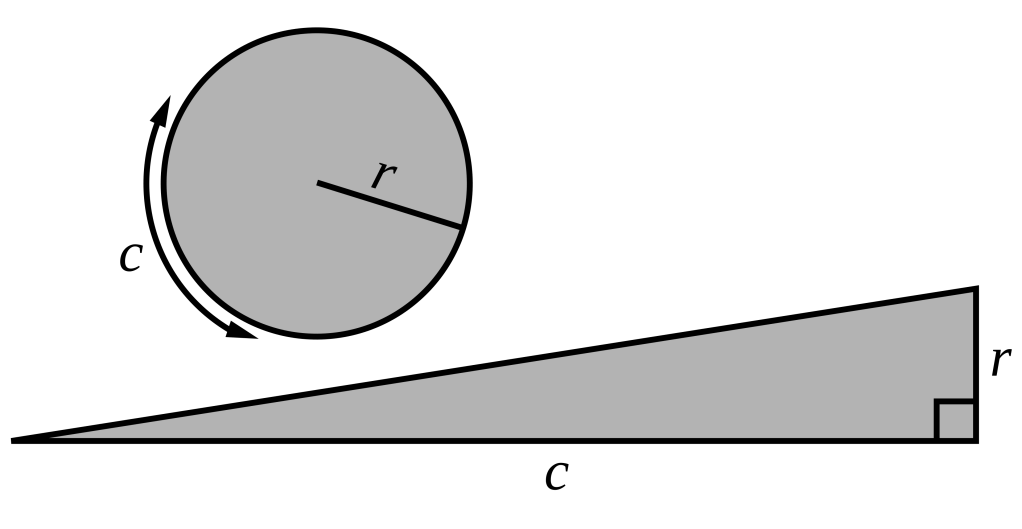
The most celebrated application of the method of exhaustion by Archimedes centered on finding the value of Pi through inscribed and circumscribed polygons, a technique he notably enhanced, achieving a highly accurate approximation of π. This endeavor is part of a broader work, “Measurement of a Circle,” which contains propositions validated through the method of exhaustion, particularly linking the area of a circle to a related right-angled triangle.
Archimedes also ventured into other domains, such as the “Quadrature of the Parabola,” showing that the area of a parabolic segment is 4/3 that of the inscribed triangle, obtained via a method involving infinite triangles—an early instance of summing geometric series. These results illustrated Archimedes’ creativity in advancing Greek geometric concepts through the method of exhaustion.
Moreover, Archimedes utilized the method to establish:
– The area of an ellipse in relation to its axes.
– Comparisons of the volume of a sphere, cone, and cylinder.
– The area defined by a spiral and a line.
One noteworthy document is Archimedes’ correspondence with Eratosthenes, “The Method of Mechanical Theorems,” detailing a “mechanical method” for deriving results before formal proof by exhaustion. Although regarded as a precursor to integral calculus, it lacked a proper limit concept; Archimedes perceived this method as a heuristic tool, rather than as a conclusive proof.
Regrettably, Archimedes’ groundbreaking thoughts on mechanics and geometry exerted minimal direct influence due to their late rediscovery in the early 20th century. Although his techniques foreshadowed concepts critical to calculus, their absence from contemporary discourse meant they did not have a direct bearing on calculus’ development.
Archimedes’ insights into tangents in spirals, while recognized as an early manifestation of differential reasoning, remained restricted to its context, highlighting his occasional yet profound contributions towards the foundational ideas of modern calculus.