**Scientific and Mathematical Instruments in the Early Modern Period**
The Early Modern Period in England saw a swift growth in the employment and accessibility of scientific and mathematical instruments. This increase was crucial in advancing the standard of mathematical education, especially for gentlemen of that time. Private mathematics instructors concentrated on imparting not the skill to use these instruments directly, but rather a comprehension that enabled their clients to engage intelligently with experts who did. This educational method allowed gentlemen to not only oversee estate calculations and bookkeeping but also to converse about navigational readings while commanding vessels.
Importantly, the tutors refrained from teaching the foundational mathematical theories, regarding thorough understanding of theory as inconsistent with the expectations of a gentleman. Instead, mechanical calculators, created by these tutors, became the preferred instruments, eliminating the necessity to learn basic arithmetic operations.
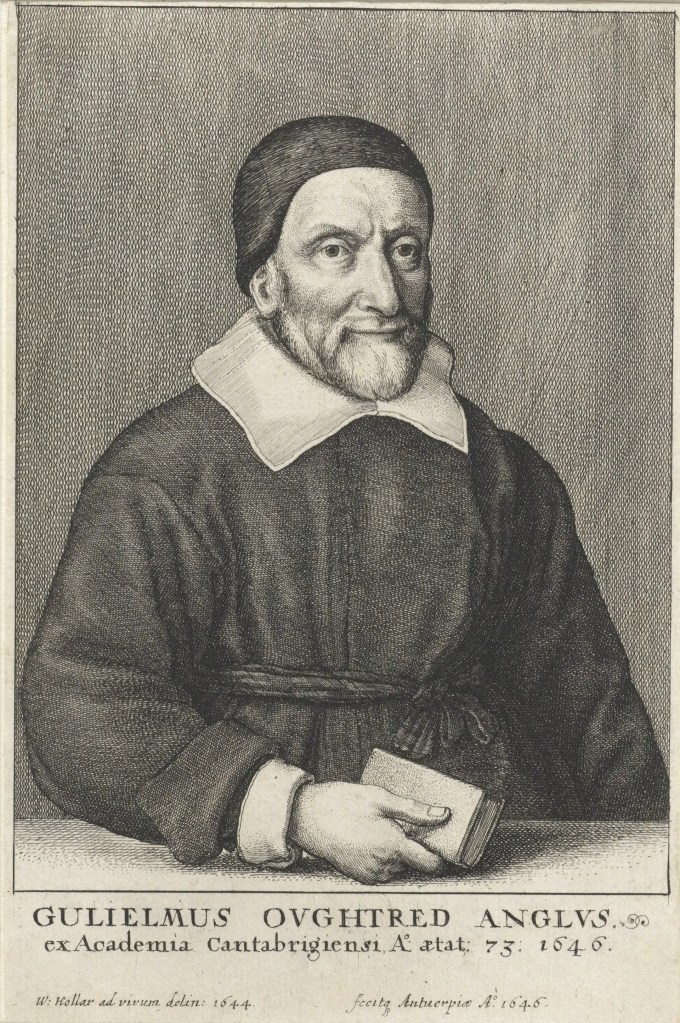
A prominent critic of this dominant educational practice was William Oughtred (1574–1660), a notable English mathematician and educator. Oughtred’s life path took him from a fervor for mathematics at Cambridge, where he independently designed instruments, to a position as a mathematics tutor for the sons of the earl. His efforts, especially the development of symbolic algebra and his impactful textbook *Clavis Mathematicae*, positioned him as a pivotal figure in the mathematics of the time.
Oughtred connected with influential individuals and contemporaries like Henry Briggs and Edmund Gunter, which spurred innovations in mathematical instruments. Oughtred’s rapport with designer Gunter and backing from Thomas Howard, Earl of Arundel, supported his exploration and creation of new technologies, including the renowned linear slide rule.
These technological breakthroughs, ranging from John Napier’s logarithms to Briggs’ table of common logarithms and Gunter’s scale, significantly improved the ease and speed of calculations. Particularly notable was Oughtred’s concept of aligning two Gunter Scales for calculations—an innovation that culminated in the linear slide rule.
The era was also characterized by disputes over invention priority, notably seen in tensions between Oughtred and contemporaries like Richard Delamain. Oughtred criticized those who allowed these instruments to overshadow essential theories, contending that mechanical skill should enhance rather than supplant theoretical insight.
Despite the disputes, the innovations of the time in scientific and mathematical instruments laid the foundation for contemporary engineering and navigation. The legacy of this dynamic period remains in the commitment to crafting and utilizing these tools, a testament to the significant influence of Early Modern innovators like Oughtred.