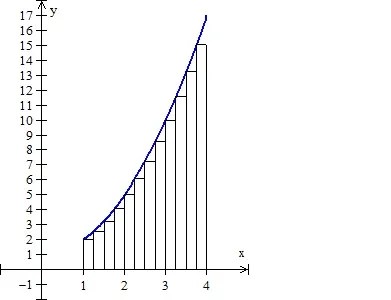
The notion of infinity is central to calculus, incorporating both the infinitely large and the infinitesimal. In the initial stages of calculus during the eighteenth century, it was predominantly known as infinitesimal calculus. When integral calculus was introduced during my educational years, it was presented via the method of calculating the area beneath a curve of a function on a Cartesian plane. This area, bounded by two x-coordinate values, is segmented into equal rectangles. The cumulative area of these rectangles along with the areas of the small triangles formed between the tops of the rectangles and the curve calculates the area under the curve. By infinitely narrowing the rectangles, the triangles vanish, leaving only the sum of the rectangles.
The ultimate phase, taking the summation to the limit, raises philosophical inquiries regarding the addition of non-existent areas. With each rectangle transforming into an infinitesimal point along the curve and an infinite array of points forming any line segment, the challenge is how to aggregate them. This philosophical conundrum will be addressed in subsequent sections, but first, let’s revisit fundamental calculus principles. The derivative is characterized as the instantaneous rate of change; it represents the change ratio of a dependent variable to an independent variable. Geometrically, for a specific point on a function’s graph, the derivative signifies the slope of the tangent at that point. It is computed by drawing a chord from the point, diminishing the chord’s length to zero, and taking the limit to ascertain the tangent’s slope. Conceptually, a derivative denotes the infinitesimal change ratio of the function’s output to its input.
Looking beyond the confines of the classroom, we examine how ancient civilizations understood infinity. Infinity surfaces in arithmetic with counting numbers such as one, two, three, etc. The development of counting systems reveals cultural exposure to potential infinity, as there is always a larger number achievable by adding one, initiating an infinite progression. On the other hand, any magnitude can theoretically be halved incessantly, suggesting the existence of infinitely small magnitudes. How did these early mathematical cultures confront infinity?
Early Babylonian mathematics provides no recorded evidence of engaging with the infinite, although undiscovered artifacts may reside on undeciphered clay tablets. The ancient Chinese notion of “wuji,” translating to limitless, emerges within cosmological frameworks. In mathematics, the concept of infinity materialized later. The ancient Egyptians embodied infinity with Heh, associated with the eternal chaotic waters preceding the world’s formation. However, their Papyrus Rhind addressed infinite series in a practical manner rather than a philosophical one.
It is not surprising that Ancient Indians thoroughly investigated infinity. Vedic texts reference “Ananta,” signifying endlessness—one of Vishnu’s innumerable titles. Categories of existence include “Ananta” (without beginning or end), “Nitya” (without beginning or end), “Anitya” (with both beginning and end), and “Anadi” (beginningless yet ending). According to Jain philosophy, the soul experiences infinite knowledge (Ananta-gyana), perception (Ananta-darshana), consciousness (Ananta-caritra), and bliss (Ananta-sukha). Jain mathematics (circa 4th-3rd century BCE) acknowledged various infinities: numerable, innumerable (finite yet unnamed), or infinite. They employed distinct computational techniques to manage these concepts.
In ancient Greece, infinity was initially a philosophical consideration, as seen with the Pre-Socratics. Anaximander referred to “apeiron,” meaning boundless, to express primordial realities. Its precise interpretation remains contested. Anaxagoras claimed matter possessed infinite divisibility, asserting that all matter stemmed from infinitely minuscule fragments. Nevertheless, his universe was finite and closed. The Atomists of the 5th century BCE envisioned infinite voids containing swirling infinite atoms that formed matter. Concurrently, Aristotle, the most significant Greek philosopher, acknowledged only potential infinity, firmly dismissing real infinity. He illustrated infinity’s paradoxes employing Zeno’s paradoxes, depicting the absurdities associated with real infinity.
Zeno’s most renowned paradox, “Achilles and the Tortoise,” pertains to a race where the slower tortoise perpetually retains a lead because Achilles must always reach the tortoise’s former position as it advances. Here, infinity’s significance in calculus emerges, much later in development.
Aristotle pointed out four additional paradoxes associated with infinity. In “The Elements,” Euclid refrained from asserting real infinity; rather, his notable proof simply indicated that no largest prime number could exist. He argued reductively: assume a greatest prime number P; construct a new number N defined as N = (product of all primes up to P) + 1. Since no prime divides it evenly, it must either be prime or divisible by a prime larger than P, contradicting the initial premise.
Infinity enters arithmetic with the advent of irrational numbers, with narratives recounting the revelation of such numbers challenging the Pythagorean conviction in a universe governed solely by natural numbers. The earliest identified irrational number was likely √2, emerging within a square’s diagonal. Alternatively, the square root of 5, discovered within a Pythagorean pentagram, could have been