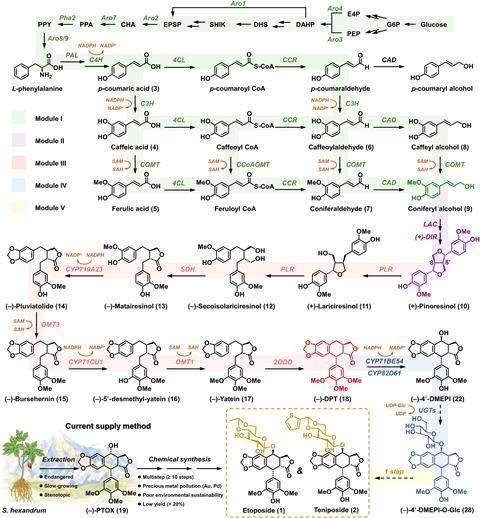
Modified baker’s yeast, Saccharomyces cerevisiae, has been developed by scientists in China to generate a precursor compound for the cancer drugs etoposide and teniposide. By reconstructing a complicated 45-enzyme biosynthetic pathway within yeast, scientists have paved the way for microbial synthesis of crucial precursors, potentially providing a more efficient production method compared to existing synthetic processes. Etoposide and teniposide are used to treat leukaemia along with specific lung and brain tumors, depending on podophyllotoxin obtained from an endangered Himalayan plant, which requires years to gather and has low synthetic yields. Under the guidance of Yating Hu and Luqi Huang at Capital Medical University, the team executed more than 60 genetic modifications and inserted 45 genes into yeast, enabling the precursor to be produced from glucose in a three-day fermentation. This process eliminated intricate chemical steps and resulted in etoposide at a yield of 89% and teniposide at 65%. Despite this advancement, industrial production faces challenges due to low precursor concentrations, yet the research lays the groundwork for additional engineering solutions.