The key aspect of iceberg A-84 is not merely its size. Its departure revealed a temporary passage to an area of Antarctic seafloor that had been hidden beneath a floating ice shelf and unreachable by any prior research expedition.
A-84 calved from the southern section of the George VI Ice Shelf on January 13, 2025. The Schmidt Ocean Institute reported its area as approximately 510 square kilometres, or 209 square miles, while NASA estimated it at about 30 kilometres long and 17 kilometres wide. Both organizations likened its footprint to that of Chicago.
Researchers on board the research vessel Falkor (too) were already conducting work in the Bellingshausen Sea. They adjusted their expedition plans and arrived at the newly uncovered area on January 25, twelve days post-calving. The timing proved fortunate, but the account requires careful consideration. This was an expedition report, not a finalized peer-reviewed species inventory, and the ages of the animals were inferred instead of directly measured.
The iceberg shifted, yet the ecosystem was already present
The calving process did not instantaneously generate life on the seabed. It merely removed the ice above, allowing a ship and a remotely operated vehicle the opportunity to approach. According to the expedition release from the Schmidt Ocean Institute, the team became the first to examine that specific zone after the ice shifted.
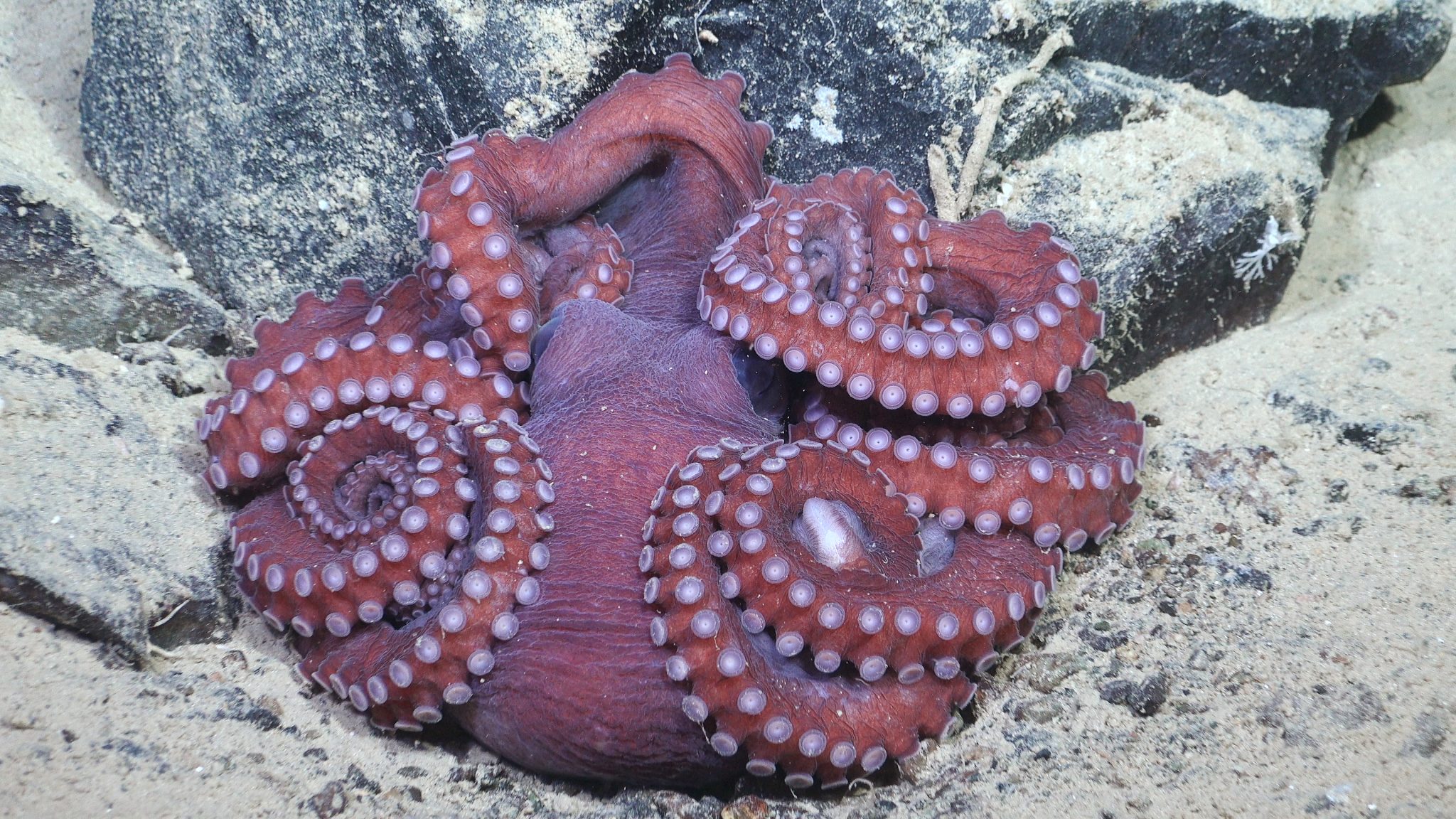
ROV SuBastian explored the seafloor for eight days at depths reaching 1,300 metres. Its cameras captured images of large corals and sponges hosting various mobile creatures, including octopuses, icefish, and giant sea spiders. The vehicle was capable of covering extensive areas, filming in high resolution, and collecting biological and geological samples for analysis following the cruise.
Thus, “found” is an observational statement. Researchers encountered and documented an established community that had been previously inaccessible to direct examination. The animals had not lingered for centuries within the calved iceberg, nor were they freed from the ice. They resided on the seafloor beneath the floating shelf from which A-84 calved.
“The size of Chicago” pertains to area, not thickness
NASA monitored A-84 as seasonal sea ice thawed and coastal currents carried it away. An analysis by the NASA Earth Observatory reported that the iceberg traveled roughly 250 kilometres between mid-January and mid-February 2025. Its rapid departure made the newly revealed water accessible while an adequate research vessel happened to be in the vicinity.
The iceberg originated from the George VI Ice Shelf, a floating extension of Antarctic land ice situated between the Antarctic Peninsula and Alexander Island. An ice shelf remains attached to the land-based ice system; an iceberg is a section that has calved and commenced drifting. The 510-square-kilometre comparison pertains to surface area. It does not imply that the iceberg resembled Chicago’s shape, and city-area comparisons can differ based on the municipal boundary considered.
Calving represents a typical method for an ice shelf to lose mass. NASA also observes that rising air and ocean temperatures, along with diminished protective sea ice, can expedite calving or contribute to collapse. A-84 on its own does not constitute a controlled climate experiment. Its scientific significance arose from the sudden access it afforded and from the measurements the expedition was able to conduct at the juncture between ice, ocean, and seafloor.
A community constructed by animals
The seafloor was not blanketed with plants. Large sponges and corals are classified as animals, yet their upright forms contribute a three-dimensional structure similar to trees on land. Anemones, worms, brittle stars, and other organisms can inhabit the surfaces and spaces surrounding them. Mobile predators and scavengers navigate through that structure.
This helps clarify why the visuals appeared richer than a solitary octopus or fish traversing bare sediment. Habitat-forming animals offer attachment points, feeding surfaces, shelter, and alterations in local water flow. A sponge or coral can serve as physical infrastructure for numerous smaller lives that are easily overlooked in a broad camera perspective.
“Thriving” in the expedition announcement referred to the biomass, diversity, and physical scale of the observed community. It was not a formal demographic result indicating that every population was increasing. The team suspected that several organisms might belong to undescribed species, but specimen analysis and taxonomic comparison were still ongoing.
The age assertion is based on slow growth
Expedition co-chief scientist Patricia Esquete remarked that the size of the animals suggested that the communities had persisted for decades, possibly hundreds of years. The Schmidt Ocean Institute indicated that sponges can grow exceedingly slowly, sometimes by less than two centimetres annually. A large specimen at nearly 230 metres depth was a contributing factor to the site not appearing newly colonized.
This forms the basis for the careful choice of the term “potentially” in the headline. The expedition release did not provide a direct age for each sponge, coral, octopus, or sea spider. Growth rates differ by species, food availability, temperature, and body form. Some organisms can endure extended periods with very low growth rates.
A large, slowly growing sponge may indicate that suitable habitat has existed for a considerable duration. It does not conclusively证明 that