**Curiosity’s Unveiling of Honeycomb Structures on Mars**
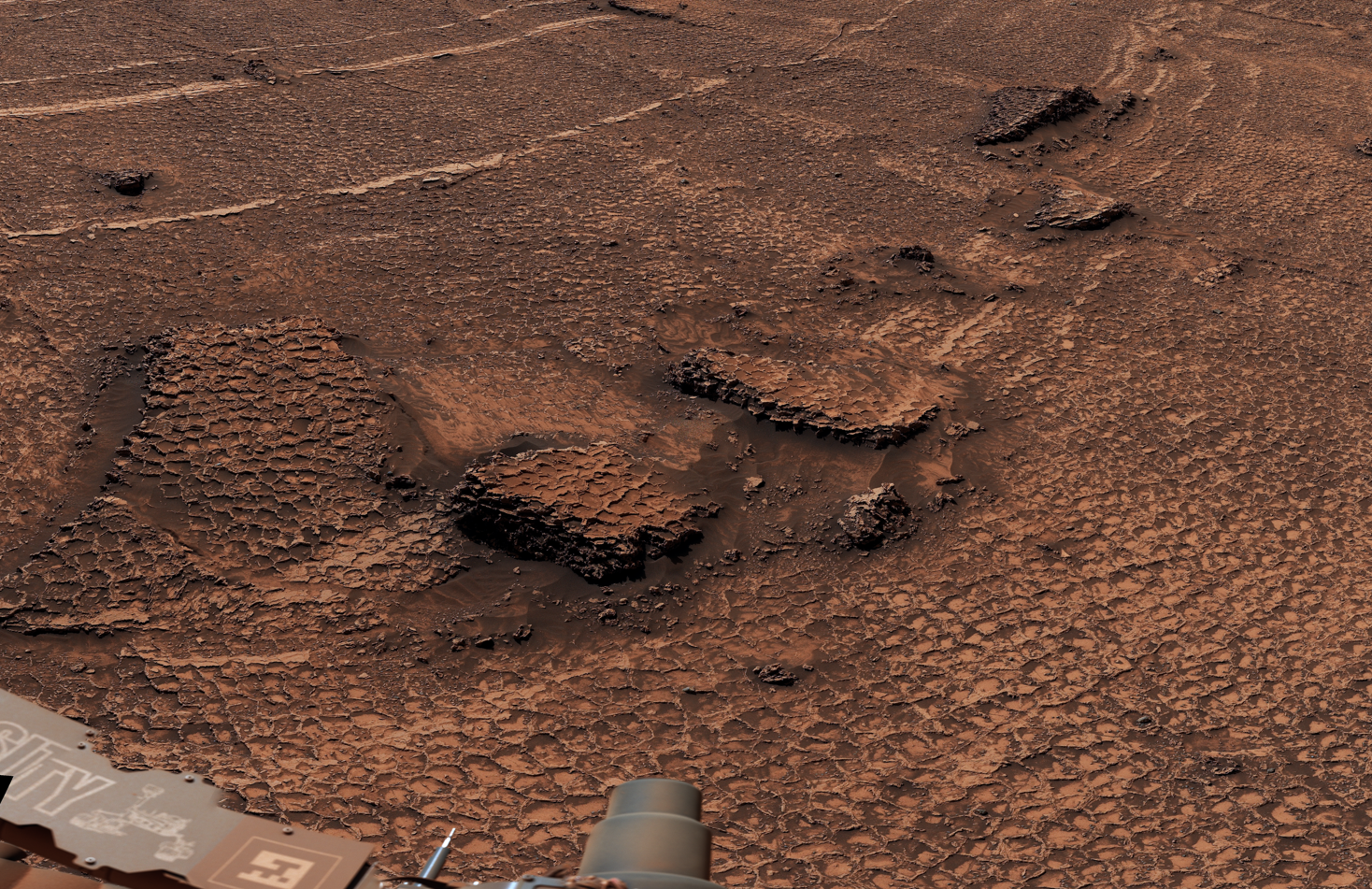
In June 2026, as Curiosity neared the fourteenth anniversary of its landing on Mars, the rover captured stunning images of an extensive area exhibiting honeycomb-like fractures across the Valle Grande landscape. In contrast to the smaller polygonal formations previously documented, this large region displayed distinct polygons measuring between 4 to 8 centimeters in size, encompassing the terrain and a nearby mound referred to as Miraflores.
A panorama compiled from 340 images collected by Curiosity’s Mastcam on its 4,930th and 4,931st Martian days (June 19 and 20, 2026) showcased this surprising geological feature. Although color-corrected to simulate human vision under Earth’s lighting conditions, the panorama provides a valuable glimpse into Martian geology.
William Farrand, a researcher involved in the mission, highlighted notable differences within this area, uncovering more eroded ridges further into the unit. The observations are intended to examine both the polygon ridges and centers to gain a more profound understanding of their origins. NASA posits several potential formation mechanisms, including drying wet materials, fluctuations in temperature, or compression due to burial processes.
Comparative investigations, such as the Zhurong rover’s radar study of buried polygons in Utopia Planitia, underscore the necessity of surrounding context and additional data for comprehending formation processes.
Earlier in-situ investigations by Curiosity, such as identifying mud cracks and sulfate enrichment, suggest environmental conditions alternating between wet and dry phases. Nonetheless, drawing conclusions from prior studies to the Valle Grande site necessitates thorough examination.
After almost fourteen years on Mars, Curiosity’s expedition continues to unveil the planet’s enigmas. While it is ready to enhance our comprehension of these captivating patterns in Valle Grande, the transition from initial observation to conclusive geological interpretation is vital in reconstructing Mars’ ancient narrative.