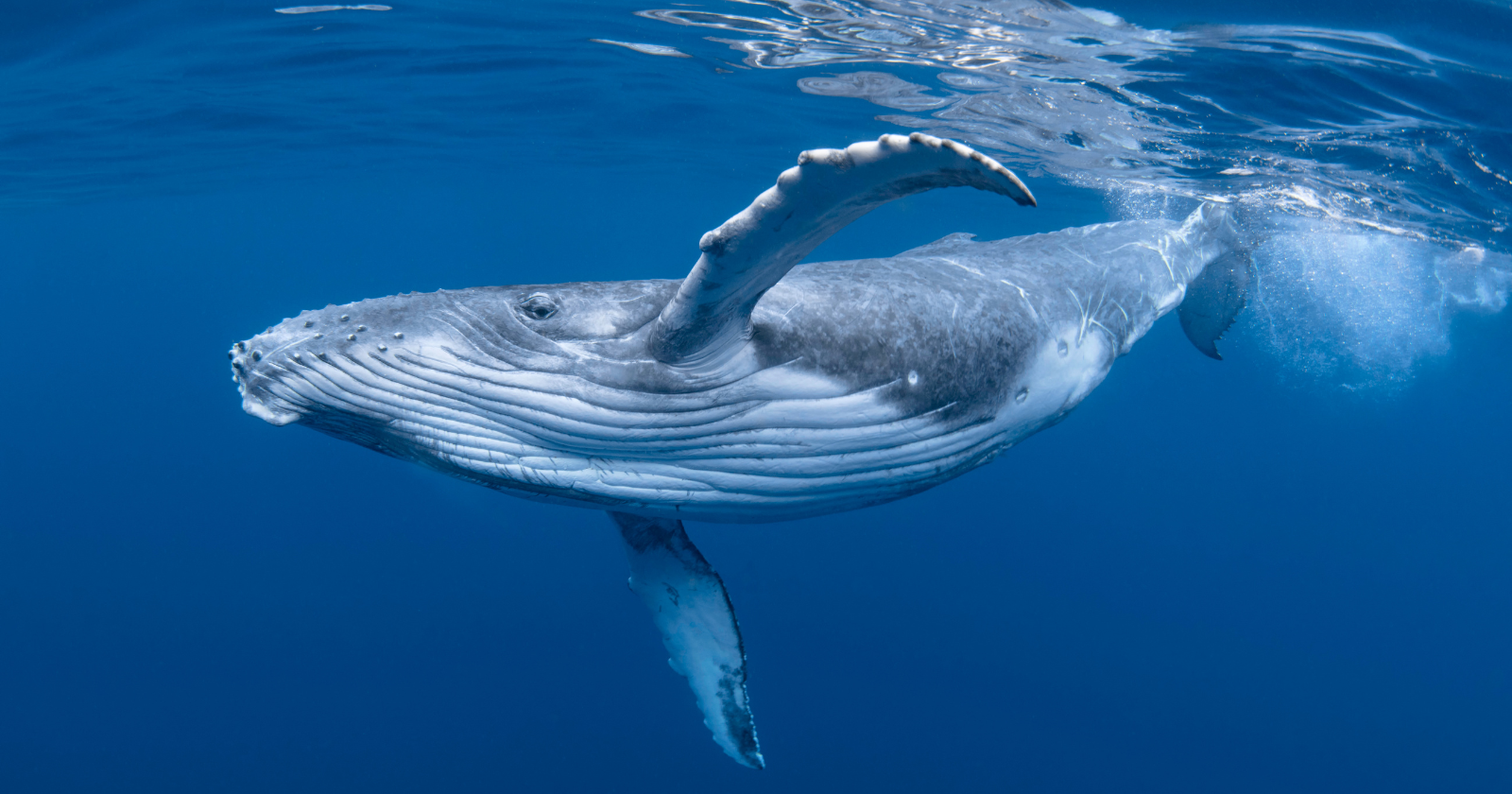
Sixteen hours of continuous singing would damage a human throat, diaphragm, and likely affect a human marriage. A male humpback whale in the warm waters off Maui, however, regards this as a routine endeavor.
This stamina is detailed in [a study published in Current Biology](https://www.cell.com/current-biology/abstract/S0960-9822(26)00879-1) by Julia Zeh, a former doctoral researcher at Syracuse University, along with her co-authors. However, what has captivated bioacousticians is something smaller and more peculiar than endurance. The song is intricately linked to the dive, phase by phase.
### What a tablet-sized barnacle heard
From 2018 to 2024, the researchers attached suction-cup recording tags, each about the size of a tablet, to the backs of 16 male humpbacks in their breeding areas off Maui. According to [Syracuse University](https://artsandsciences.syracuse.edu/biology/news/how-a-whales-dive-shapes-its-song/), the tags were applied from small boats using long poles and, in subsequent seasons, drones. They captured sound and body movement simultaneously, then lost suction, floated to the surface, and awaited retrieval.
Capturing both simultaneously is crucial. Most research on whale song has used hydrophones listening from afar, providing clear sound data but almost no information about the animal’s body movements while singing.
### Descent, bottom, ascent
A singing humpback’s dive has a defined shape. It goes down, maintains a long, steady stretch at depth, ascends, and then surfaces for a breath.
The song has a structure too. Short sounds known as units come together to form phrases, repeated phrases create a theme, and themed sequences form a song.
Zeh and her team discovered that these two shapes interlock, as shown in the project’s [public data archive](https://data.mendeley.com/datasets/yg9yfxg3bc/1). Specific themes were consistently observed on descent, others on ascent, and an assorted mix while the whale glided at the bottom of the dive. Generally, one dive corresponds to one song.
Themes for descent and ascent remained constant across whales and years, hinting that factors beyond personal choice guide their selection.
### The lazy part of the dive is the showy part
Why, then, does the deepest, calmest section exhibit the most variety?
The explanation proposed in the paper involves a division of labor. Sinking and rising are physically demanding, requiring oxygen management and buoyancy control, thus it is likely these themes are dictated by the whale’s physical state rather than personal preference. At a steady depth, coasting, a male has the opportunity to move. Zeh has theorized that males may push their vocal limits at their lowest points to stand out in a dense breeding environment, as noted by [Oceanographic Magazine](https://oceanographicmagazine.com/news/humpback-whales-sing-most-complex-songs-at-deepest-points-of-dives/).
This remains a hypothesis regarding sexual selection rather than evidence of one. No one has yet demonstrated a female selecting a mate based on his improvisations during the bottom phase.
### Sixteen whales, one island chain
Sixteen whales is a commendable count for tagging but modest for other studies. Zeh clearly states that it remains uncertain whether the same patterns apply to humpbacks in different regions, as mentioned in [coverage by Phys.org](https://phys.org/news/2026-08-humpback-whales-song-themes-phases.html).
There is valid reason to be cautious. Humpback song is subject to change, and such trends can be regional. Michael Noad and colleagues reported in [Nature](https://www.nature.com/articles/35046199) that the east Australian population’s song was entirely replaced by that of the west coast population after a few foreign singers emerged. Ellen Garland’s team later tracked these song changes moving eastward across the South Pacific, from Tonga to French Polynesia and on to Ecuador, as documented in [Royal Society Open Science](https://royalsocietypublishing.org/rsos/article/9/8/220158/96907/Humpback-whale-song-revolutions-continue-to-spread).
Oxygen and buoyancy operate consistently across oceans, but the melodies do not.
### A narrow band, badly crowded
The same low-frequency capability that enables humpback songs to travel vast distances also comes with limitations. Coen Elemans and Tecumseh Fitch, vocal scientists from Denmark and Austria, discovered that baleen whales utilize laryngeal structures unique to them, where air passed over a substantial fatty cushion produces low-frequency vibrations. In a publication in Nature, they illustrated that these structures also [impose strict physiological limits on frequency and depth](https://www.nature.com/articles/s41586-024-070).