We have been investigating the historical progression of the method of exhaustion in Ancient Greece and China. This method shares characteristics with integral calculus, although notable distinctions exist. The method of exhaustion was geometrical, whereas calculus is arithmetical and algebraic. The Greeks faced challenges with incommensurable numbers and depended on magnitudes, while calculus employs a base ten place-value system with real numbers, encompassing complex numbers.
During the time of Eudoxus and Archimedes, algebra and the decimal system were nonexistent. Euclid’s “Elements” illustrates geometric algebra. Quadratic equations are referred to as second-degree equations, and cubics as third-degree equations because a magnitude squared denotes a square’s area and cubed indicates its volume.
We then examine the rise of the decimal system and algebra, along with their incorporation into European mathematics. The decimal system developed in Northern India. The Babylonians utilized a base sixty system without zero, a crucial element that was established in India.
Āryabhaṭa introduced a decimal system devoid of zero, relying on number words. Brahmagupta subsequently completed the system with the inclusion of zero, negative numbers, and symbols. His “Brāhmasphuṭasiddhānta” presented comprehensive arithmetic operations, which continue to be taught today, despite his erroneous division by zero rule.
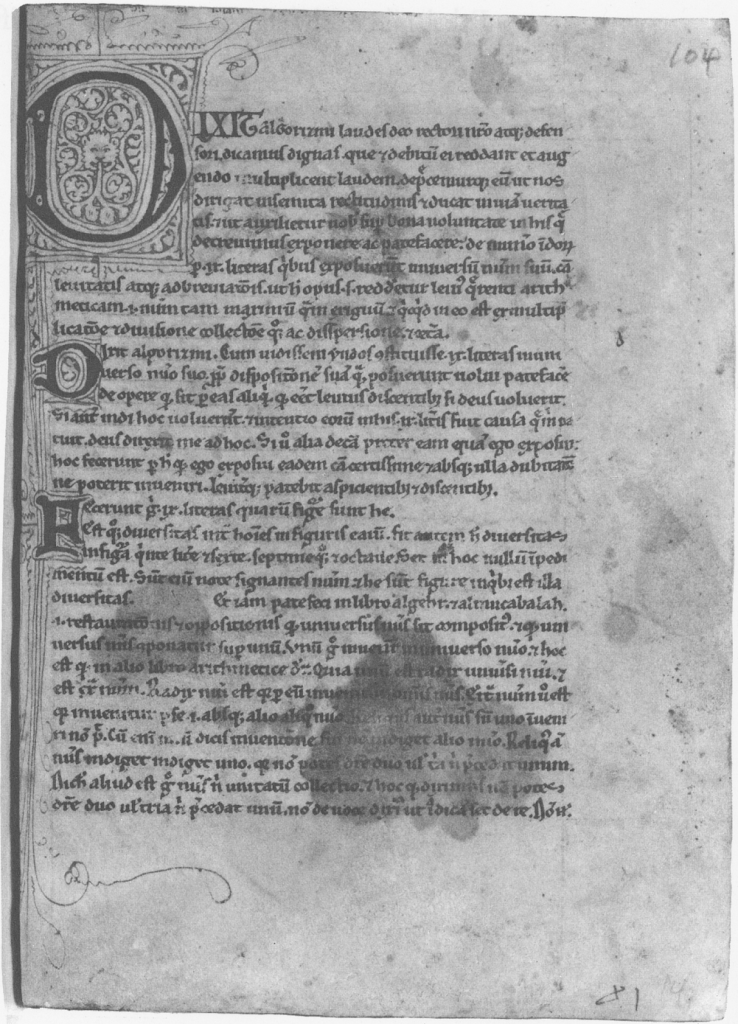
The “Brāhmasphuṭasiddhānta” was translated into Arabic around 770. Al-Khwārizmī described this system, leading to the Latin “Algoritmi de Numero Indorum” in the 12th century. The translation, found in manuscripts like “Dixit Algorizmi,” facilitated the adoption of Hindu-Arabic numerals. Al-Khwārizmī’s algebraic work, “al-Kitāb al-Mukhtaṣar fī Ḥisāb al-Jabr wal-Muqābalah,” the first textbook on algebra, was significant. Its Latin translation impacted European mathematics.
In Arabic cultures, the decimal system was primarily used for commerce rather than astronomy. Leonardo Pisano, known as Fibonacci, learned about it in Bugia, Algeria. His “Liber Abbaci” popularized it throughout Europe. Although its initial adoption was slow, it gained momentum with double-entry bookkeeping in Italy during the commercial revolution, prominently featuring in Pacioli’s “Summa de arithmetica, geometria, proportioni et proportionalita.”
Abbacus schools propagated practical arithmetic, diverging from the formal Latin mathematics practiced in universities. They instructed in vernacular languages and served trades beyond commerce. The dissemination began in Italy, extending to Spain, France, and Germany by 1500, before reaching the Netherlands and Poland.
Even university instructors, such as Peter Apian, wrote practical arithmetic textbooks. Homogeneous practical and formal mathematics began to merge during the 16th century. Symbolic algebra developed, replacing rhetorical techniques. German practitioners like Johannes Widmann introduced symbols, including the plus and minus signs.
Algebra transitioned into formal mathematics, initiated by Pacioli’s “Summa.” German cossists like Christoph Rudolff advanced this with symbols like √. Stiffel’s “Aritmetica integra” expanded the symbolic array, despite algebra’s gradual symbolic transition.
The German coss influenced Robert Recorde, who brought it to England, introducing the equals sign in “The Whetstone of Witte.” Simon Stevin did similarly in the Netherlands. The contributions of Cardano and Bombelli extended to complex numbers and contemporary algebra.
Cardano’s writings, along with Bombelli’s algebra, shifted algebra toward formal mathematics. Viète’s “In artem analyticem isagoge” is frequently acknowledged as the first instance of symbolic algebra, despite earlier works laying the foundation.
Despite the resistance from new science advocates like Kepler and Galileo towards algebra, Jesuit Christoph Clavius embraced it, creating a textbook based on Viète’s analysis, which was utilized in Jesuit education.
Over ten centuries, from Brahmagupta’s numbers to Viète’s analysis, algebra transitioned from practical to formal mathematics, establishing an analytical method that paralleled Euclidean geometry.