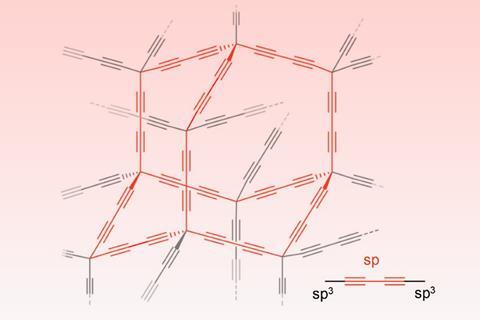
Porous diamond represents the newest addition to the expanding catalog of carbon allotropes. This new configuration, referred to as diamondiyne, broadens the rigid 3D lattice of diamond by integrating alternating single and triple bonds at the junctions and stands as the only other carbon variety capable of covalent bonding in three dimensions. The peculiar combination of sp and sp^3 carbon centers may give rise to distinct optical and electronic characteristics, the full spectrum of which remains to be investigated, the authors note.
Carbon allotropes have long intrigued chemists. Once confined to diamond and graphite, a surge of discoveries in the past five decades has rekindled interest in these alternative structural forms, leading theorists to predict 1635 unique carbon allotropes. Although diamondiyne was initially proposed in 1991, assembling the reactive monomer unit into an organised crystal structure proved challenging, resulting in its synthesis remaining elusive. Nonetheless, utilizing methods from the construction of covalent organic frameworks, Karl Bӧrjesson and his team at the University of Gothenburg in Sweden have managed to harness reaction kinetics to meticulously regulate the assembly process, successfully yielding this elusive allotrope for the first time.
The fundamental unit of diamondiyne is tetraethynylmethane – an sp^3 carbon center linked to four alkyne groups. Each sp^3 center is consequently separated by an alternating pattern of single and triple bonds, preserving the highly ordered symmetry of diamond while significantly enlarging the crystal lattice’s footprint. If left ungoverned, the monomer’s triple bonds tend to cluster into an amorphous mass; therefore, Bӧrjesson’s team localized the essential coupling step at a liquid–liquid boundary, retarding the reaction to a feasible molecule-by-molecule assembly process.
Initially, they dissolved a stable silyl-protected variant of the monomer in chloroform, subsequently adding a copper fluoride catalyst to an upper aqueous phase. At the interface of these two layers, the fluoride deprotected the silyl group, unveiling the active tetraethynylmethane monomer, while the copper facilitated the vital coupling reaction to create the essential diyne bond. This sequence establishes a kinetic preference for adherence to the membrane, imposing order on the way it assembles, explains Bӧrjesson. Simulations also indicated a considerable energy cost for defect creation, further steering the reaction toward the ordered diamondiyne format.
Up to this point, the team has successfully produced films spanning approximately 5cm^2, and they are just starting to investigate the properties of this novel material. “We understand that it’s porous, we anticipate that the surface area is quite large, and we could speculate that the optical band gaps are likely substantial due to the presence of an sp^3 carbon node in the system,” states Bӧrjesson. “However, further production of more and higher quality material is essential to clarify these promising attributes,” he adds.
These initial observations, particularly the merger of 3D structure and mixed hybridization within a stable film, have drawn the attention of other researchers within the carbon structures field. “This is an impressive study that broadens the spectrum of carbon allotropes,” remarks Wei Xu, a nanostructures chemist at Tongji University in China. “Though its anticipated characteristics suggest potential avenues for advanced carbon-based materials, additional experimental inquiries will be imperative to ascertain its intrinsic properties and practical applications, and future efforts should concentrate on enhancing the scalability and controllability of diamondiyne synthesis.”