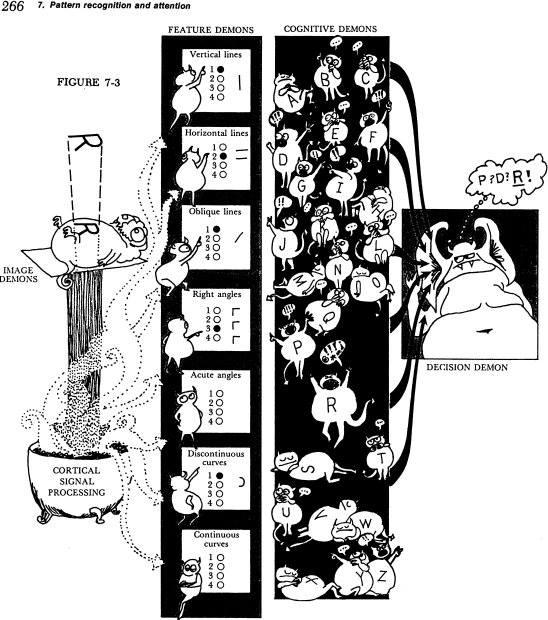
Oliver Selfridge was a significant presence in the formative years of artificial intelligence. In 1959, he introduced the Pandemonium architecture, a revolutionary idea in AI. This framework consisted of a network of simple units, or “demons,” each designed for a specific role, which work together to perform complex cognitive functions. This architecture had a profound impact on the evolution of neural networks, which have become integral to contemporary machine learning.
The Pandemonium model received acclaim partly due to the whimsical artwork by Leanne Hinton, showcased in Lindsey & Norman’s 1977 textbook ‘Human Information Processing’. These illustrations, although reminiscent of a child’s nightmare to some, possess a charming quality that encapsulates the playful yet complex essence of the idea.
In addition to his AI contributions, Oliver Selfridge wrote four children’s books and was involved in revealing the National Security Agency’s ECHELON surveillance program. Despite the fame of the Pandemonium model and its illustrations, the artist Leanne Hinton often remains unacknowledged. Attempts to confirm her as the illustrator yielded inconclusive results, underscoring a lack of historical acknowledgment for contributions to AI and its promotion.