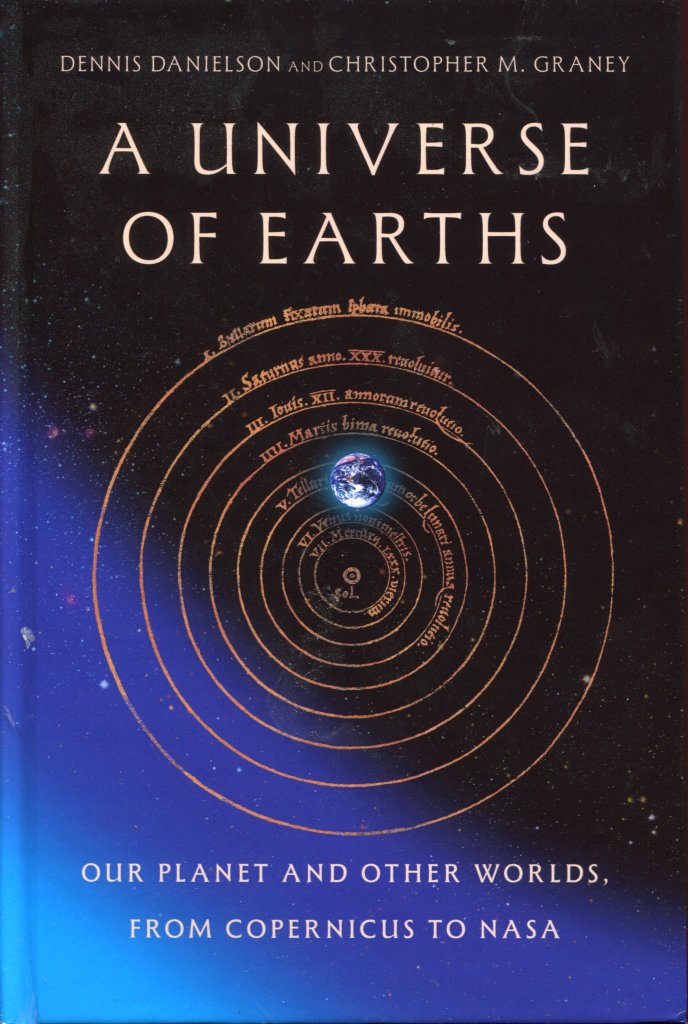
Dennis Danielson and Christopher Graney have collaborated to produce an engaging book entitled “A Universe of Earths: Our Planet and Other Worlds, From Copernicus to NASA.” Renowned for their individual contributions to the field of astronomy history, the authors combine their knowledge in this succinct 185-page work. Although brief, the book provides an in-depth investigation into humanity’s intrigue with extraterrestrial existence, tracing its origins to the release of Copernicus’ “De revolutionibus” in 1543.
The authors dispel the misconception that Copernicus sidelined Earth by shifting it from the center of the universe. Rather, they contend that Copernicus raised Earth from its humble Aristotelian status, igniting curiosity about life on other planets. The book profiles notable individuals such as Rheticus and Galileo, addressing valid challenges to the heliocentric theory—a focus of Graney’s scholarship.
Danielson and Graney lead readers through this historical narrative, scrutinizing scientific theories regarding alien life. They delve into the “big numbers” hypothesis, positing that the enormity of the universe suggests the potential for intelligent life elsewhere. In contrast, they introduce the counterargument, where refined search techniques and lack of discoveries point to the possibility of Earth’s singularity.
Each chapter is meticulously detailed, supported by thorough research and presented in an engaging manner. The book features footnotes, a bibliography, an effective index, and is well-illustrated. However, the authors overlook citing Michael Mästlin’s studies on earthshine and Thomas Digges’ early interpretation of Olber’s paradox.
In summary, “A Universe of Earths” is a captivating and approachable academic work, suitable for a wide range of readers interested in astronomy, the evolution of science, or alien life. It is highly recommended as a thoughtful gift for aficionados in these disciplines.