Title: Enhancing Skeletal Editing: A Novel Technique for Integrating Nitrogen Into Aromatic Rings
For a long time, chemists have been in pursuit of efficient techniques to substitute aromatic carbon atoms with nitrogen, owing to the existence of nitrogen-rich rings in numerous pharmaceuticals and natural compounds. Realizing this transformation has proven to be difficult, particularly with compounds sensitive to reactions, as the generally inert nature of radical intermediates and the extreme conditions of current methods pose significant challenges. Nonetheless, recent developments have unveiled a promising alternative that operates under gentler conditions, heralding notable advancements in the skeletal editing arsenal.
The conventional method for introducing nitrogen into an aromatic ring entails exposing an aromatic azide to ultraviolet light, resulting in the formation of a singlet nitrene. This intermediate has the potential to undergo ring expansion to incorporate nitrogen, followed by oxidation to restore the ring to its original size. Regrettably, the singlet nitrene frequently transitions to a triplet state too swiftly, obstructing ring expansion and yielding low outputs. Additionally, these techniques are excessively oxidizing, which restricts their application for delicate natural products.
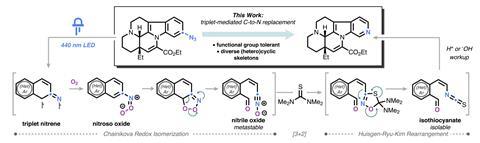
In a groundbreaking breakthrough, a research team led by Mark Levin at the University of Chicago has embraced a distinct strategy that utilizes the triplet radical intermediate. Rather than evading the triplet state, the team has capitalized on it to incorporate nitrogen atoms into aromatic bicyclic rings. This process involves generating the triplet radical from an azide-containing substance and reacting it with oxygen to create a nitroso oxide anion. Following this, intramolecular reactions occur, resulting in a metastable nitrile oxide. A subsequent cycloaddition with a thiourea compound produces an isothiocyanate, which can reform the ring with an inserted nitrogen atom upon interaction with an acid or base.
Central to this progress is the employment of molecular oxygen as the most reactive element, yielding a milder methodology compared to earlier approaches. This innovative technique is applicable to a range of bicyclic rings, including indoles, indazoles, and naphthalenes. The efficacy of this method was illustrated by the incorporation of a nitrogen atom into the alkaloid vinpocetine, markedly improving its solubility and clearance while requiring fewer synthetic steps than previously needed.
Despite its benefits, the addition of the necessary azide group for the reaction can pose challenges during late-stage synthesis. Investigating alternative approaches, such as employing sulfilimine instead of azide groups, is underway to enhance safety and scalability, suggesting the opportunity for further refinement of this sophisticated method.
This breakthrough in skeletal editing marks a substantial advancement, equipping chemists with the ability to explore variations in molecular attributes more efficiently during drug development. By facilitating precise atomic-level modifications, this technique not only accelerates synthesis but also conserves resources and lays the groundwork for studying the influence of regioisomers. This development stands as a testament to the power of chemistry in enhancing pharmaceutical and natural product synthesis.