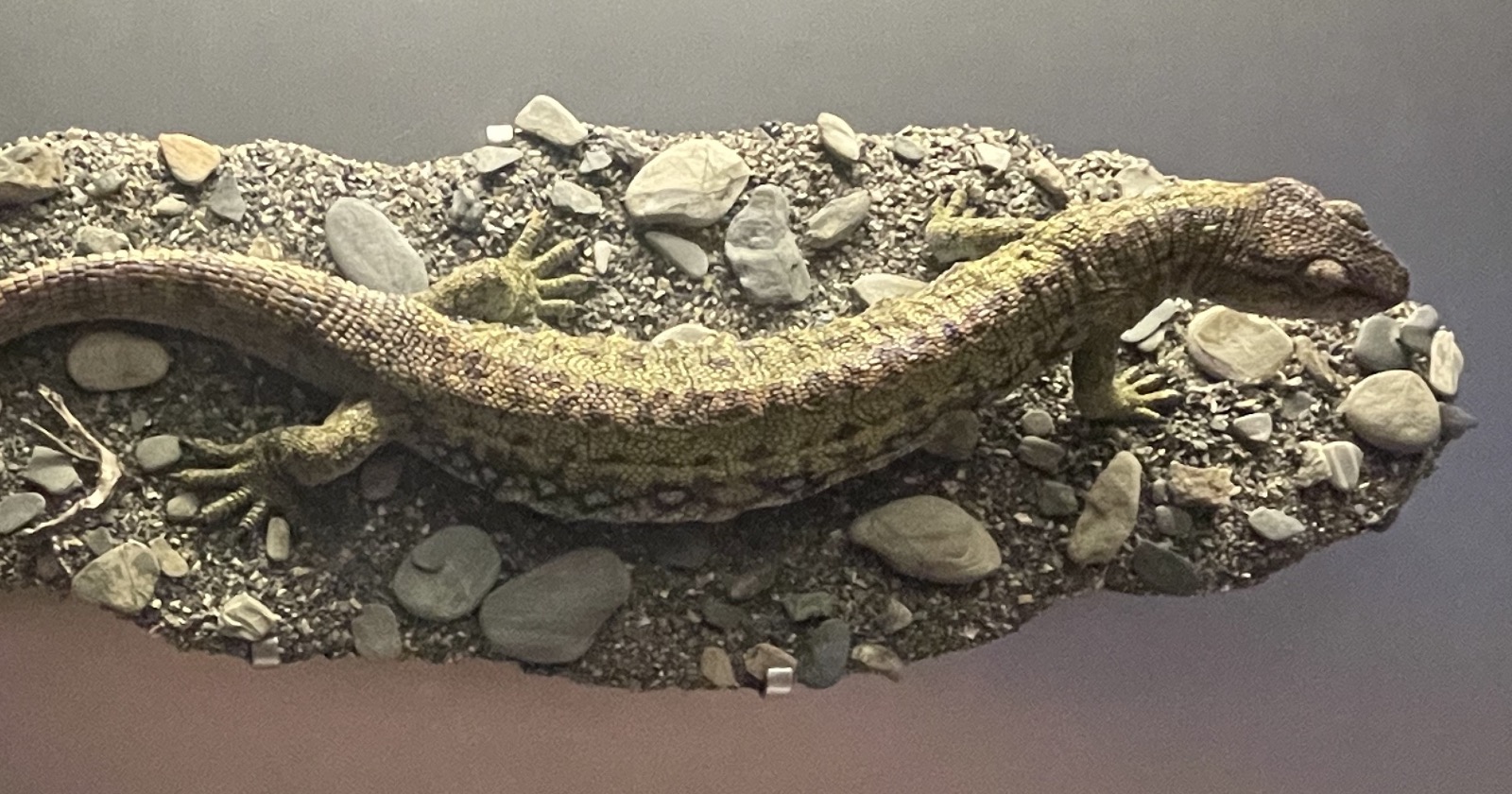
In the Survival gallery of the National Museum of Scotland located in Edinburgh, there exists a skeleton measuring less than 20 centimetres in length, preserved within a split slab of limestone. It earned the nickname Lizzie due to its resemblance to a lizard, and for over 30 years, it has been referenced as one of the earliest reptiles discovered, or at least as one of the oldest relatives of reptiles and other amniotes.
A [study published in Nature](https://www.nature.com/articles/s41586-026-11090-6) on 30 September 2026, spearheaded by Ben Igielman and Xavier Jenkins, claims that it was neither. Synchrotron X-ray scans uncovered an ossified internal gill skeleton and “extensive denticles,” small tooth-like projections, on the palate and lower jaw of *Westlothiana lizziae*. The team’s assessments categorize it among stem tetrapods, limbed creatures on branches that diverged before the last common ancestor of living amphibians and amniotes (reptiles, birds, and mammals). That ancestor and all its offspring constitute the tetrapod crown group. The paper designates Lizzie as “a crownward stem tetrapod, far removed from amniotes”: relatively close to that ancestor on the evolutionary tree while being distanced from the amniote lineage.
The [peer review file](https://media.springernature.com/original/springer-static/esm/art%3A10.1038%2Fs41586-026-11090-6/MediaObjects/41586_2026_11090_MOESM3_ESM.pdf) published by Nature alongside the study indicates that the initial submission still classified Lizzie within the amniote branch. The reclassification followed a reviewer’s assertion that the scans had been misinterpreted, and the family-tree analysis was faulty, prompting the authors to revisit the data.
## Gill bones in a crushed skull
The fossil is flattened, complicating the surface interpretation. The research team conducted scans on the ID19 beamline at the European Synchrotron Radiation Facility in Grenoble, France, utilizing a particle accelerator that generates extremely bright X-rays, subsequently digitally isolating each bone from the encompassing rock and reconstructing the skull on a screen.
The gill evidence originates from bone. Actual gill tissue is seldom preserved, but the bony structures supporting gills can be. The scans reveal at least two pairs of gill arches, and furrows on them for the afferent gill artery, which carries blood to the gills, suggest “that the arches were vascularized, most plausibly indicating functional internal gills,” according to the paper. Functional gills are inferred from the skeleton rather than directly observed.
In other areas of the skull, the abstract notes “unexpected plesiomorphies,” characteristics retained from much earlier ancestors, in the skull roof, palate, braincase, and lower jaw. The paper’s [supplementary information](https://media.springernature.com/original/springer-static/esm/art%3A10.1038%2Fs41586-026-11090-6/MediaObjects/41586_2026_11090_MOESM1_ESM.pdf) describes a palate that is “almost entirely denticulate” and a lower jaw that is “extremely denticulate,” with regions of denticles extending back to the articular, the bone at the jaw’s hinge.
The [American Museum of Natural History](https://www.amnh.org/explore/news-blogs/first-reptile-fossil), where two of the seven authors are employed, summarizes this as “a fish-like mouth filled with thousands of tiny teeth.” The paper counts the regular teeth along the jaw edges but excludes the denticles; “thousands” is the museum’s terminology. The paper compares the denticles to the velvet-like tooth patches found in modern fishes and concludes that Lizzie “fed subaqueously,” beneath the water.
## How Lizzie became the earliest reptile
Lizzie originated from East Kirkton Quarry near Bathgate in West Lothian. [National Museums Scotland](https://www.nms.ac.uk/explore-our-collections/stories/natural-sciences/westlothiana-lizziae/) characterizes the site as a small lake nourished by volcanic hot springs, whose chemicals settled in layers of rock over the organisms that inhabiting the area. Aquatic creatures are uncommon in those layers, according to the museum, likely due to the lake being “scalding hot or poisonous.” The recent study points out that Lizzie’s original interpretation as a terrestrial animal was partially based on the view of East Kirkton as “a predominantly terrestrial fauna.”
In December 1989, T. R. Smithson presented the specimen in Nature under the