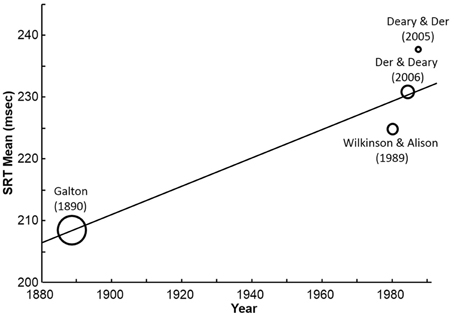
Psychologists have historically leveraged reaction time as a fundamental metric, with its origins predating the formal establishment of psychology as a discipline. Reaction time experiments continue to be pivotal in cognitive psychology currently, as they illuminate how rapid or sluggish responses to stimuli can signify variances in cognitive processing across different contexts. The historical foundations of this approach can be attributed to Sir Francis Galton, a well-known eugenicist and statistician, who amassed a comprehensive collection of ‘simple reaction times’ from more than 3,410 participants in the late 19th century. Galton intended to analyze reaction times to investigate individual differences, hypothesizing that discrepancies in processing speed might represent variations in intelligence.
The modern-day analysis of Galton’s data prompts an intriguing exploration into whether individuals today are quicker or slower than their Victorian counterparts. This inquiry carries implications for our grasp of performance in tasks requiring rapid responses, and could also reveal insights regarding broader generational shifts in cognitive abilities. Reaction time data offers a compelling contrast to the extensively documented Flynn Effect, which outlines the generational rise in IQ scores over time. This effect often contests the belief held by some that newer generations are less intelligent or disciplined.
Even though the Flynn Effect indicates enhanced cognitive capabilities over time, certain studies highlight potentially slower reaction times in current populations in comparison to Victorian participants. Research contrasting Galton’s results with more current data suggests that present-day individuals may exhibit reaction times roughly 20 milliseconds slower than those recorded in the past, translating to around a 10% reduction in speed.
Interpreting the significance of these variations in reaction times is complex. Possible explanations include a potential decrease in cognitive ability, alterations in experimental settings, or variations in participants’ engagement and motivation levels. Independent factors, such as heightened cognitive demands from contemporary life or shifting societal perspectives on assessments, may also contribute.
The discourse surrounding the evolution of reaction time encapsulates the complexities of evaluating cognitive function across generations. Although the exact implications remain subject to interpretation, the investigation of reaction time data continues to yield insightful revelations about human cognitive development. Researchers are actively examining the many factors that contribute to these results, adopting a careful yet inquisitive approach to the cognitive competencies of the “youth today.”
**References:**
1. Irwin, W. S. (2010). Simple reaction time: it is not what it used to be. *American Journal of Psychology*, 123(1), 39-50.
2. Woodley, M. A., Te Nijenhuis, J., & Murphy, R. (2013). Were the Victorians cleverer than us? The decline in general intelligence estimated from a meta-analysis of the slowing of simple reaction time. *Intelligence*, 41(6), 843-850.
3. Woodley, M. A., Te Nijenhuis, J., & Murphy, R. (2015). The Victorians were still faster than us. Commentary: Factors influencing the latency of simple reaction time. *Frontiers in Human Neuroscience*, 9, 452.