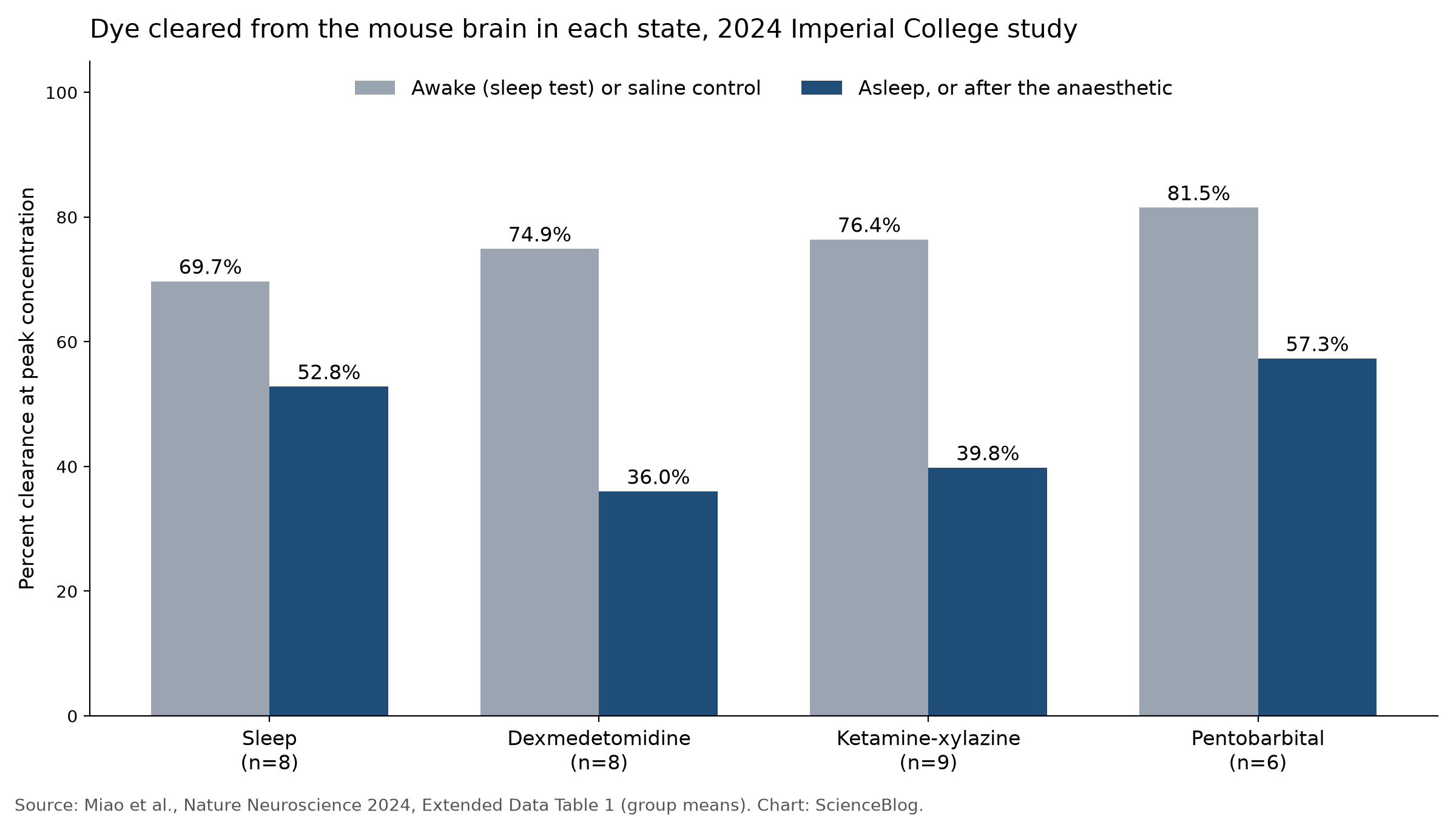
In 2024, scientists at Imperial College London carried out research that challenges the widely held view that sleep aids in the removal of brain toxins. Their results were published in Nature Neuroscience, revealing that mice that were asleep cleared a lower amount of an injected fluorescent dye than those that were awake. The research, headed by biophysicist Nicholas Franks, indicated that awake mice eliminated 69.7% of the dye at its highest concentration, while their sleeping peers cleared only 52.8%. This led to a decline of 16.9 percentage points in clearance during sleep, roughly a quarter when compared to the figures of the awake mice. Franks observed a relatively minor decrease, around 20%, questioning the previous belief that the primary function of sleep is to clear toxins.
This research raises doubts about the widely accepted glymphatic system theory proposed by Maiken Nedergaard’s laboratory at the University of Rochester. Their prior studies indicated that sleep enhanced the movement and removal of cerebrospinal fluid (CSF) throughout the brain, effectively washing away metabolic byproducts. They claimed that, during sleep, injecting a tracer into CSF allowed for more efficient penetration into the brain, and amyloid-beta, associated with Alzheimer’s disease, was cleared at a faster rate. The glymphatic system was believed to be nearly ten times more active while sleeping, a statement now contested by Franks’ findings.
Franks and his associates contend that their technique for tracking dye clearance offers a more precise measure than previous studies, which assumed that increased tracer entry equated to waste removal. Their research involved direct dye injection into a deep region of the brain and observing its movement with optical fibers. Their findings suggested higher dye retention during sleep, which they interpreted as reduced clearance.
The ensuing debate has prompted broader examination of how to accurately assess brain clearance processes, with Nedergaard’s team arguing that Franks’ study fails to convincingly demonstrate clearance, but rather indicates redistribution within the brain. Moreover, the situation is complicated by additional studies aiming to replicate the findings in human participants; however, these studies have faced criticism for their limited sample sizes and potential conflicts of interest.
The conversation about brain toxin clearance during sleep remains controversial. While Franks’ study casts doubt on established theories, ongoing investigations continue to probe the role of the glymphatic system in sleep, with ramifications for understanding neurodegenerative diseases such as Alzheimer’s. As the scientific community reflects on these findings, the quest for clarity continues, highlighting the necessity for ongoing exploration into the complex functions of the brain during rest and its influence on overall neurological health.