A Spore’s Arctic Adventure: Unraveling the Secrets of Cloud Creation
A spore sets off on an incredible expedition, originating from a fungus in the boreal woodlands of Alaska or Canada. It rises into the atmosphere, hitching a lift on the wind, embarking on a journey across the expansive stretch of open ocean until it arrives in the Arctic. If the circumstances are favorable, this minute traveler could become the core around which an ice crystal develops. This expedition, and its importance in Arctic cloud creation, has been comprehensively recorded for the first time by Takeshi Kinase and his group at the Japan Agency for Marine-Earth Science and Technology.
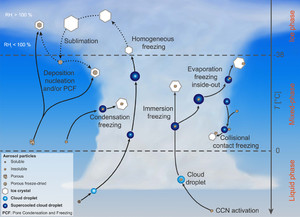
For five weeks in the late summer of 2022, Kinase and his team sailed aboard the research vessel Mirai. They navigated the Bering Strait, the Chukchi Sea, and the Beaufort Sea, gathering aerosol particles that are vital for comprehending Arctic cloud dynamics and the feedback loop of a warming Arctic. These particles, termed ice-nucleating particles (INPs), are crucial for the formation of ice crystals in supercooled Arctic clouds. However, the sources of Arctic INPs have been poorly understood until recently.
Conventional sources of Arctic INPs consist of local elements such as sea spray and glacial dust. While terrestrial ecosystems have been recognized, real-time evidence from oceanic environments had been absent. Previous studies suggested a terrestrial origin for these particles, linking fungal spores with Arctic monitoring stations and forest fires in Siberia to increased INP levels over the Pacific.
Kinase’s team enhanced the understanding of this phenomenon through a multifaceted strategy. They utilized filters to assess INP activity across different temperatures, employed electron microscopy to examine particle composition and ice crystal formation, and utilized atmospheric models to trace the origins of the air masses.
On certain days, the concentration of INPs rose markedly, especially near the Bering Strait and Mackenzie Bay. Electron microscopy showed that a significant proportion of the biologically sourced ice-forming particles were distinctly fungal spores. These findings were supported by on-deck fluorescence sensors, which identified biological aerosol signatures matching known fungal spores from Arctic research.
The FLEXPART-WRF atmospheric model further indicated that air masses with heightened INP levels had spent extended time traversing the forests and tundras of Alaska and Canada. This link highlighted the critical role of terrestrial ecosystems as contributors of biological INPs.
However, the passage across the ocean introduced challenges. Among the spores that failed to form ice crystals, many were mixed with sea salt aerosols collected during their journey. This interaction seemed to impede their ice-nucleating capabilities, a phenomenon suggested by laboratory experiments but now confirmed by field data.
The efficacy of spores as ice nucleators diminishes the longer they travel over saltwater. This degradation, along with the effects of sea salt aerosols, sets in motion a feedback mechanism in Arctic cloud formation that present climate models have yet to thoroughly capture.
As the Arctic warms, alterations in vegetation and expansive ocean areas are anticipated to increase both fungal spore generation and sea salt aerosol production. This changing dynamic creates a complex interaction between biological INPs and sea salt aerosols, affecting the precision of Arctic climate models.
Kinase’s research reveals direct evidence of terrestrial ecosystems supplying cloud seeds to the Arctic Ocean. Whether this supply escalates with changing Arctic conditions and how it affects regional warming or cooling remains an unresolved question, with processes taking place over vast geographical areas that are yet to be fully comprehended.
Explore the study here: [Nature Study Link](https://www.nature.com/articles/s41612-025-01291-7)
Your support for our reporting enables us to keep providing precise and captivating science news. Consider contributing to sustain our efforts. Thank you for your support!