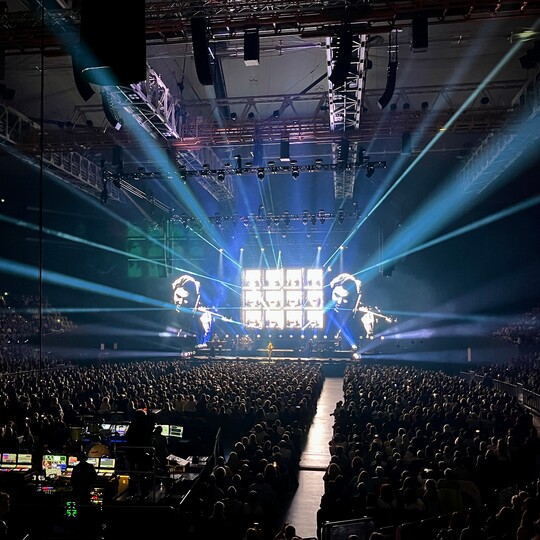
The violinist strides onto the stage of a rich crimson concert hall, bow at the ready, and something changes — not in the acoustics, but in your mind. A recent study from Berlin’s Technical University indicates that your visual experience truly affects your auditory perception; the hue on a concert hall’s walls unexpectedly infiltrates your interpretation of the music.
In particular, it alters the perceived warmth of the sound. Vivid blues and greens rendered the same musical performance cooler to the audience, while darker, less intensely hued halls received higher enjoyment ratings overall.
This impact arises from a fascinating interplay of senses. Stefan Weinzierl, an acoustician at TU Berlin, articulated it simply: “Room acoustics perception is multidimensional. We experience halls as either more or less reverberant; we perceive them as louder or softer, but we also recognize different timbres of a hall — a hall can seem warm, or it can come across as bright or metallic in sound.” The inquiry, until recently, was whether the walls could influence that perception. Evidently, they can — albeit not in the expected ways.
Loudness remained unaffected. The same goes for reverberance. Those traits, it appears, resist visual influence.
To investigate this, Weinzierl and associates Christos Drouzas and Jochen Steffens enlisted 48 participants and immersed them in virtual reality — a detailed digital replica of the Konzerthaus Berlin’s small chamber hall, exhibited in 12 varying colour schemes of red, green, and blue with different brightness and saturation levels. The performances (Bach on violin, contemporary clarinet compositions) were motion-tracked recordings combined with binaural room impulse responses, dynamically adjusting as participants moved their heads. Truly immersive material.
Participants evaluated what they listened to based on eight acoustic attributes, including warmth, brilliance, clarity, and metallicness. The findings for warmth were evident and statistically significant, with more saturated colours consistently yielding cooler sound perceptions.
The plausible explanation is semantic, perhaps initially sounding peculiar. We refer to “warm” in describing visual colours, physical temperatures, and acoustic timbre — and the brain, seemingly, doesn’t always segregate these categories neatly. When seated in a vivid blue hall and consciously trying to judge the acoustic warmth of the music, the visual “coolness” of your environment may subtly influence that assessment. Weinzierl’s team terms this a “semantically mediated cross-modal interaction,” with more musically experienced participants exhibiting a stronger effect. Musicians and frequent concert attendees appear to have, over years of exposure, cultivated richer sensory connections between a space’s appearance and its anticipated sound.
That influence from musical experience is arguably the most remarkable aspect of the entire phenomenon. Without considering listeners’ musical backgrounds, colour accounted for merely about 5% of the variance in warmth perception. Once this was included, the figure increased to nearly 14%. Not dramatically significant in absolute terms, but substantial when investing millions in a performance venue.
Weinzierl remains cautious about the practical implications. “Given the efforts made to enhance acoustical properties — all the funds spent on ensuring a concert hall sounds good — it should not be ignored that the visual aspect contributes to the hall’s sound.”
His guidance to architects is straightforward: “If you’re designing a concert hall, remember to contemplate the visual presentation. It will influence how the sound is perceived.”
Concert hall acousticians already grapple with the frequency-dependent absorption characteristics of seating materials, wall finishes, and flooring. The different scattering properties of a crimson curtain versus a blue one is well acknowledged; whether its hue alters your perception of the music’s timbre, however, has not been fully understood. This study implies that these two issues — the physical and the perceptual — might be more interconnected than previously thought.
The subsequent step likely involves testing actual halls rather than virtual ones, and across a broader range of musical styles and listener experiences. But for the time being, the old notion that the colour of concert halls is purely decorative appears increasingly challenging to maintain.
Study link: [https://pubs.aip.org/asa/jasa/article/159/2/1674/3380889/The-influence-of-the-color-design-of-auditoriums](https://pubs.aip.org/asa/jasa/article/159/2/1674/3380889/The-influence-of-the-color-design-of-auditoriums)
**There’s no paywall here, but there are expenses**
If our reporting has educated or inspired you, please think about making a donation. Every contribution, regardless of size, enables us to keep providing precise, engaging, and reliable science and medical news. Thank you for supporting us!