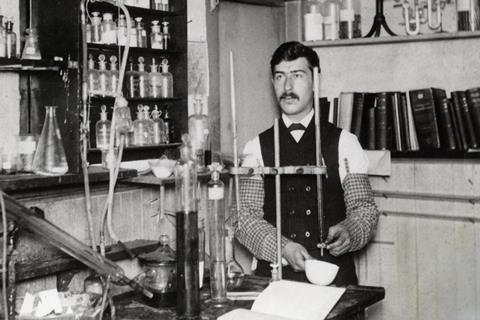
**Moses Gomberg: Trailblazer of Radical Organic Chemistry**
Moses Gomberg, celebrated as the ‘father of radical organic chemistry,’ may have unknowingly made a revolutionary discovery years ahead of his formal announcement of organic free radicals in 1900. Chemists revisiting and replicating Gomberg’s preliminary experiments suggest that his results might have offered convincing proof of trivalent carbon’s existence sooner than acknowledged, potentially changing the timeline for its acceptance within the chemistry field.
Originally from Russia, Gomberg followed his chemistry interests at the University of Michigan, embarking on a career that would ultimately challenge established notions in structural chemistry. While in Germany, Gomberg confronted the synthesis of tetraphenylmethane, a significant challenge described by Bart Kahr, a crystallographer at New York University. Upon returning to Michigan, he aimed to pursue hexaphenylethane, a task that unknowingly led him toward the reactive free radical because of his failure to synthesize this ostensibly simple compound.
In one significant effort, Gomberg utilized triphenylmethyl halides reacted with silver in benzene, producing a white powder susceptible to oxygen and halogens, which led him to deduce the existence of a free radical, triphenylmethyl. He theorized that this radical existed in equilibrium as a dimer with hexaphenylethane. This proposition, which challenged the revered four-bond rule for carbon, faced considerable opposition from his peers and took years to gain acceptance in the scientific community.
Kahr and his team, while synthesizing herapathite—a dichroic material formerly utilized by Polaroid—rediscovered Gomberg’s contributions. Their experiments, which involved mixing triphenylbromomethane, iodine, and benzene, were initially believed to yield a simple molecular complex. However, recent X-ray crystallography uncovered that these experiments generated three unique crystal structures, each containing the triphenylmethyl cation with different iodine and bromine combinations. Such findings might have hastened acknowledgment of hypovalent carbon had Gomberg been able to use modern analytical instruments like X-ray crystallography, which became available shortly after his research.
This retrospective analysis highlights Gomberg’s groundbreaking yet initially overlooked accomplishments, demonstrating that even prominent scientific figures can overlook the full significance of their findings. As Peter Schreiner from the Justus Liebig University observes, Gomberg’s contributions continue to inspire contemporary chemists, emphasizing the fluid nature of scientific comprehension.