California’s environmental safety agency has determined that recycled tires used as crumb rubber in synthetic turf are unlikely to result in cancer or other health issues for individuals playing on these fields. This conclusion comes after years of ongoing discussion regarding the safety of such artificial turf.
“Taking into account the health-protective, ‘worst-case’ assumptions and parameters utilized in the exposure assessment, the minor exceedances in the few instances and scenarios related to turf field-associated chemicals are of low likelihood and of minimal concern, requiring no further evaluation,” noted the report from California’s Office of Environmental Hazard Assessment (OEHHA), published on 5 March.
To arrive at its conclusion, the OEHHA examined 35 synthetic turf fields throughout California by gathering data on their unique environmental conditions and performing ‘non-targeted analyses’ to pinpoint the various types of chemicals found in crumb rubber. The study also evaluated the potential exposure of users of the synthetic turf fields to these chemicals, carried out ‘time-activity’ studies to gather data on their regular contact with the crumb rubber, and refined previously existing models used to evaluate potential exposure and health risks.
Additionally, OEHHA created a model to illustrate scenarios of human exposure to chemicals released from crumb rubber infill of synthetic turf fields. It demonstrates, among other things, how gases emitted from synthetic turf are dispersed into the air and inhaled by athletes, coaches, and spectators.
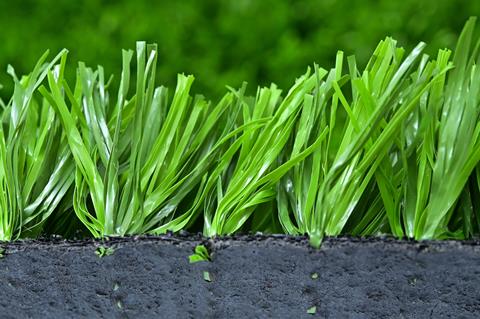
The so-called ‘third generation’ sports playing surfaces consist of artificial grass, a layer of sand, and rubber granules distributed between the synthetic grass fibers. This synthetic turf has faced controversy for several years. For instance, in 2017, an analysis conducted by the Dutch National Institute for Public Health and Environment determined that the health risks posed by rubber granules on sports fields were negligible. However, another study led by researchers at the University of Amsterdam seemingly contradicted this finding, indicating that these rubber granules actually release chemicals that could pose health risks.
Despite reports of health issues linked to these surfaces, minimal research has been conducted until recently.
“This study should alleviate concerns regarding the safety of crumb rubber usage in synthetic turf fields,” remarked OEHHA’s director, Kris Thayer. “Athletes of all ages can utilize these fields without parents worrying about this widely used material.”
Nevertheless, some public health experts, such as Andrew Watterson, an occupational and environmental health researcher at the University of Stirling who has investigated artificial turf, express skepticism about the findings. “A comprehensive perspective should be taken into account when evaluating the material—a holistic rather than reductionist approach—and this would indicate that a precautionary policy should be adopted, phasing out crumb rubber from 3G pitches,” Watterson informs Chemistry World.
“A number of European researchers have questioned the methodology and data presented in the OEHHA interim report, and some of us share similar concerns regarding the final report,” Watterson remarks. “While the report contains useful details and valuable information, it overestimates the capabilities of modeling studies given that personal and biomonitoring studies were not conducted, leaving substantial gaps in the range of chemicals evaluated.” Furthermore, he states that there is a deficiency of “solid, well-conducted epidemiological studies” focusing on users of 3G pitches.
Hans Larsson at McGill University in Canada, who has studied the toxicological implications of materials used in synthetic turf, also has concerns. “I would prefer not to engage in a debate about the toxicity of crumb rubber at this juncture,” he states, “but I would question what ‘available data’ they rely on, or what data was not provided to them.”
Moreover, Larsson expresses surprise at receiving this information from California, considering that the EU and several jurisdictions in the US have prohibited the use of artificial turf. California is perceived as one of the most proactive states concerning environmental regulations, often establishing standards that are notably stricter than federal laws.
A prior report published by the US Environmental Protection Agency and other federal bodies in April 2024 echoed some of OEHHA’s findings, revealing that although crumb rubber in artificial turf contains harmful chemicals, human exposure to them appears to be too low to present significant health risks.
In October 2023, the EU took steps to prohibit the sale of tire crumb rubber infill for application on synthetic sports surfaces under its Reach chemicals regulation, with this ban set to take effect in October 2031. However, this action was primarily driven by concerns over microplastics entering the environment rather than human health considerations.