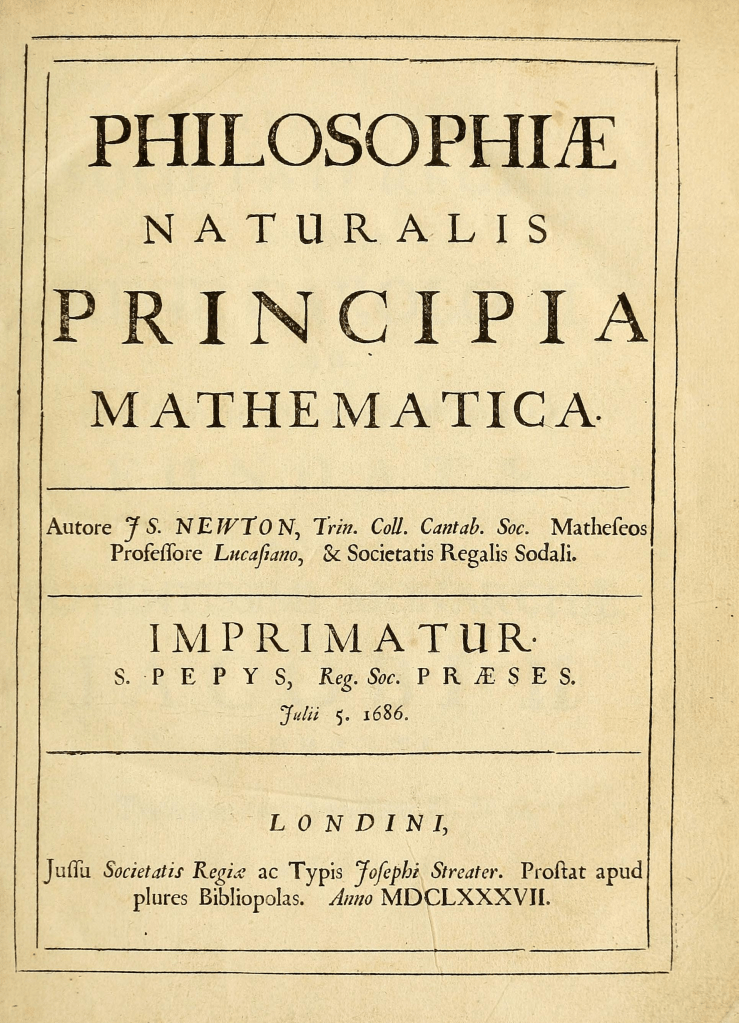
In the expansive chronicle of scientific evolution, Isaac Newton’s “Philosophiæ Naturalis Principia Mathematica” (The Mathematical Principles of Natural Philosophy) is frequently celebrated as one of the most essential texts, if not the most transformative, in the domain of science. Often, its importance is naively ascribed to Newton’s “discovery” of gravity. However, as numerous academics contend, Newton did not simply find gravity; he established mathematical verification of its concepts. More significantly, what Newton accomplished with his seminal work was to connect terrestrial and celestial mechanics, thereby dismantling a longstanding philosophical division introduced by Aristotle over two millennia prior.
Aristotle’s cosmology classified the universe into two separate domains: the sublunar area, beneath the Moon’s orbit, and the supralunar, beyond it, with distinct mechanics regulating each. While the Stoics disputed this separation, Aristotle’s philosophical doctrine prevailed until the Early Modern era. Aristotle argued that natural motion in the sublunar zone was a direct descent towards Earth, a hypothesis later disproven by John Philoponus in the sixth century, who began to unravel Aristotle’s concepts through empirical investigation. Philoponus presented ideas that evolved into the impetus theory for projectile motion, which Islamic scholars later refined.
In the fourteenth century, the Oxford Calculatores and the Paris Physicists established foundations anticipating much of Galileo’s investigations into the laws of falling bodies. By the sixteenth century, individuals such as Tartaglia and Benedetti had built upon theories of projectile motion, yielding findings that predated Galileo’s comparable discoveries. As the seventeenth century commenced, researchers like Guidobaldo dal Monte and Galileo illustrated that the paths of projectiles were parabolic, while Beeckman proposed the proper law of inertia, further challenging Aristotelian mechanics.
In spite of these developments, Aristotle’s division between celestial and terrestrial domains remained mostly unquestioned until the late sixteenth century, at which point celestial mechanics, constrained by the Aristotelian concept of immutable, perfect circular motion, began to be examined critically. Astronomers tasked with addressing discrepancies in planetary movement created mathematical models perceived as mere computational instruments, not reflections of physical truths. Aristotle’s stringent cosmological framework involved nested crystalline spheres propelled by divine motion, yet it was incapable of accommodating new celestial occurrences like comets.
In the fifteenth century, astronomers such as Toscanelli started recognizing comets as celestial, as opposed to atmospheric, entities. The sixteenth century witnessed revived discussions around Aristotelian cosmology, shaped by Stoic philosophy that regarded comets as celestial events. The 1572 supernova and 1577 comet provided counterarguments to the concept of an unchanging celestial realm, undermining Aristotle’s framework and fostering new cosmological models, including Copernicus’ heliocentrism and Brahe’s geo-heliocentric system. These models ignited disputes among astronomers and philosophers, culminating in Kepler’s introduction of elliptical orbits and laws of planetary motion derived from Tycho Brahe’s precise observations.
While Kepler hypothesized a magnetic-like force guiding planetary orbits, Borelli elaborated on this notion, repudiating Aristotle’s eternal spheres and aligning celestial mechanics with terrestrial doctrines. The seventeenth century continued to diminish Aristotle’s ideas, contested by inventions like Torricelli’s barometer, which highlighted the presence of vacuums, contrary to Aristotle’s claims.
By the late seventeenth century, Newton faced a scientific environment primed for integration. Terrestrial mechanics had already unified into a coherent structure through the efforts of scholars like Christiaan Huygens. Conversely, celestial mechanics remained fragmented between Kepler’s forces and Descartes’ vortex theory. Despite their theoretical distinctions, Newton harmonized these domains, adapting existing theories to create a comprehensive system of mechanics. This conceptual unification of terrestrial and celestial principles signifies the true heritage of the “Principia,” transcending mere discovery to symbolize a monumental convergence of scientific thinking.