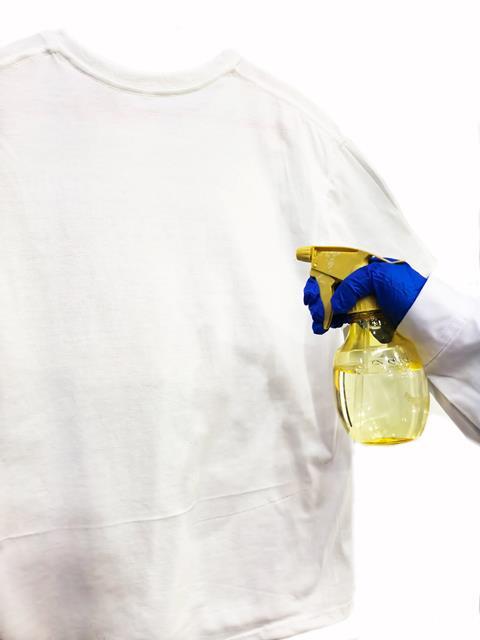
Stained and soiled garments may one day be cleaned merely by rinsing with water, thanks to an innovative self-cleaning coating for fabrics. Researchers claim it could make laundry tasks more convenient and environmentally friendly by cutting down on water consumption and limiting wastewater tainted with detergents and microplastic fibers.
Self-cleaning coatings are not a novel concept and generally rely on three main types of materials. Superhydrophobic coatings combat water-based pollutants but struggle with greasy residues. Photocatalytic self-cleaning surfaces can break down pollutants in the presence of light, but they do not stop dirt from adhering in the first place. Meanwhile, lubricant-based self-cleaning coatings let contaminants slip away but lack long-lasting stability and durability on flexible materials.
Now, scientists in China have developed a new variety of self-cleaning coating for textiles that depends on molecular interactions within a polyelectrolyte multilayer, forming a ‘nano-shield’ of water molecules. This effectively blocks pollutants from attaching to fibers, facilitating the removal of stains, oily residues, bacteria, and mold with only water.
‘Our initial inspiration wasn’t just laundry; it was a more fundamental inquiry into interfacial chemistry: what type of surface can prevent contaminants from adhering tightly enough to be removed with water alone?’ states Chongling Cheng from Southeast University, China.
The team had earlier explored surfaces containing sulfonate groups, which have a strong affinity for water. They discovered that when arranged densely, these groups maintained a stable and continuous nanoscopic layer of tightly bound water molecules that effectively shielded the solid surface from external contaminants.
In applying this concept to textiles, the researchers sprayed polyester, cotton, and silk with two oppositely charged polyelectrolyte materials. This technique—similar to nanoscale painting or brushing—was performed repeatedly to create a continuous and uniform coating across the fabric’s surface. This ensured the protective water layer was dense enough to prevent contaminants from locating gaps and reaching the underlying fibers.
The treated textiles were then stained with ketchup, soy sauce, and engine oil, along with being exposed to bacteria and mold. After undergoing a single rinse cycle in a washing machine, the outcomes either matched or surpassed uncoated textiles that underwent a traditional wash cycle with detergent followed by four rinse cycles.
The researchers estimated that overall water and electricity consumption and time spent was reduced by about 82%. Additionally, the need for and disposal of detergent was eliminated, and the release of microplastics in wastewater was significantly minimized. ‘Without detergent, it becomes significantly harder for microplastics to enter the water,’ explains Cheng. ‘Thus, this method may help curb microplastic release in two ways simultaneously: by lowering fiber generation and by decreasing fiber dispersion.’
‘This research represents a sophisticated shift in our perspective on laundry,’ remarks Rajesh Ramanathan, a nanomaterials chemist at The Royal Melbourne Institute of Technology, Australia. ‘What’s particularly fascinating is that the mechanism is non-catalytic and non-biocidal, relying solely on interfacial physics instead of chemical degradation.’
‘It is indeed an intriguing approach and delivers some remarkable results concerning cleaning efficiency,’ notes Richard Blackburn, who studies sustainable materials and textiles at the University of Leeds, UK. However, he points out that user comfort, specifically the breathability of the coated materials, as well as their biodegradability and end-of-life considerations are not addressed. ‘Some textile coatings, particularly those with similar chemistry, significantly diminish the biodegradation rates of treated textiles. If such treatments are difficult to remove, they also greatly reduce the recyclability of the fabrics.’
‘Naturally, these results should be seen as preliminary and promising indicators,’ states Cheng. ‘Environmental assessment, integration into manufacturing processes, and long-term durability under practical conditions all remain areas for further research.’