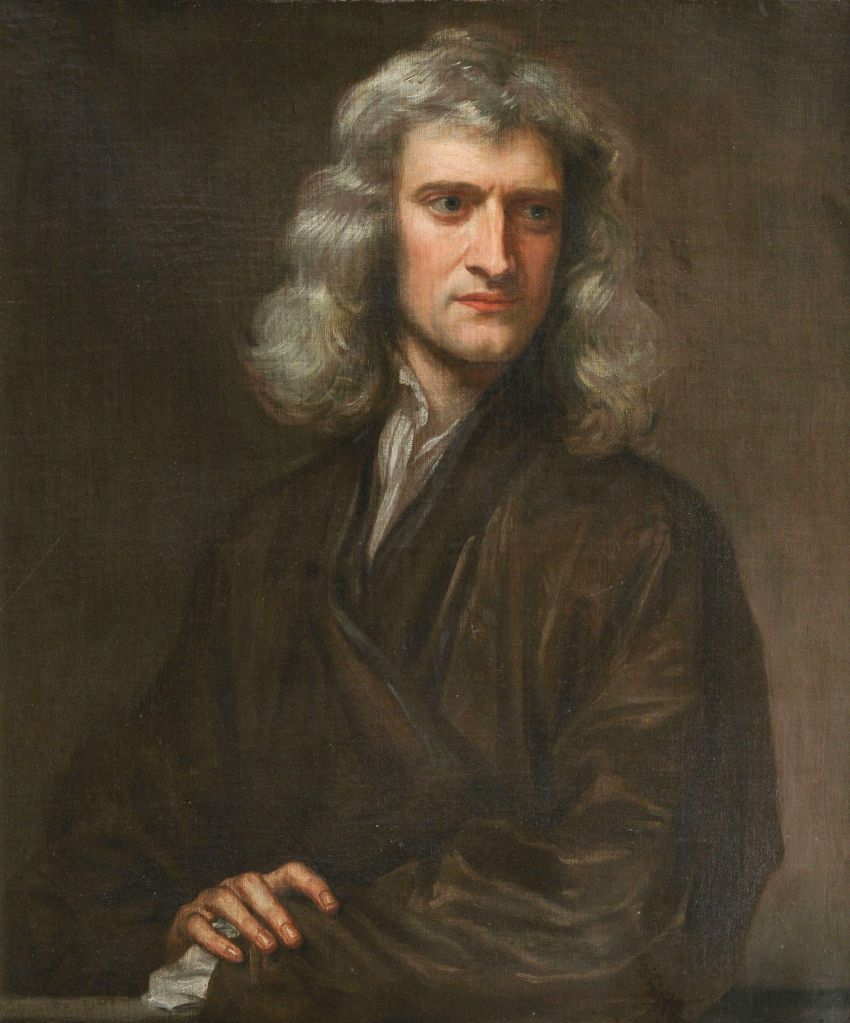
When Sir Isaac Newton corresponded with Robert Hooke in 1679, the exchange reignited his fascination with planetary motion—a topic he had intermittently investigated since 1664. Hooke’s theory regarding the gravitational force acting inversely with the square of the distance captivated Newton and inspired him to create a short illustration of this concept, even though he did not share it with anyone. When Edmond Halley visited Newton in 1684 to ask about the trajectory planets would follow if their attraction to the sun were inversely proportional to the square of their distance, Newton quickly responded with ‘an ellipse,’ indicating he had calculated it before.
Driven by Halley’s inquiry, this dialogue led to the development of a nine-page manuscript titled “De motu corporum in gyrum” or “On the Motion of Bodies in an Orbit.” This document demonstrated that a planet’s elliptical orbit arises from an inverse-squared force linked to one focus and proposed a more extensive idea of dynamic systems that encompassed Kepler’s laws and projectile motion in a resisting medium.
Despite Halley’s excitement to publish this valuable manuscript for the Royal Society, Newton opted to refine and enhance his theories further. This commitment absorbed him from the fall of 1684 until the spring of 1686, resulting in the publication of “Philosophiæ Naturalis Principia Mathematica” or “The Mathematical Principles of Natural Philosophy” in 1687. This evolution was not merely an extension but a comprehensive transformation characterized by new ideas emerged through profound realizations.
Newton expanded upon three manuscripts of “De motu,” one presented to the Royal Society, another copied by Halley, and a personally edited version. In this work, Newton established the foundation of centripetal force, distinct from Huygens’ centrifugal counterpart—a crucial addition to the discussion of motion and forces.
Newton’s formulation of three laws of motion, revered in modern physics, developed through multiple revisions, beginning with theories in the initial “De motu.” These grew to five laws before ultimately being consolidated into the renowned triad.
Importantly, Newton made an innovative leap by incorporating mass into the dynamics paradigm, moving beyond simple kinematics. The ‘fundamental principle of dynamics’—intimately linked to his second law of motion—arose from real-world observations like Jean Richer’s gravity tests in French Guiana.
The idea of universal gravitation was another critical enhancement as Newton sought and evaluated data from John Flamsteed, illuminating the gravitational pull between celestial objects and further refining the terminology surrounding centripetal force.
Although mainly reclusive during his writing process, Newton depended on ongoing communication with fellow scientists for essential data. Halley, notably, served as a mediator, securing information that propelled Newton’s progress.
Drafts of Books I and III of “Principia” evolved from manuscripts of “De motu corporum,” with Halley taking on the roles of editor and publisher, aiding the manuscript’s path to publication despite financial difficulties.
“Principia” was partly written in reaction to Descartes’ “Principia Philosophiae,” contesting its mechanical vorticity model through mathematically substantiated principles. Although initially met with doubt, the work’s influence on physics has been monumental, challenging the Baconian principles of the Royal Society.
The mixed reception and legacy of Newton’s “Principia” prevent a more thorough exploration in future accounts.