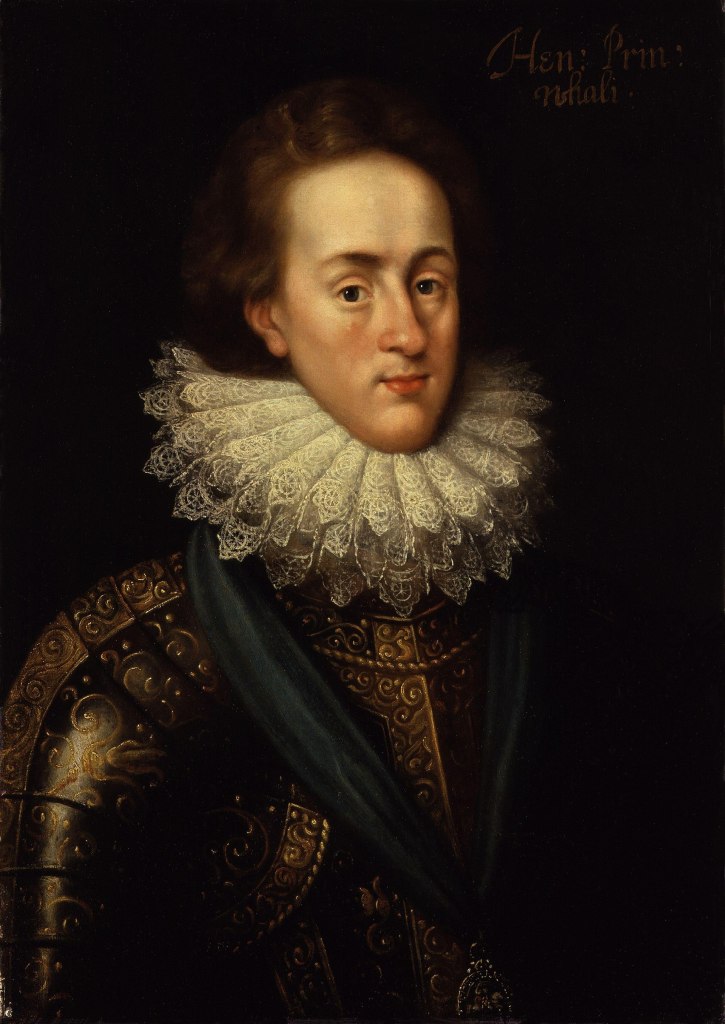
**Henry Frederick Stuart: A Prince of Promise and Adventure**
Henry Frederick Stuart, born in 1594 at Stirling Castle, was the firstborn of King James VI of Scotland (later James I of England) and Anne of Denmark. The life of this young prince was marked by an education that integrated academic, cultural, and practical sciences, equipping him for greatness that was never fully achieved due to his premature death.
Henry was distanced from his mother and brought up by a foster family at Stirling Castle, where his education began. His father mandated that his household be more akin to a college than a court, emphasizing the significance of education. He acquired knowledge in various sports, music, and dance, which were typical for someone of his rank. In 1603, Henry relocated to England with his family when his father took the English throne, becoming Duke of Cornwall and Prince of Wales.
With a profound interest in geography and inspired by the concepts of John Dee and Richard Hakluyt, Henry advocated for the establishment of colonies, envisioning a British Empire. Sir Thomas Chaloner, the governor of his household, played a crucial role in creating a “courtly college” atmosphere, underlining Henry’s academic interests in geography and military subjects from an early age.
Henry also displayed a strong passion for naval matters. The Earl of Nottingham introduced him to shipwright Phineas Pett, who crafted a miniature vessel named the *Disdain* for Henry. This initiative marked the onset of Henry’s involvement with maritime activities, which included listening to stories from the imprisoned explorer Walter Raleigh and exhibiting a notable interest in colonization.
Numerous prominent figures of the era contributed to Henry’s education. He received tutoring in mathematics and practical geography from two distinguished mathematicians, Thomas Harriot and Edward Wright. Wright dedicated his important work *Certaine Errors in Navigation* to Henry, underscoring the prince’s deep interest in exploration and cartography.
Henry also showcased his support for various figures in science and exploration. He backed navigation and instrument making, as illustrated by his connection with William Barlow, who crafted navigational tools for him. His ties to science were further evidenced by his selection of notable individuals to broaden his understanding in these disciplines, including magnetism, as discussed in Gilbert’s *De Magnete*.
In his short life, Henry fervently backed efforts that showcased England’s maritime and exploratory ambitions. He was a patron of the East India Company and promoted projects like Robert Harcourt’s exploration of Guiana. He financed Thomas Button’s endeavors to discover the Northwest Passage. Henry’s impact also reached colonial ventures in Virginia, where he supported settlement initiatives through leaders such as Thomas Dale.
Sadly, Henry passed away at the age of eighteen in 1612, likely from typhoid fever. Despite his brief existence, his enthusiastic backing for the sciences and exploration established a legacy of a prince who, had he lived longer, might have profoundly influenced English exploration and colonial projects. His untimely death provokes contemplation on the potential impact he could have made as a king, fostering Britain’s rise in global exploration.