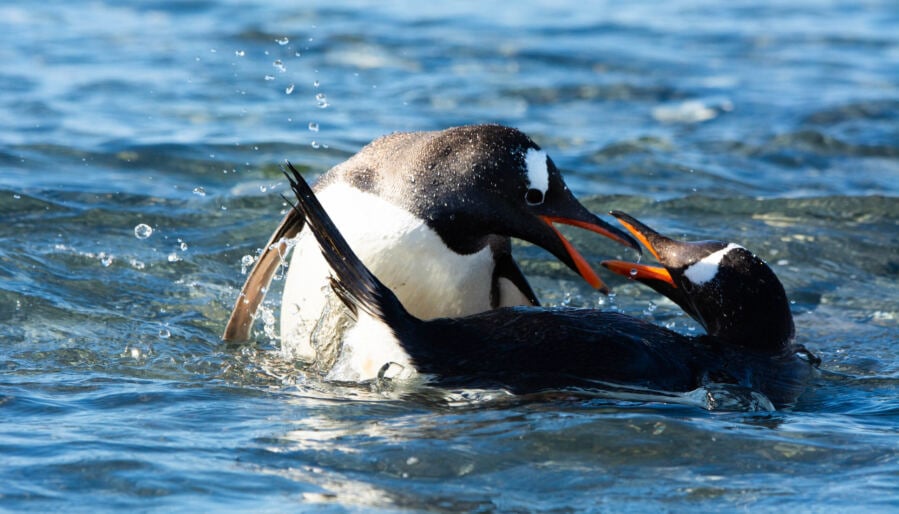
It appears just like any other gentoo penguin. White belly, black back, that orange beak. It swims through the icy Southern Ocean in the same manner, returns annually to the same nesting location, and raises chicks that, to any sensible observer, are utterly indistinguishable from those nurtured on islands more than a thousand miles away. Yet, genetically, the gentoo penguins of the Kerguelen archipelago (referred to by the French, with a certain somber poetry, as the Desolation Islands) represent something entirely different. A distinct species, hiding in plain view for over a century, only recognized now because scientists finally have had the means to investigate.
This discovery marks the first new penguin species identified in over a hundred years. However, it is coupled with a challenge: three of the four gentoo lineages now acknowledged as separate species face an uncertain fate as climate change alters the sub-Antarctic islands they occupy.
## One Species Transforms into Four
For an extended period, the gentoo penguin was believed to be one widely dispersed species, *Pygoscelis papua*, potentially with a few subspecies spread across an extensive arc of the Southern Hemisphere. Taxonomy had been debated since the 19th century, with scholars arguing about how many subspecies existed or whether these distinctions had any biological significance. Rauri Bowie, a professor of integrative biology at the University of California, Berkeley, and a curator at the Museum of Vertebrate Zoology, has explored this issue for nearly ten years alongside his colleague Juliana Vianna at Andrés Bello National University in Santiago, Chile. “There’s likely no penguin species where the taxonomy has been debated more than the gentoo penguin,” Bowie remarked. “For over 100 years, the number of species or subspecies has been a controversial topic.”
The recent paper, published in *Communications Biology* in April, signifies a form of consensus. It amalgamates complete genome sequences from 64 individual birds spanning 10 breeding colonies, covering nearly the entire geographical distribution of the species complex. That amounts to a great deal of data. Prior research focused on selected genetic markers; this study included thousands of single nucleotide polymorphisms, tiny variations spread throughout the entire genome, and combined them with analyses of body size, vocalizations, diet, breeding timing, and feeding habits.
The outcome revealed four distinctly separate lineages. The northern gentoo, *Pygoscelis papua*, inhabits the Falkland/Malvinas and Martillo Islands off the coast of South America. The eastern gentoo, *Pygoscelis taeniata*, breeds on Crozet, Marion, and Macquarie Islands. The southern gentoo, *Pygoscelis ellsworthi*, is the sole species that actually resides in Antarctica itself, on the Antarctic Peninsula and South Georgia. And then there’s the newly identified one: the southeastern gentoo, *Pygoscelis kerguelensis*, which developed on Kerguelen and possibly nearby Heard Island, roughly 2,000 miles from any permanently inhabited landmass. “What this paper accomplishes,” Bowie noted, “is to tackle that question using innovative integrative approaches.”
## Why Penguins That Consume Anything Remain Stationary
The emergence of four species from one likely correlates, in part, to the gentoo’s flexible diet. Unlike Emperor penguins or Adélies, which specialize in krill and travel great distances to locate it, gentoos consume whatever is accessible: fish, squid, cuttlefish, krill. This flexibility keeps them near their breeding colonies; they don’t have to venture far, so they do not. And since they return to the same nesting locations year after year, island populations essentially remain stationary for generations.
The Antarctic Polar Front, a boundary of temperature and salinity in the Southern Ocean, serves as an additional hindrance to dispersal. Over approximately 300,000 to 500,000 years, isolated populations diverged, accumulating genetic differences now recognizable as lineage-specific signatures of positive selection. The southern gentoo exhibits genomic changes related to thermoregulation, fat storage, and light perception. The eastern gentoo shows enrichment in genes associated with oxygen transport and diving efficiency. The northern gentoo possesses more genes tied to digestion and cardiac functionality. Each population adapted precisely to its location of confinement.
The cryptic species, *Pygoscelis kerguelensis*, is particularly fascinating. It lies directly on the Polar Front, which might elucidate why it has remained undetected for so long: its position at the boundary between lineages would have made it easy to categorize it with whichever neighboring population a researcher happened to examine. It appears the same. The genetic data, however, is unequivocal.
## Three Species, Three Uncertain Futures
The timing of this revelation holds significance for reasons that reach beyond taxonomy. Vianna highlighted the conservation implications