**StructureMASST: Revolutionizing Access to Public Metabolomics Data with Structure-Oriented Searching**
The field of metabolomics is experiencing rapid expansion, with the public release of a variety of datasets increasing consistently. This increase brings forth a distinct challenge: efficiently exploring and leveraging raw mass spectra data. Although indexing technologies have accelerated search processes, existing methods struggle when faced with the complexities of structure- and substructure-oriented searches. In this context, the names of molecules can differ significantly, complicating the task of finding all relevant mass spectra.
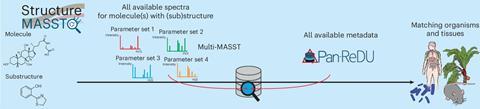
Introducing StructureMASST, an innovative solution crafted to address these limitations. Developed by researchers at the University of California, San Diego, and the University of California, Riverside, StructureMASST presents a novel method for performing structure-based searches across vast metabolomics datasets. It allows users to retrieve every spectrum within its database that features a specific molecule, structure, or substructure, irrespective of different naming conventions.
A primary challenge in this domain has been the intricate nature of cross-repository searches. Such searches often face difficulties due to disparate datasets, instruments, and acquisition parameters. StructureMASST counters this issue by enabling searches across various major public metabolomics repositories, permitting scientists to examine multiple MS/MS spectra simultaneously. This feature facilitates the identification of organisms, organs, or health conditions linked to particular molecules.
StructureMASST builds upon established metabolomics data repositories and tools, such as MASST and Pan-ReDU. By integrating data from the NORMAN/DSFP suspect screening repository, it broadens the capabilities of these platforms. Additionally, its functionality to filter over 1.5 million spectra based on chemical name or structure greatly improves search effectiveness. The tool’s output, which features meta-visualization through Sankey plots, offers a clear understanding of the connections among data points.
The influence of StructureMASST is significant, granting users access to a rich dataset via a streamlined retrieval mechanism. The developers foresee this platform as a robust resource for formulating hypotheses, promoting discovery, and revealing new insights into metabolism, exposure, and microbial interactions. As public metabolomics data continues to evolve, StructureMASST stands out as a vital tool in unlocking its complete potential.