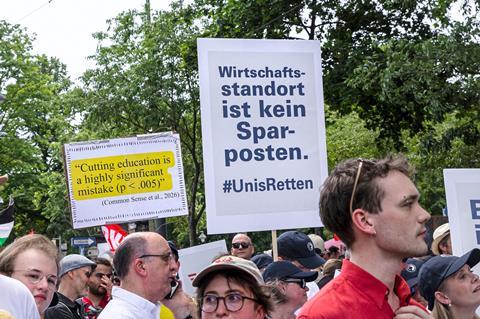
**Cuts to University Funding in Austria Trigger Protests as Polish Researchers Demand Boost in R&D Investment**
Scholars, students, and university personnel throughout Austria have been vigorously protesting against the government’s suggestion to reduce funding for universities by €1 billion (£860 million) over the next three years. This considerable decrease in financial backing has raised alarms regarding its potential effects on the nation’s academic and scientific competitiveness. Simultaneously, Poland is experiencing demands for a significant rise in Research and Development (R&D) expenditures, aiming for 3% of Gross Domestic Product (GDP).
On May 27, more than 28,000 people assembled in Vienna to express their opposition to the planned budget reductions. The response was widespread, with further protests occurring in Graz, Linz, Salzburg, and Klagenfurt the following day. Austria’s current university budget earmarked for the 2025–2027 cycle is €16.5 billion, yet projections from the Austrian Institute of Economic Research (WIFO) indicate that the upcoming budget (2028–2030) should rise to €18 billion to accommodate increasing operational expenses.
Marko Mihovilovic, dean of the faculty of technical chemistry at TU Wien, noted that the Austrian science minister suggested the next budget might only be €15.5 billion, with no adjustment for inflation. This possible reduction threatens the existence of over 10,000 lecturer positions, which would significantly disrupt education and the training of future industry talents. Universities, which represent about 4% of the national budget, bear an unequal strain in the government’s strategy to cut €5 billion from the total budget.
Bernhard Bayer-Skoff, a nanomaterials researcher at TU Wien, characterized the cuts as severe and abrupt, putting at risk essential funding necessary for engaging in innovative projects. While he acknowledges the necessity for budget reductions due to Austria’s economic conditions, Mihovilovic claims that investing in academia yields substantial returns, and alternative budget adjustments could lessen harmful impacts on education.
Austria’s student union has launched a petition opposing the proposed reductions, as the government reevaluates its choice, with outcomes expected in the autumn.
In Poland, a simultaneous push for increasing science funding emerged on the same day as the Austrian demonstrations. Thousands gathered outside the parliament in Warsaw, urging the government to increase science expenditure to 3% of GDP. At present, Poland spends 1.41% of GDP on R&D, which is equivalent to 51.5 billion złoty (£10.5 billion). Meeting the 3% goal aligns with the EU’s Lisbon Strategy targets and would elevate R&D funding to around 110 billion złoty.
Katarzyna Marzec, a spectroscopist at Jagiellonian University Medical College, underscored the urgent requirement for consistent investment to uphold modern research infrastructure and draw in international talent. With academic salaries for PhD candidates falling below the national minimum wage, Poland confronts difficulties in retaining young researchers. Increasing the R&D budget would enhance Poland’s competitiveness in acquiring third-party funding and grants, thereby further reinforcing its National Science Centre, the primary public funder of fundamental research.
Marzec stressed the necessity of a stable, long-term national science and innovation strategy that transcends political changes to keep Polish academia competitive on a global scale.