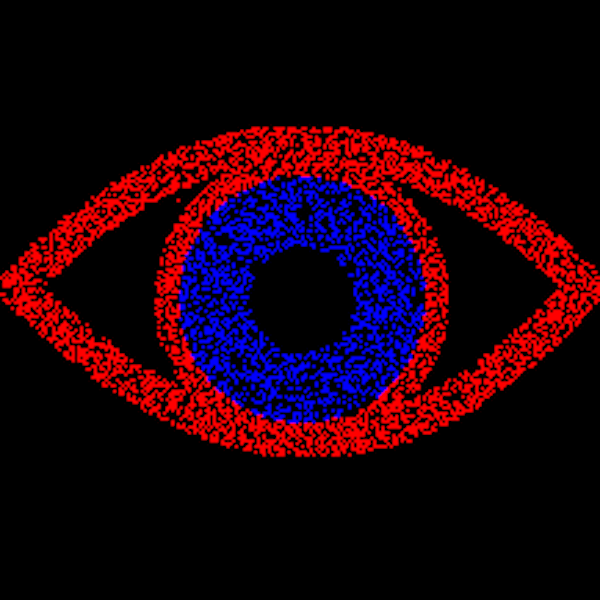
The idea of chromostereopsis represents a captivating optical illusion capable of generating the impression of depth and varying distances within a flat, static image. This phenomenon has been visually depicted in illustrations like the blue iris within a red eye, where some people may only observe the fundamental colors. Conversely, for others, this illusion instills an intriguing feeling of depth, where the blue and red shades seem to reside at differing distances.
The effects of chromostereopsis can be intensified under specific circumstances, such as rapid blinking, augmenting screen brightness, and viewing the image in a dimly lit environment. Some may even notice that the illusion fades momentarily before resurfacing, resulting in an experience where the colors seem to shift apart as head movements are perceived.
A crucial aspect of chromostereopsis is the considerable variation in personal perception. While generally, red appears nearer with blue positioned further away for most observers, some, including the author, find this to be reversed. This occurrence is distinct from conventional stereo-depth illusions that necessitate different images shown to each eye, which is the reason 3D films require glasses to present separate images for depth perception.
The allure of chromostereopsis lies in its functioning as a genuine stereo illusion reliant on binocular vision, unlike other depth illusions that do not need both eyes. Closing a single eye can eliminate the effect, underscoring its binocular requirement. Moreover, individuals experiencing stereoblindness, who cannot combine binocular input for depth perception, may not perceive the illusion.
The underlying principles of chromostereopsis remain not entirely clear. It is believed to be affected by factors such as the positioning of red and blue within the color spectrum, the differing light wavelengths that focus variably in the eyes, and potentially the image’s brightness along with its environment. This effect has been intuitively integrated into various artistic expressions, ranging from stained glass to digital media.
For a more comprehensive examination of this topic, one may consult the Mind Hacks book and additional scientific publications, such as Kitaoka’s contributions regarding chromostereopsis in the Encyclopedia of Color Science and Technology.
Note: Clarified the definition of the eye anatomy, highlighting that the iris is the colored segment of the eye, not the pupil.