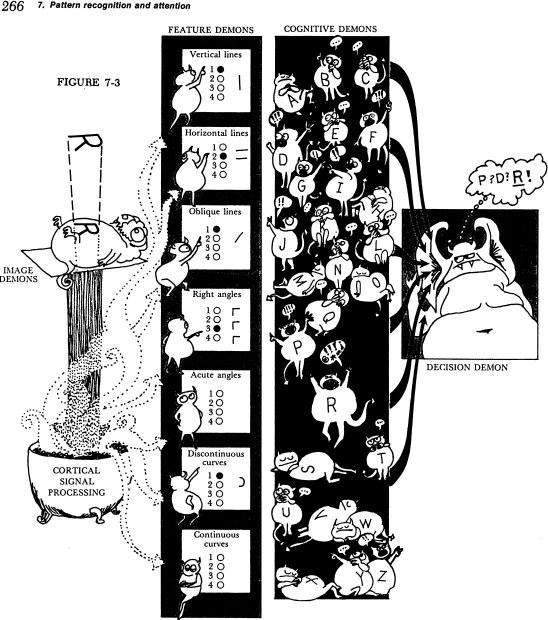
Oliver Selfridge, a pivotal contributor to the initial advancements in artificial intelligence, made noteworthy impacts with his groundbreaking paper in 1959, which presented the idea of “pandemonium architecture.” This model suggested a structure where multiple simple units, each designed for a specific function, were linked to execute complex cognitive operations, establishing the foundation for what would later develop into neural networks and contemporary machine learning.
The Pandemonium framework became well-known, in part due to its creative and vivid illustrations by Leanne Hinton in the 1977 textbook “Human Information Processing” authored by Lindsey and Norman. These images, characterized as capturing the intricacies of Parallel Distributed Processing through the perspective of childhood fears, evoke a sense of nostalgia for many, with the demons depicted as more amiable than frightening.
In addition to his contributions to AI, Selfridge wrote four children’s books, although the specifics of their illustrations are less well-documented. His personal life comprised three marriages, and he was instrumental in revealing governmental surveillance through his participation in the Echelon program.
Despite the recognition of the Pandemonium model, the contribution of Leanne Hinton, likely the illustrator, frequently remains unrecognized. Attempts to verify her involvement and secure permission to display her artwork have, to date, been unsuccessful. Should any readers possess further information or corrections about this account, they are invited to make contact.