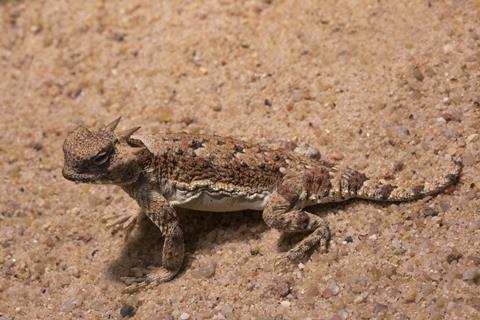
A bioinspired system designed for extracting water from soil provides a sustainable approach to addressing water scarcity in dry regions, as reported by researchers from Seoul National University and Daegu Gyeongbuk Institute of Science and Technology who created it. Desert horned lizards (Phrynosoma platyrhinos) possess distinctive skin microchannels that facilitate water collection in the arid conditions of North America where they dwell. However, the specifics of how they consume the gathered water have ‘long remained elusive,’ according to the research team. Through detailed observation of 12 lizards, the researchers have discovered that these lizards utilize ‘unique’ rhythmic jaw movements to squeeze and transfer water from their skin – a method they have now adapted into a multifunctional water system.
The lizards utilize their skin to extract water from rain droplets and wet or moist areas of soil via capillary action in the arid deserts of North America. The team demonstrated that the gradual opening of the lizards’ jaws facilitates the initial drawing of this water into the corners of their mouths, between their lower and upper jaws. Upon swiftly closing their jaws, the skin at the corners folds inward, pushing the water into the lizards’ mouths. Using hydrodynamic modeling, the researchers determined that this motion enhances effective water intake. They implemented these findings into an artificial system which they claim ‘holds promise’ for areas where water is scarce but could potentially be sourced from moist soil.
During experiments, the ‘lizard-jaw mimicking device’ utilized porous media akin to the microchannels on the lizards’ skin to extract water from a collection of glass beads in a polymer reservoir designed to simulate soil. It also employs an asymmetric cyclic motion observed in the jaw movements of horned lizards to pump the collected water, functioning between two glass plates – one stationary and one hinged. ‘Much of the world’s untapped water isn’t found in rivers or reservoirs but rather trapped in damp, frequently contaminated soil that’s challenging to utilize – and the desert horned lizard has demonstrated that it can be extracted through simple, rhythmic capillary action instead of high pressure or significant energy inputs,’ describes Ho-Young Kim at Seoul National University. ‘As our system gathers and purifies in a single low-power step and scales by operating numerous small units in parallel, it is ideally suited for off-grid, resource-limited environments, from isolated arid communities to disaster relief efforts. We view it less as a standalone device and more as a versatile, nature-inspired model for sustainable water harvesting in areas unreachable by traditional infrastructure.’
Additionally, a Nafion ion-exchange material was incorporated into the pores of the spongy material to eliminate harmful contaminants such as heavy metals and purify the water. After saturation, the Nafion coating can be reactivated by soaking it in an acidic solution for approximately 30 minutes, restoring its efficacy. The research team emphasizes that even amidst a ‘complex mixture of cations’ present in damp soil, the system continues to be effective in removing heavy metals and may also be applicable in the purification of brackish water.