Those who have been keeping up with this series will recognize that during England’s Early Modern Period, mathematical and scientific tools were pivotal in the domain of applied mathematics. As demonstrated by the modest beginnings in the mid-sixteenth century, the craft of creating instruments flourished to become a crucial element within the mathematical community by the mid-seventeenth century. Undoubtedly, scientific and mathematical tools had existed since ancient times, but in the Early Modern Period, the variety of instrument types and the volume of each type produced grew dramatically. One might contend that the development and utilization of such tools were among the key characteristics of the scientific and mathematical culture of that time.
Yet, these instruments not only characterized the era but also delineated the roles of mathematical practitioners. The term mathematical practitioner, while not officially defining a career or profession, serves as an umbrella term for the various professions grounded in applied mathematics, such as surveyors, navigators, artillerymen, architects, shipbuilders, sundial creators, military engineers, and accountants—many of whom we encountered in previous installments of this series. These individuals often included the designation mathematical practitioner, or a variation thereof, in their professional descriptions in publications, for example:
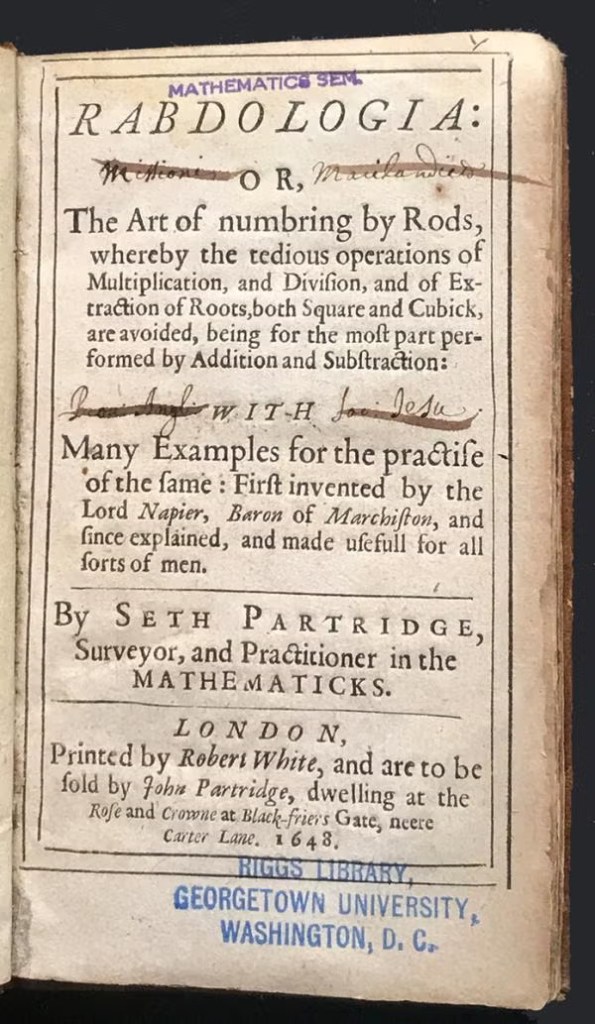
For example, Henry Bond’s A New Booke of Gauging is authored by ‘Henry Bond, practitioner in the Mathematicks.’ Similar credits can be found in Seth Partridge’s Rabdologia, which is penned by ‘Seth Partridge, Surveyor, and Practitioner in theMathematicks’ and William Purser’s Compound Interest and Annuities, where Purser refers to himself as ‘Mariner and Practitioner in the Mathematicks.[1]
Gauging refers to the assessment of the capacity of full barrels or a ship’s holds for the purpose of assessing customs duties, utilizing some form of approximation through specialized instruments and mathematical calculations, since direct measurement is not feasible due to the shapes involved. Publications on gauging and the literature concerning the crafting of sundials were the most widely produced mathematical texts in the sixteenth and seventeenth centuries in England. Johannes Kepler authored a book on gauging wherein he elaborates on determining the volume of barrels via the method of exhaustion, an early technique of integration. Rabdologia offers guidance on the use of Napier’s Bones, a straightforward calculating apparatus devised by John Napier, the pioneer of logarithms. The complete title of Partridge’s book is:
‘Rabdologia, or the Art of numbering by Rods … with many Examples for the practice of the same, first invented by Lord Napier, Baron of Merchiston, and subsequently elucidated and rendered useful for all sorts of men. By Seth Partridge, Surveyor and Practitioner in the Mathematicks,’[2]


This transformation in the function and status of applied mathematics