Protein Sheaths Created via Deep Learning: Solubilizing Membrane Proteins
Scientists in the US have harnessed a deep learning algorithm to develop protein sheaths capable of solubilizing cell membrane proteins without greatly modifying their structure or functionality. This breakthrough is expected to facilitate the examination of membrane proteins and presents opportunities for innovative drug and vaccine creation.
About one-third of the human proteome consists of membrane proteins such as receptors and ion channels, which are the focus of over half of clinically approved medications. However, researching these proteins is difficult due to their inherent insolubility in water. Ljubica Mihaljević, a computational biologist at the University of Washington’s Institute of Protein Design, notes that membrane proteins reside in the lipid bilayer’s “greasy environment,” requiring detergents for their extraction. This process is similar to using detergent to eliminate greasy residues from dishes, effectively breaking open the membrane and enabling protein solubility.
This approach is frequently labor-intensive and inconsistent, necessitating additional purification steps to isolate proteins for further use. In 2015, scientists introduced a novel method utilizing apolipoprotein AI, which naturally encases membrane proteins due to its amphipathic characteristics. Nonetheless, this interaction lacks specificity.
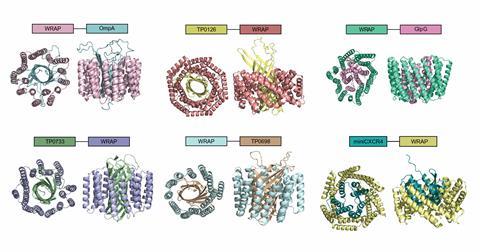
The team, spearheaded by David Baker, who will receive the 2024 Nobel Prize in chemistry for his work in computational protein design, has applied the RF diffusion deep learning algorithm to design custom protein sheaths known as Wraps (water-soluble RF-diffused amphipathic proteins). These Wraps are specifically crafted to encapsulate designated target protein regions without interfering with their functional domains. These sheaths are genetically encoded and expressed alongside the membrane protein in Escherichia coli bacteria, enabling successful capture and analysis of a variety of membrane proteins.
The method has validated the unchanged structure of a Mycobacterial porin protein, previously elucidated through traditional techniques. Although some smaller proteins still await structural determination, advancements in methods like cryo-electron microscopy show promise for upcoming analyses.
The research team has additionally examined outer-membrane proteins from Treponema pallidum, the bacterium responsible for syphilis. By applying the AlphaFold protein folding algorithm, they predicted the structures of these proteins and engineered suitable Wrap sheaths. The resulting sheaths effectively bound the proteins and stabilized them in solution, showing reactivity towards serum from rabbits infected with syphilis. Mihaljević remarks that the current research acts as a “proof of concept,” with ongoing collaborations aimed at investigating the technology’s potential in monoclonal antibody and vaccine development.
Synthetic biologist Chang Liu from the University of California, Irvine, recognizes the importance of this advancement in tackling the challenge of solubilizing membrane proteins. He foresees applications in biochemical assays of patient samples and expects that researchers will pinpoint optimal scenarios for utilizing the technique.