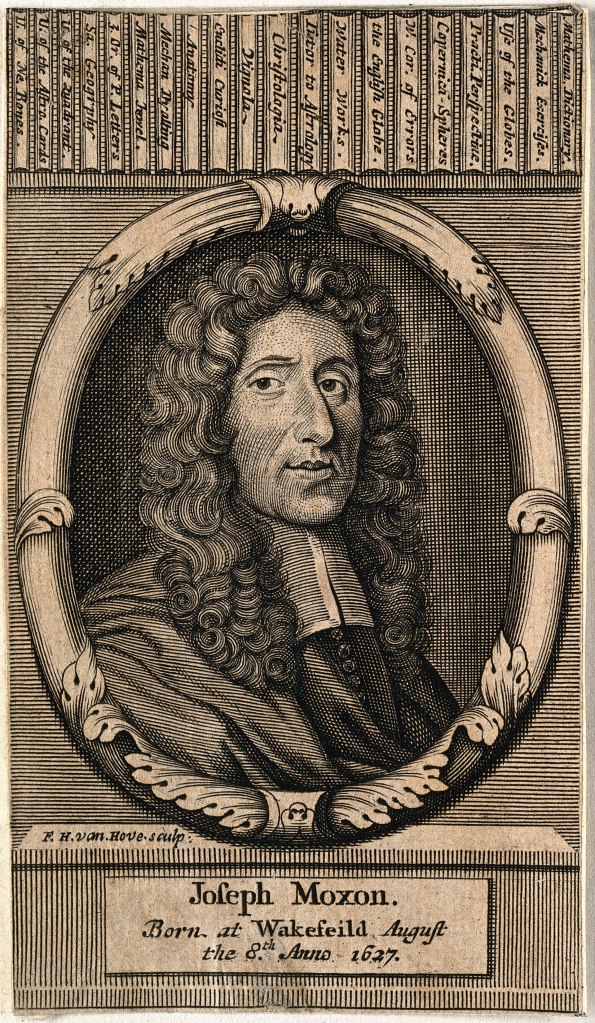
**The Innovative Contribution of Joseph Moxon to Early Modern English Globe Crafting**
In the field of globe crafting, Joseph Moxon (1627–1691) occupies a key position as the individual who rejuvenated this artistry in England following the departure of Emery Molyneux, the country’s inaugural printed-globe creator, to the Netherlands in 1597. Molyneux’s departure initiated an extended period of dormancy in English globe manufacturing, which only concluded with Moxon’s notable contributions sixty years later.
Moxon was born in Wakefield, England, into a Puritan family that migrated to the Netherlands due to religious strife during Archbishop William Laud’s administration. His father, James Moxon, played a critical role in founding a printing business that produced English Bibles for the Puritan community, an endeavor that undoubtedly shaped Joseph’s later pursuits in printing and publishing.
Possessing a strong interest in practical mathematics, Moxon developed his expertise in map and globe crafting. In 1652, he traveled to Amsterdam to obtain engraved copper plates vital for globe production, thus launching his enterprise in England. His workshop, identified by the Atlas sign, became a center for printing maps, charts, and innovative paper mathematical tools, offering affordable alternatives to expensive metal instruments.
In 1654, Moxon entered the publishing arena with “A Tutor to Astronomy and Geography,” an unacknowledged translation of Willem Janzoon Blaeu’s “Institutio Astronomica.” Over a span of thirty years, he published more than thirty scientific texts, establishing a reputation for his commitment to mathematical literature.
With ambitions of enhancing his standing, Moxon appealed to King Charles II, obtaining the title Hydrographer to the King in 1661. This position notably elevated his status, as did his later involvement with the Royal Society. Moxon was the inaugural tradesman elected as a member, though his election marked the sole occurrence of a non-unanimous vote in the society’s historical record at that time.
Moxon’s impact transcended globe making to encompass groundbreaking publications such as “Mechanick Exercises,” which clarified the technical knowledge of various professions. Volume II of this work contained the first comprehensive description of printing practices in English, while his “Mathematicks made Easie” became the first mathematical dictionary in any language.
Through his contributions, Moxon emerged as a vital figure in England’s scientific landscape, collaborating with notable figures like Robert Hooke and Edmond Halley. Despite his significant role in the spread of scientific and technical knowledge, the historical narrative frequently underrepresents the extent of Joseph Moxon’s contributions. His endeavors not only revitalized the craft of globe making in England but also established him as a crucial link within the scientific communities of his era.