**The Concealed Message on the Voyager Golden Record’s Exterior**
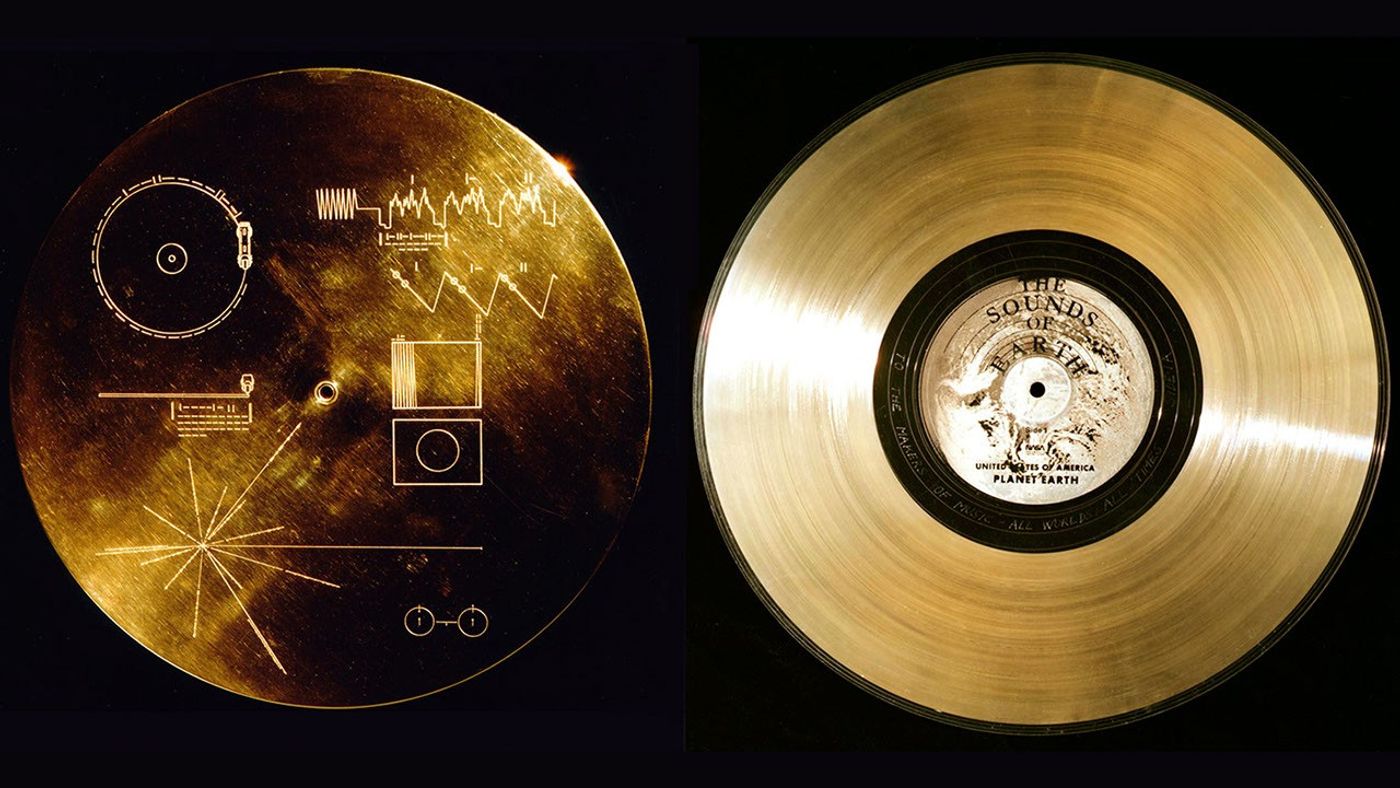
The Voyager Golden Record is celebrated as a universal message in a bottle, featuring music, salutations, visuals, sounds from Earth, and diagrams on the two Voyager spacecraft that were launched in 1977. Nonetheless, one of its most clever aspects is not found on the record but on its protective cover. NASA applied a layer of ultra-pure uranium-238 onto the cover, functioning as a “clock” because of its predictable radioactive decay, enabling any future discoverer to gauge how long the record has been in transit since departing from Earth.
**A Timepiece without Mechanisms**
Uranium-238 is recognized for decaying over 4.51 billion years, providing a slow, dependable timeline appropriate for Voyager’s interstellar expedition, ultimately conveying to us the duration of the record’s journey through space.
**Cover as a Guide**
This intricate cover additionally contains the guide for understanding the record through engraved directions. It elucidates playback techniques and features a locator map that uses pulsars to pinpoint the Sun’s location, paired with the uranium clock for temporal validation.
**Why an Additional Date?**
The redundancy provided by uranium guarantees various approaches to determine the record’s origin, particularly vital if the pulsar map becomes illegible. This technique circumvents human-made constructs such as calendars for more enduring physical principles.
**The Billion-Year Vision**
Engineered to endure for over a billion years, the record’s duration symbolizes NASA’s aspirations for interstellar dialogue, a forward-thinking timeframe surpassing the scope of recorded human history.
**A Message That Self-Records Its Timeframe**
Although aimed at possible civilizations, the elaborate design of Voyager’s cover outlines a plan that goes beyond mere aesthetics, using physics to eternally timestamp the record, ensuring its message endures across both time and space.